

Has Any State Mastered 8th Grade Reading Scores?
Please stop knocking Mississippi and Louisiana

I’ve noticed a few pieces lately throwing shade at the progress states like Mississippi and Louisiana have made in 4th grade reading by pointing out that their 8th grade reading scores haven’t made the same jump.
That’s true…ish.
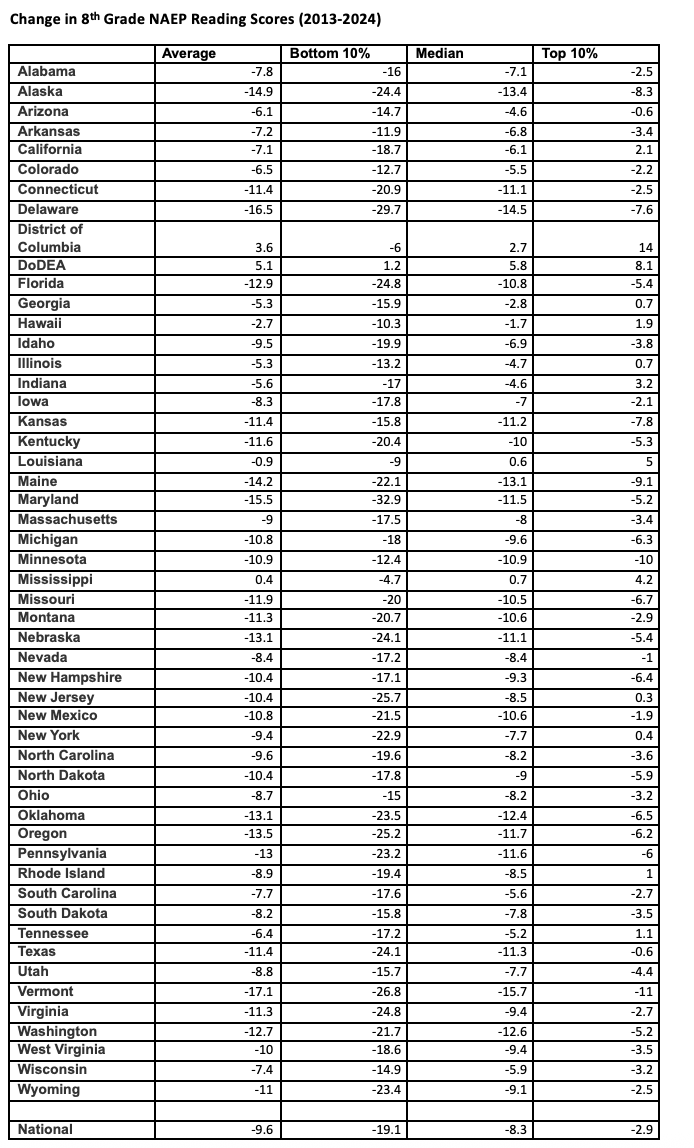
But what these pieces leave out is that no state is really covering themselves in glory in 8th grade reading scores. Nationally, we’re down 10 points since 2013. We even declined two points from 2022 to 2024, when math scores rebounded somewhat.
Not only that, but the declines have been worse for the lowest-performing students. From 2013 to 2024, the scores for the top ten percent of students fell 3 points. They fell 8 points for the median student. But they fell a whopping 19 points (!) for the bottom ten percent.
In other words: 8th grade reading scores are a national problem, not a Southern one.
Is anyone bucking the national trends? Kind of? The Department of Defense Education Agency (DoDEA) again stands out here, with their scores rising by 5 points. The District of Columbia is also up 4 points—they’re a quiet success story that deserves more attention. And then there comes Mississippi, eking out a gain of 0.4 points over this time period.
These are the only places with gains in 8th grade reading over the last decade. For what it’s worth, Louisiana comes next, with a decline of 0.9 points. Compared to the national decline of nearly 10 points, these “Southern Surge” states are among the best performers in the country—even in 8th grade reading.
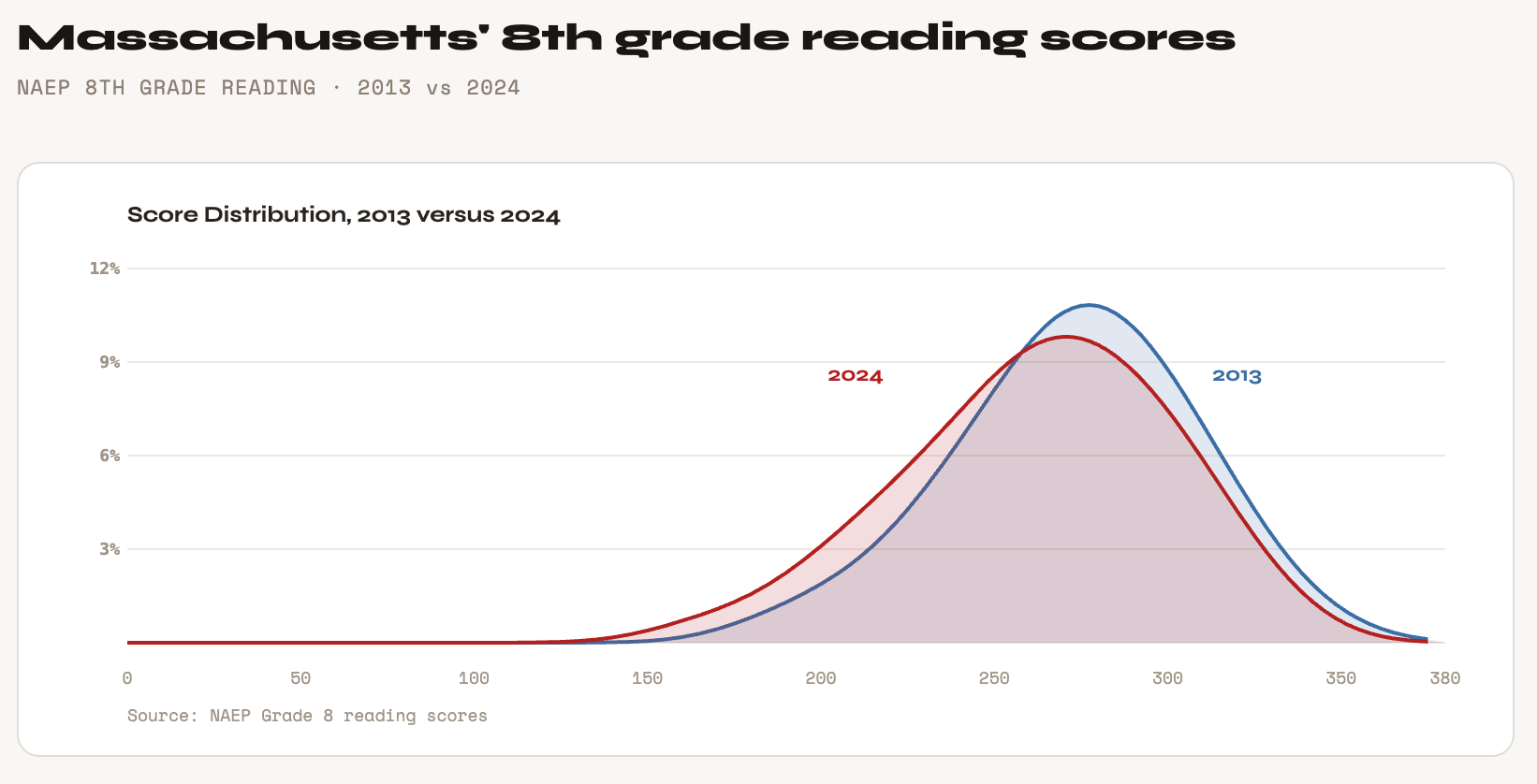
What about our leading states as of 2013? Can we just copy what they’re doing? No, please don’t do that. Massachusetts, for example, tied for the lead in 2013 with the DoDEA schools. But while DoDEA rose, Massachusetts scores fell 9 points. (Yes, DoDEA schools are now leading the pack by a wide margin.) As you can see in the graph below, Massachusetts’ entire score distribution shifted in the wrong direction. Whatever they did in the past is now history.
Among other leading states as of 2013, New Jersey scores fell 10 points by 2024, Connecticut was down 11, Vermont 17, and New Hampshire 10.
Which states brought down the national average the most? The biggest declines came from Vermont, Delaware, Maryland, Alaska, Maine, Oregon, Nebraska, Oklahoma, Pennsylvania, and Florida.
What about states with the biggest gap growth? That is, which states had their highest-performing student pull further away from their lowest-performers? That dishonor goes to Maryland, which saw its 90th percentile pull nearly 28 points further ahead of its lowest-performing 10th percentile. Other notable gap growth states include New Jersey (26 points), Texas (24 points), New York (23 points), Delaware (22), Virginia (22), Wyoming (21), California (21), Rhode Island (20), and Indiana (20). These states all declined on average, but they let their lowest-performing students fall even more.
Should we care more about 4th or 8th grade reading scores?
Both 4th and 8th grade results matter, but they tell us different things. On one hand, the 8th grade scores reflect more about a student’s total body of knowledge up to that point. They are also more indicative of what a student might be ready to do for their college and careers.
But if you care about whether school systems can systematically improve outcomes—especially for struggling readers—the 4th grade results may be the more actionable signal. That’s because early advantages (and disadvantages) can compound over time. This is especially true in reading, where scores are so heavily tied to things like background knowledge and language skills.
For schools in particular, they have the most control over whether students are mastering basic skills. This is why it’s so much easier for interventions to move the needle in math versus reading and earlier versus later ones.
TLDR: Don’t dismiss the Southern Surge states just because their 8th grade reading scores haven’t moved as much. There’s still a lot to learn from how they’ve raised the floor on reading performance.
Reading List
Linda Jacobson: Should states receiving federal literacy grants have to follow the science of reading?
Nora Gordon: Snow days, moral hazards, and Montgomery County’s request for an exception
Matthew Yglesias: Worry less, do more
Bill Gurley: How to Succeed and Thrive in a Career You Love
I love when you publish a piece that I have been writing in my head because it’s stuff that needs to be said. Thank you!
I’d add:
I think it’s unfair to compare these states to the national average without noting that all four Southern Surge states are in the bottom quintile for childhood poverty. They are achieving these gains in spite of those headwinds.
When you consider demographics, the picture gets even more impressive.
Louisiana 2nd in the nation and Mississippi is 4th for demographically-adjusted 8th grade reading performance, according to the Urban Institute.
I’m also seeing journalism that ignores these details, which is a bummer.
Great piece - it’s funny to me how this mirrors the issues in England. Doing great in PIRLS (9-10 year olds); not so much in PISA (15 yr olds). This was covered a bit in my piece on English phonics in The Bell Ringer on Friday.