

Why don't kids comprehend what they read?
To improve reading scores, we need to understand the problem

On the 2024 NAEP exam, 4th graders were asked to read a short passage from the book The Tale of Despereaux by Kate DiCamillo.
Then, they were asked a series of questions about the passage. One of those questions asked them about the use of the word “conform” in the context of the passage.
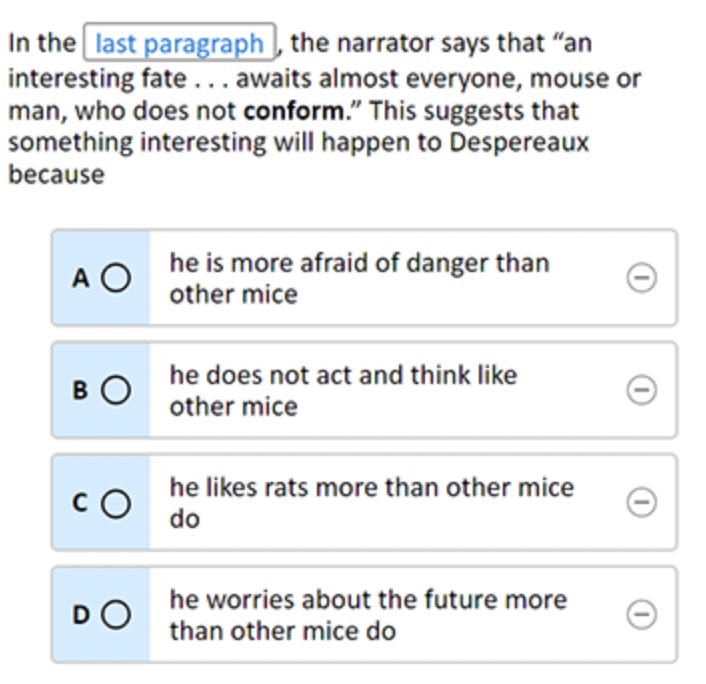
The correct answer was B, “he does not act and think like other mice.” Just over half of the test-takers got it correct (54%), and the rest (46%) got it wrong. The wrong answers were fairly evenly distributed across A, C, and D.
But why? Was it because they didn’t understand the question, didn’t know the meaning of the word “conform,” or got misled in some other way? The truth is we don’t know.
When students miss a comprehension question, the problem often isn’t about higher-order thinking skills. It’s that they can’t read the words fluently and accurately enough to understand the passage in the first place.
Why do kids struggle with reading comprehension?
The question about “why” kids couldn’t get a question correct isn’t just an academic exercise. It should animate what schools do to improve their students’ ability to read and understand text.
One strategy might be to say, ok, students are bad at reading comprehension, so we should just drill them with lots of similar exercises. Under this way of thinking, students would read a lot of short excerpts and practice answering questions about them.
Schools today are doing a LOT of this. My kid came home last week and said his homework was to read two passages. One was about the Berlin Wall and the other about Earth Day. These are both fine topics, but they were not integrated into history or science lessons; they were part of an English Language Arts curriculum. But why these two? What did they have in common? Nothing. Nothing at all.
To be clear, there is some research that instruction on comprehension strategies can help students on standardized tests, but the effects don’t translate into gains from more and more practice. Once kids have been reminded to “find the main idea,” they don’t need to practice it all year long.
So what does matter? A reader recently pointed me to the 2018 NAEP Oral Reading Fluency Study. It explores these questions about why students are struggling, and it turns out that bad readers are bad at several important skills. It notes that:
When there is weakness in oral reading fluency (evidenced by errors in reading, hesitation, or inappropriate pauses that signal the student is challenged by the text), it is often explainable in terms of the difficulties a child is experiencing in word reading, phonological decoding, vocabulary, or grammatical structures of the English language.
Let me repeat that first part back to you: Bad readers struggle because they literally cannot read the words.
Many kids simply don’t know how to decode letters on a page into English words. This is a big part of my work at ReadNotGuess, and I’m optimistic that recent policy changes around curriculum, teacher preparation, and early screening will help boost students’ early decoding skills.
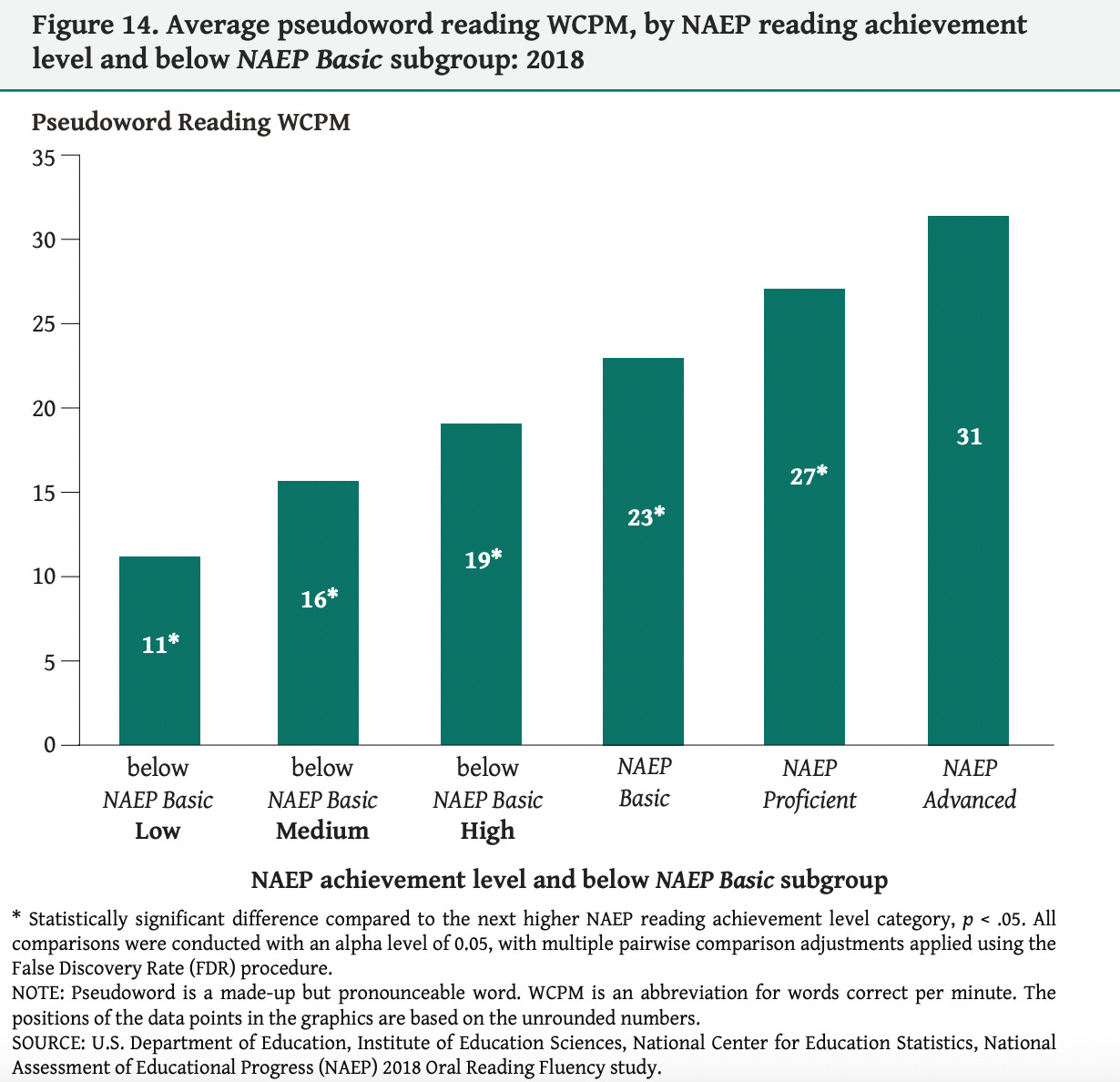
In the NAEP study, they tested this by looking at whether students could decode what are called “pseudowords” or “nonsense” words like “bep” or “glork.” These aren’t actual words but they should be decodable anyway if kids know how the English language works. As you can see in the graph below, the kids who score the lowest on NAEP reading comprehension questions are the worst at reading these nonsense words. Better readers are better decoders.
This is one reason I’m such a big fan of England’s phonics check. They ask all 6-year-olds to read 40 words out loud to their teachers. Half of the words are real words and the other half are nonsense words. Students earn a passing score if they get at least 80% correct, and the percentage of England’s 6-year-olds who can pass the phonics check has risen from 58 to 80% in recent years. It’s a simple, effective check on a core reading skill.
Letters build into words, and words build into sentences. And bad readers happen to be slow readers. The lowest-scoring students read about half as slow as the highest-performing ones.
But it’s not just about speed. Speed without accuracy is worthless. Bad readers also struggle to read with expression. They don’t know to pause when they come to a comma or a period, and they struggle with appropriate intonation, rhythm, and emphasis.
Bad readers also tend to guess, skip words, or make other mistakes. The next graph shows the words correct per minute (WCPM) by performance level. Again, bad readers tend to be slow and to make a lot more mistakes.
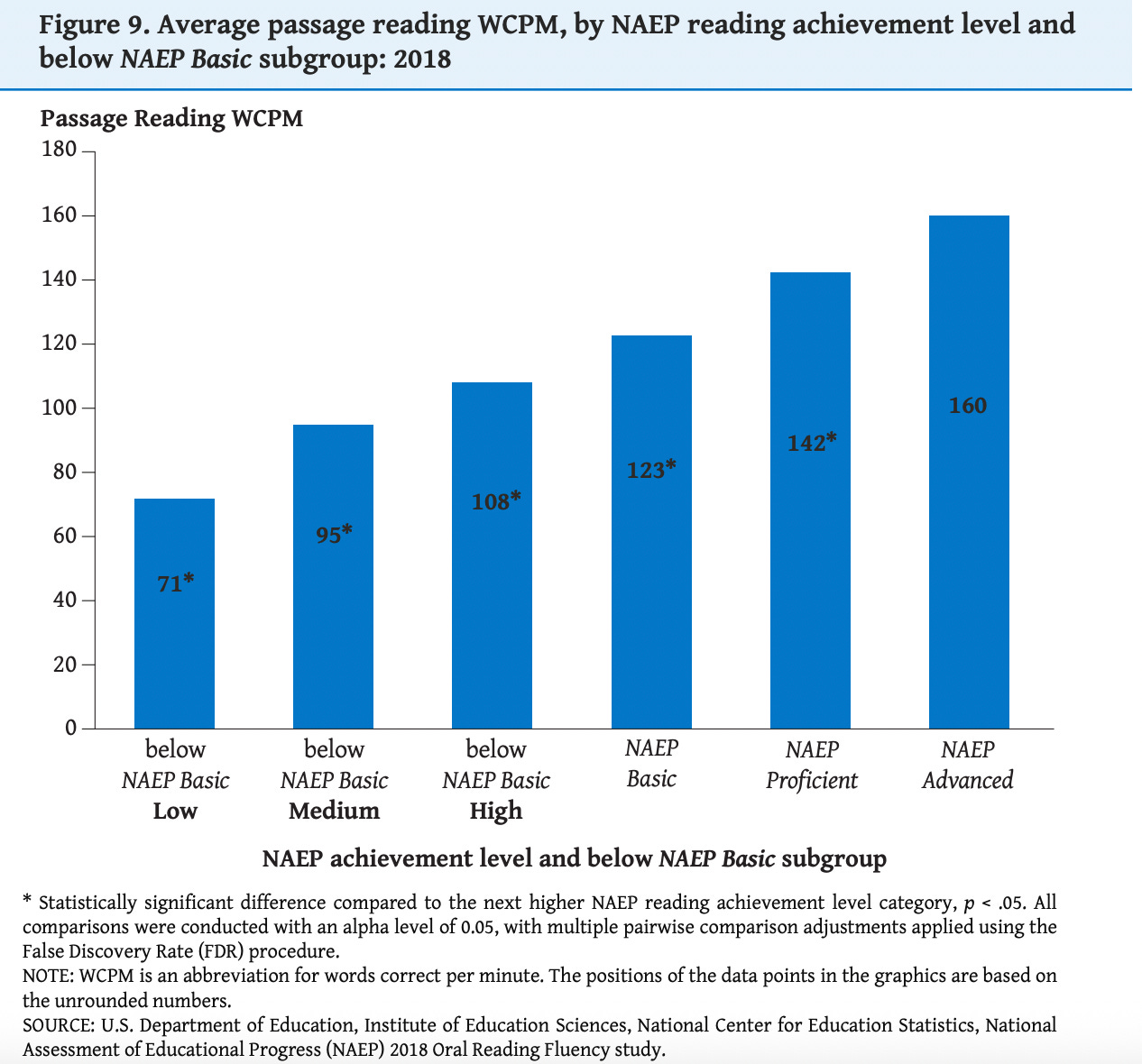
The lowest-performing students weren’t just slightly slower—they read roughly half as fast and with far more errors. The gap between the very lowest readers and the next tier up was larger than the gap between Proficient and Advanced students. The biggest opportunity for growth isn’t at the top—it’s among students who still struggle to decode and read accurately.
So why do kids struggle with reading comprehension?
Once you start to decompose reading comprehension into its component parts, the picture becomes much clearer. Students struggle not because comprehension is some mysterious higher-order skill, but because they lack the foundational abilities that make comprehension possible in the first place.
That starts with phonics and decoding. The point of phonics isn’t phonics for its own sake; it’s to allow students to reliably translate print into spoken language. When students cannot decode words automatically and accurately, their cognitive energy is consumed just getting through the text. Research has also shown that weak decoding skills can also limit middle and high school students’ access to more complex academic material.
Decoding alone, however, is not enough. Students also need the vocabulary knowledge to attach meaning to words. A sentence can be perfectly decodable and still incomprehensible if too many of the words are unfamiliar. Vocabulary, like decoding, accumulates gradually through systematic instruction and sustained exposure to coherent, content-rich text.
Fluency sits at the intersection of these skills. In the NAEP oral reading fluency study, all of these measures were captured by listening to students read aloud. Students who read slowly, inaccurately, or without appropriate phrasing were far less likely to answer comprehension question correctly. Yet most comprehension assessments—and much of the practice students receive—are entirely silent, masking the underlying source of difficulty.
This helps explain why drilling students on comprehension strategies or isolated passages produces limited returns. Strategy practice cannot compensate for weak decoding, limited vocabulary, or lack of fluency.
When a fourth grader misses a question about the word conform, the problem may not be that the student failed to think deeply about the passage. It may be that the student never fully understood what was being asked of them. If schools want more students to answer those types of questions correctly, the solution begins earlier and runs deeper: ensuring that all children can read words accurately, fluently, and with understanding.
Reading List
Tim Daly: Student effort is way down. It’s not their fault - it’s ours.
Philadelphia: Student attendance craters on half days
More research on the importance of high school quality
More research on the racial effects of teacher licensure tests in Texas
Thanks again for another insightful piece. Years ago, Dan Willingham was at an event and read an article from a British newspaper about a cricket match. If you didn't know anything about cricket like me, it was totally unintelligible. After he was done, he noted that this is the way many students feel when reading a story on the front page of the New York Times. It really drove home the importance of content-rich, vocabulary-rich, knowledge-building curricula.
How is it possible that people with masters degrees and PhDs don’t understand the frustration of ordinary people seeing an education system that claims teaching kids basic reading skills by 3rd grade is a great mystery yet to be solved? And then there’s the problem with basic arithmetic.
How long do the “experts” think they can get away with this?