

Mississippi raised the floor (and the ceiling)
Looking at score distributions over time

Borrowing a methodology from Dan McGrath, I’ve been playing around with seeing how NAEP score distributions have changed over time. Aka, rather than just looking at average scale scores or the percentage of students reaching various “proficiency” thresholds, it’s possible to see how the full distribution of student scores shifts over time.
Dan himself has been doing a series on New England states, or I worked with The 74 to show how the 12th grade reading and math scores have evolved over time. The result: Some cool charts showing ugly results.
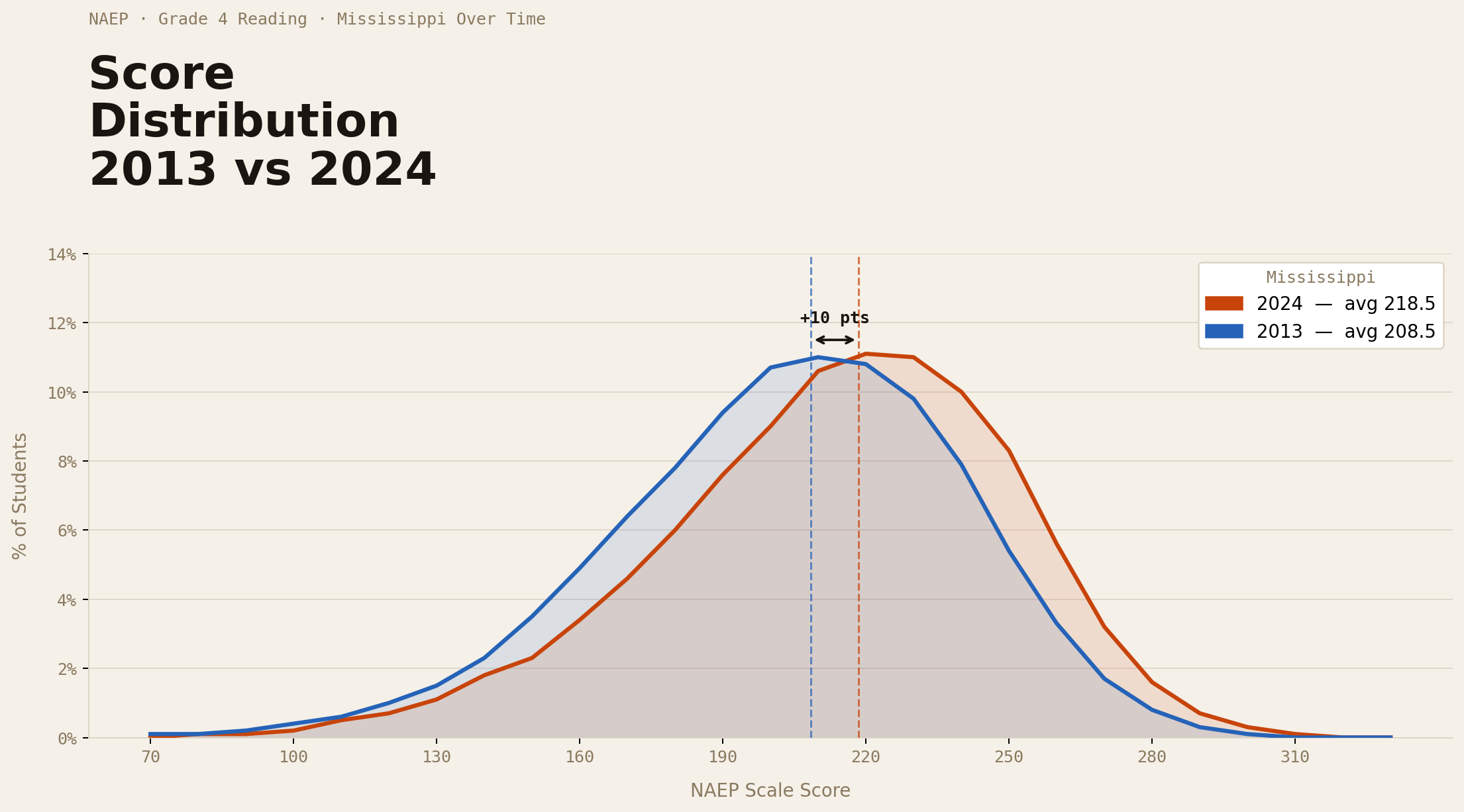
So today I’m going to return to everyone’s favorite: Mississippi’s 4th grade reading scores. As I noted when the scores first came out, Mississippi is the only state in the country that saw scores rise for its lowest performing students. In fact, Mississippi was able to increase scores at the 10th, 50th, and 90th percentiles.
But those are just words, Chad, show me a picture!
Ok, here’s what it looks like visually. The blue curve represents Mississippi’s 4th grade reading scores in 2013, and the red curve represents those scores as of 2024. As you can see, the average rose by 10 points, which is great, but the entire curve shifted to the right. There were fewer kids who were very low scoring and a lot more kids on the higher end. It was a success all around.
Yay Mississippi!
So how did they do it? For more on the “how” question, read my original article in The 74, or see more from Karen Vaites, Kelsey Piper, or Rachel Canter.
Reading List
Robert Pondiscio: “Fragile systems rely on great teachers. Durable systems assume ordinary teachers and build routines strong enough to support them.”
New research: NAEP math scores are linked to income, teen motherhood, incarceration, and arrest rates
Yours truly: The Maryland School District ‘Doing the Improbable’ in Teaching Kids to Read
Yours truly: 5 Things the Government Can Do to Help Make Reading Cool Again
Jorge Elorza: “When the federal government offers states money to help working families, ideological objections are illegitimate. Take the money and help your constituents.”
Brandon Brown: Indianapolis is putting charters and traditional public schools on the same footing
Sarah Mervosh: The new Texas private school choice program has received more than 16,000 applications for preschool
Annie E Casey Foundation: “There is every reason to think that when national data for 2025 becomes available, it will show that youth crime continued to decline.”
