

What’s your bottom line on student achievement?
Do you have one?

My wife officially homeschooled our kids during the 2020-21 school year. Our local public schools were only offering virtual classes, and those weren’t a great fit for our family.
The requirements for homeschooling in Virginia are minimal. Parents must either be licensed teachers, hold at least a high school diploma, or provide “evidence that the parent can provide an adequate education.” We chose the last option because it was the easiest to demonstrate. After looking for samples online, we discovered we only needed to provide a declaration of what subjects we planned to cover. We submitted a simple list saying our kids would receive grade-level instruction in:
- Math
- Reading
- Social Studies
- Science
- Physical Education
- Foreign Language
- Art and Music
That’s it.
No one asked which curriculum we were planning to follow or press us on the specifics of how we were going to do this. At the end of the year, we had to prove that our kids scored at or above the “fourth stanine” on a nationally normed standardized test. That essentially meant that our kids had to score at or above the 24th percentile nationally.
Of course, no one gave us any money to do this. The state had invested in public schools. By opting out, we were choosing to forgo that investment.
That arrangement made sense. We were on our own, and the state wasn’t funding our decision. But the policy question looks different when the state is providing public funding.
Where should states set the bar?
Most states have minimal standards for public schools. Thanks in part to federal requirements, every state administers reading and math tests to all students in public schools grades 3-8. Publishing those results provides at least a minimal amount of transparency. Anyone can go to state report cards or GreatSchools to see how any public schools is faring.
And, while it varies by state, there is usually some sort of accountability for persistent poor performance. If students in a particular school or district do particularly poorly, year after year, the state will step in and provide extra scrutiny or potentially even take over district operations. State takeovers happen in both red and blue states.
But, as I wrote earlier this year, many states have forgotten about these minimal safeguards when it comes to private school choice programs. Most states with vouchers or ESA programs don’t require students to take any tests, let alone the same ones required by public school students. In other words, they have at least some minimal standards for public schools but nothing for private schools that take public money.
Iowa is an exception to that rule. It requires students to take the same state tests in exchange for $7,988 in an education savings account. In a piece last month for Informed Choice, John Kristof compiled the results. In one clear chart, he showed that Iowa’s ESA students were outperforming other public school students.
Now, higher achievement levels do not mean that the ESA program caused any performance differences. Given that parents had to apply to the ESA program, it’s likely that its beneficiaries were different in some ways than non-applicants.
But Iowa goes one step further. It also calculates Student Growth Percentiles for ESA program recipients. As Iowa explains it, “a student growth percentile (SGP) describes a student's growth compared to other students with similar prior test scores (their academic peers).” Across all students, the median SGP is 50.
The graph below shows the SGP math scores for Iowa’s ESA participants. Across the entire group, the median for ESA program participants came in at 49. According to this metric, Iowa’s ESA program participants overall are learning just a little bit less than other similar students across Iowa.
But particular groups of students made slightly more progress with the ESA. English Learners, students with disabilities, and low-income students who received an ESA all made slightly more progress in math than their peer groups across the state.
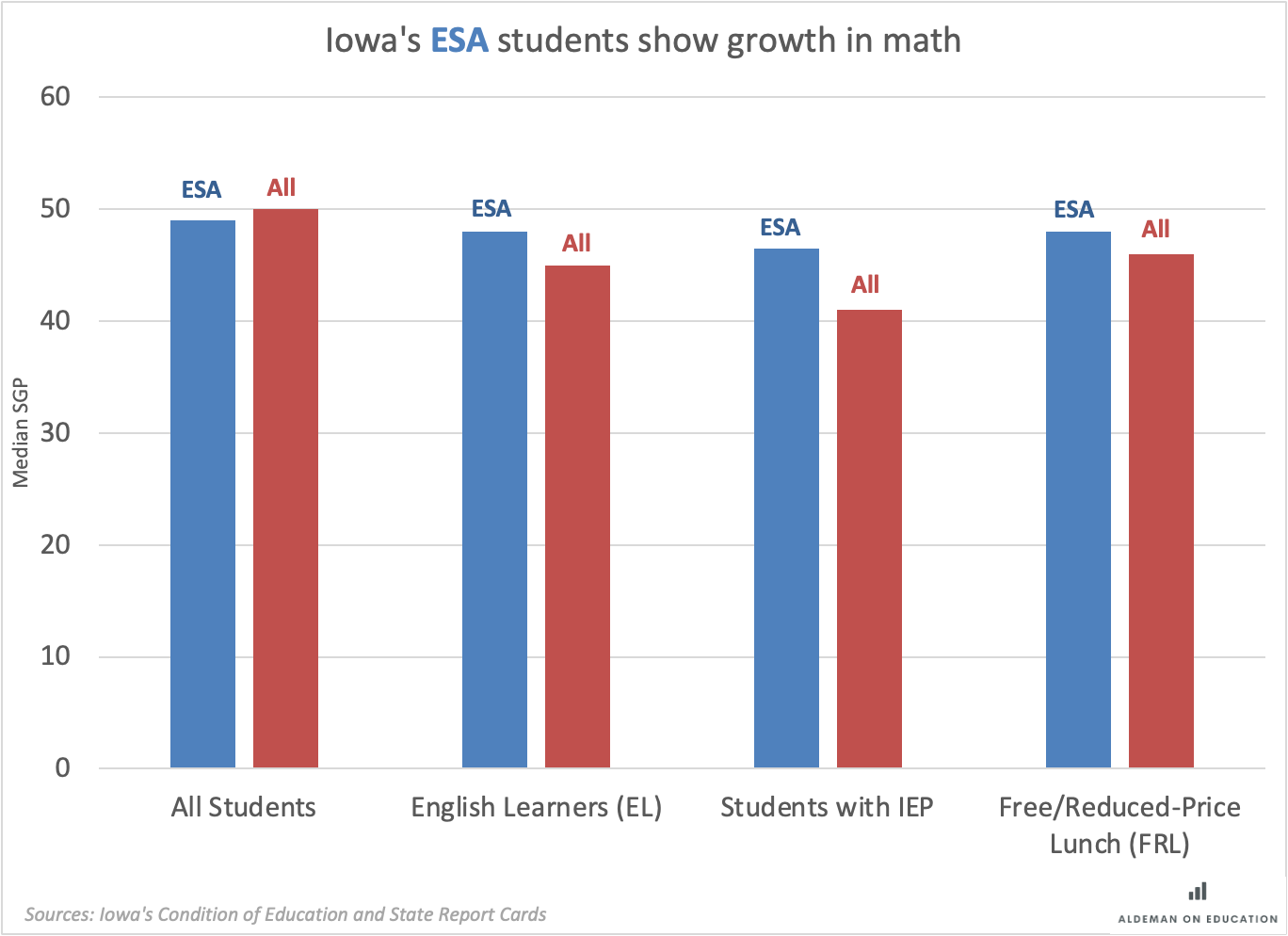
ESA participants showed similar growth rates in reading.
Iowa’s approach isn’t perfect. It still doesn’t provide school-level results. If I were a parent in Iowa, I would want to know which schools and programs were getting the strongest results, but the state doesn’t provide that level of transparency.
However, Iowa taxpayers can at least be confident that their ESA program participants are learning something and making roughly comparable progress in reading and math. Most states with private school choice programs can’t make that claim, but Iowa can.
Reading List
Linda Jacobson: National, State Data Point to Slow Pace of Pandemic Recovery
NWEA: Math and reading scores lag even among 1st and 2nd graders
Patrick Graff: The positive effect of competition on public schools is quite large
Per my piece last week, EdWeek finds that Arkansas teachers have the highest morale
Zach Groshell: The only question that matters is whether students learn
It's good to see at least one state putting even minimum standards in place. In most states, homeschooling regulations have been gutted. While many homeschooled children are provided with excellent educationso, others are provided wiith no education. The laxity of the regulations make it virtually impossible for the state to enforceme educational neglect.
"and the state wasn’t funding our decision"
"The State" doesn't fund your decision. You fund your decision. With ESAs the state allows you to get back some of your taxes to spend on a limited set of items yourself rather than spending it themselves. "The State" is not doing you any favors.
Tests scores are just genetics, you're not going to see meaningful impacts beyond selection.
Freedom, parental, and child satisfaction are the main benefits of ESAs.