

Raise the Floor on Teacher Salaries
It could boost recruitment, retention, and academic performance

Earlier this week Matthew Yglesias wrote a piece on teacher salaries. He noted that:
…while New York pays 70 percent higher teacher salaries than Louisiana on average, its entry-level salaries are only 7 percent higher. That doesn’t come close to compensating for the higher cost of living. If you ask where “teacher” counts as a decent-paying job for someone just starting out, Mississippi and Louisiana look good and New York looks terrible, despite there being much higher average salaries in New York.
That observation raises a lot of interesting questions. But today I want to explore what happens when a state or district dramatically increases starting teacher salaries.
Let’s start with the state-level data. Consider the graph below. It shows the average teacher starting salary by state (left to right) versus the top salary (up and down). As the graph shows, states with higher starting salaries tend to also offer their teachers higher maximum salaries. Washington, California, and the District of Columbia pay the highest salaries regardless of a teacher’s experience level.
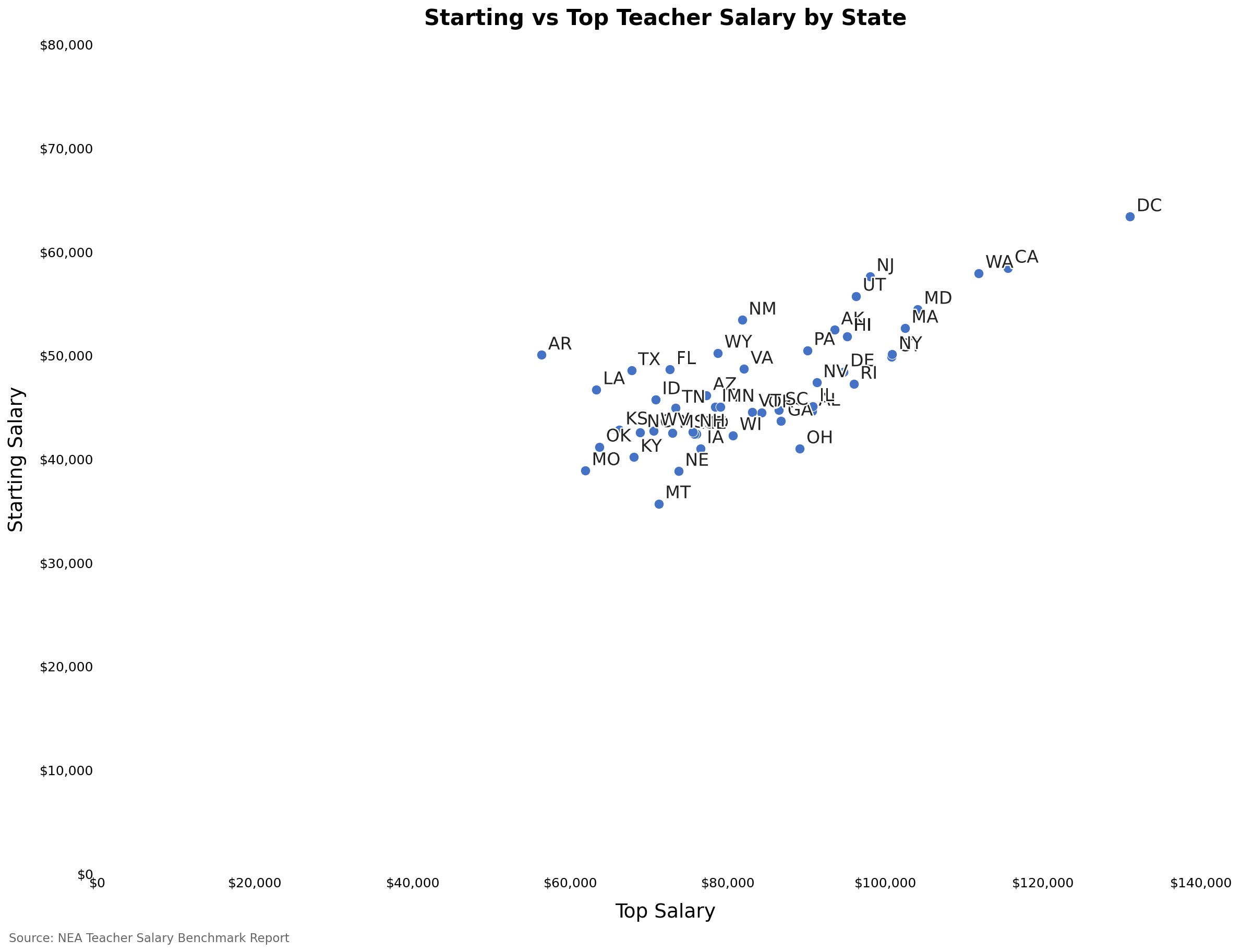
None of these are adjusted for cost of living. But now I want you to focus just on the starting salary aspect. I’ve added a red line to show something interesting. As of last year’s data, Arkansas schools offered nearly identical starting salaries ($50,031) as New York ($50,077). That’s a striking comparison given the huge differences in cost of living between the two states.
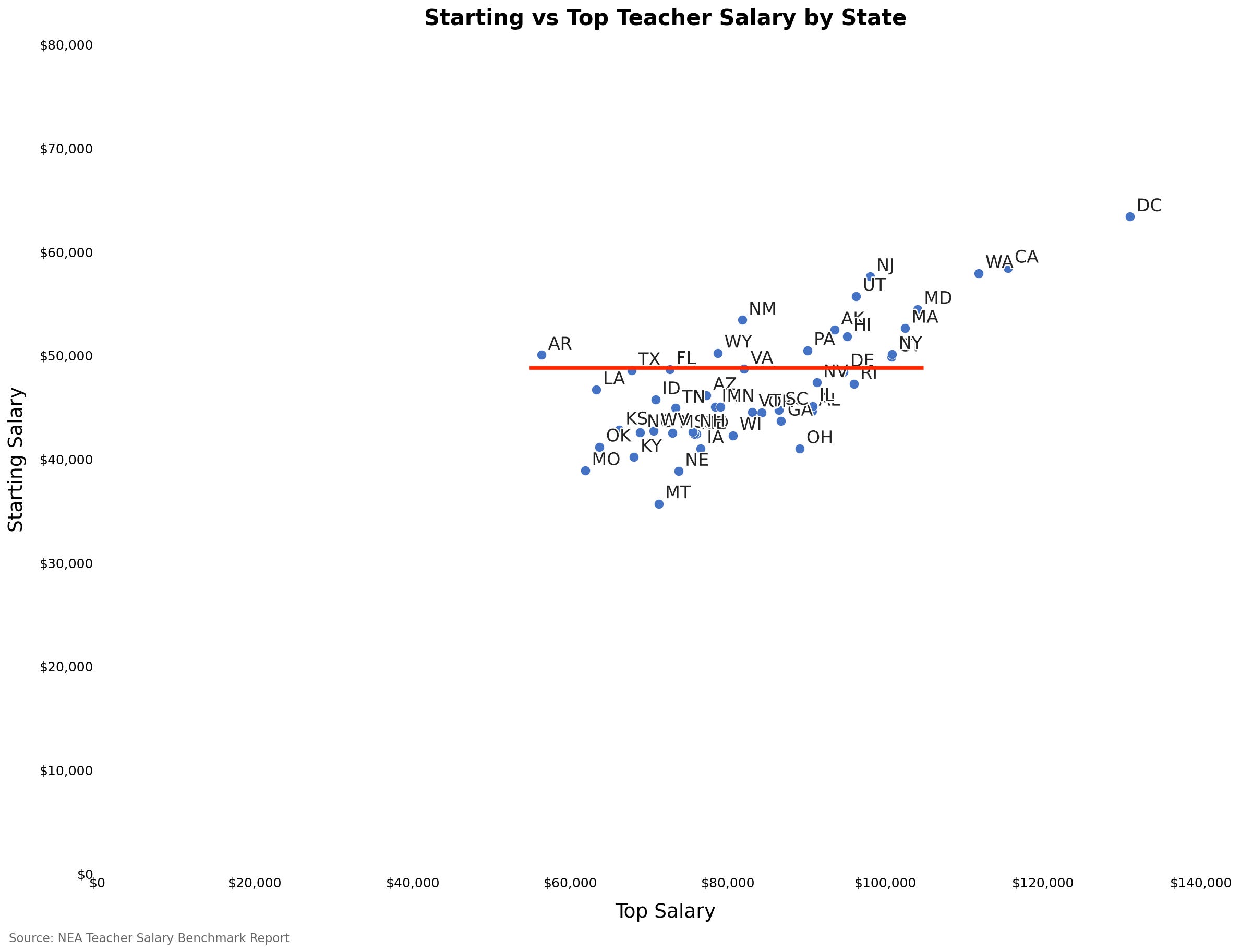
In fact, Arkansas’ starting teacher salary is now higher than it is in states like Illinois, Rhode Island, Delaware, Virginia, and Connecticut. All of these states have higher costs of living than Arkansas does.
Arkansas is an extreme case. Among all the states with data, Arkansas ranks 14th in terms of starting salaries but last in terms of maximum salary.
How did Arkansas get to this point? And why?
The short answer is a piece of legislation passed in 2023 called the Arkansas LEARNS Act. Among other things, it lifted the floor of teacher salaries in the state up from $36,000 to $50,000 and guaranteed all teachers a raise of at least $2,000 if they were above the minimum. That was a big change, and the state paid for it all, ultimately costing $183 million. Because many teachers in poorer, rural districts had been closer to the old minimum, much of the money flowed into those areas.
So what happened? A team of researchers at the University of Arkansas led by Gema Zamarro has been tracking the results. According to their most recent analysis, presented at the CALDER conference last week, they found that, “the reform largely eliminated the previously negative and significant association between starting teacher salaries and district poverty and rurality.” Moreover, the salary increases boosted teacher retention and reduced retirements and transfers to other districts. The gains were particularly large for teachers who earned salary increases of $6,000 or more (aka, those in poor, rural areas). The Arkansas researchers are still exploring how the LEARNS Act affected teacher recruitment, but the results so far are positive.
The Arkansas results are consistent with a broader emerging literature on starting salaries. In a recent working paper, Prasiddha Shakya looked at what happened after a union-led effort pushed school districts to raise base salaries in New Jersey. The campaign led to higher starting salaries, as intended. But, without any new money attached, the districts had to find a way to pay for them. And they did so by increasing class sizes slightly and generally reallocating money away from other staff.
Shakya found that, despite these trade-offs, boosting early-career salaries led to some achievement gains, particularly in math, and boosted graduation rates. The districts did not appear to be poaching workers from each other. Instead, the gains seemed to have come from bringing in new talent or increasing effort in some way.
Put all this together and a clear pattern emerges. Raising starting salaries appears to change the teacher labor market in meaningful ways. Places that concentrate more resources on early-career teachers may see real benefits for recruitment, retention, and ultimately student outcomes.
Reading List
Mike G: Cut kids’ screen time by getting them in sports or finding them a job
Will Austin: Massachusetts education is #1… For some kids.
Yours truly: Illinois’ “Comprehensive Numeracy Plan” Has Very Little Math In It
Interesting analysis. However... (1) please don't use graduation rates as an indicator of academic performance. Thanks to grade inflation and credit recovery, it is the biggest fraud in K12. You know better... (2) When we lived in Alberta, increases in teacher pay followed improvements in academic performance, as measured by PISA scores. The higher taxes required to pay for those increases always received strong support. Contrast that with what we've seen in Colorado -- endless demands for higher teacher pay with zero linkage to performance, beyond the lame, "if you don't pay us more the best teachers will leave and that will hurt academic results" (your own research shows how few teachers actually leave K12 for jobs in the private sector that offer better pay and benefits (including defined benefit pension plans). By now, lots of parents see through these claims, and more and more of them are moving away from traditional public schools (just look at the reaction to the introduction of ESAs).
So interesting, Chad. I had somehow missed the analysis of the LEARNS Act impact. So glad you shared it.