

Three unrelated graphs
Early math gaps, teacher incentive pay, and spending on early childhood

This isn’t a full post, and I’m not going to try to pull these things together into a coherent story, but I wanted to share three graphs that have stood out to me recently.
Math proficiency rates tend to fall over time
I have a new piece out for EdSource noting that math proficiency rates tend to decline across grades. As I write, “Among third graders, just 46% of California students met the state’s expectations (proficient or advanced) in math. That’s bad, but it gets worse. Among fourth graders, the percentage fell to 42%. Those percentages continued to decline until just 31% of 11th graders met the state’s expectation in math.”
The editors at EdSource turned the state data into the graph below. As you can see, the green bars (students who score “Proficient” or “Advanced”) are just a bit smaller every year.
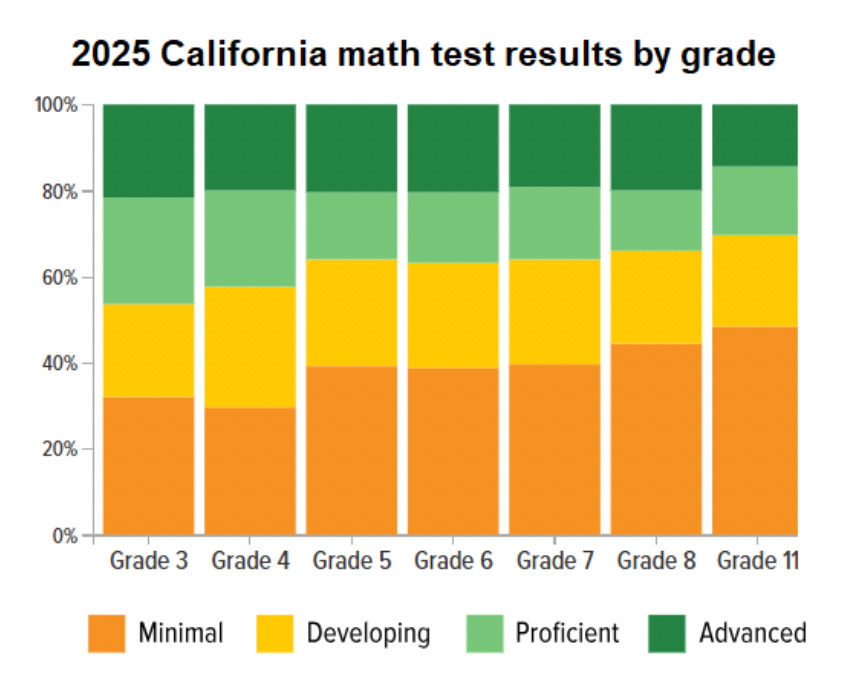
This piece and the chart are focused on California, but this issue tends to pop up in many other states as well.
Now, it’s not literally true that kids get dumber as they age. They are improving, but they’re just not keeping up with what their state defines as “proficient” at each grade level. As a result, the older they get, the more kids fall off track. This is a problem with early reading skills as well, but math is such a cumulative subject that if kids don’t master their times tables they’re likely to struggle with fractions, and if they struggle with fractions they’re likely to struggle with algebra, and on up the chain.
Read my full piece here.
Nurses, teachers, and differential pay
The National Parents Union published a report recently looking at the differences between teachers and nurses when it comes to differential pay. It turns out that the nursing profession is much more likely to use differential pay to combat shortages in particular geographic areas or specialty areas.
I’ve written about this in the abstract before—salaries for nurses are rising while salaries for teachers are not—but NPU makes it more concrete. In the graph below, you can see that nurses in Cincinnati receive the equivalent of a 14% pay differential if they work evening and night shifts.
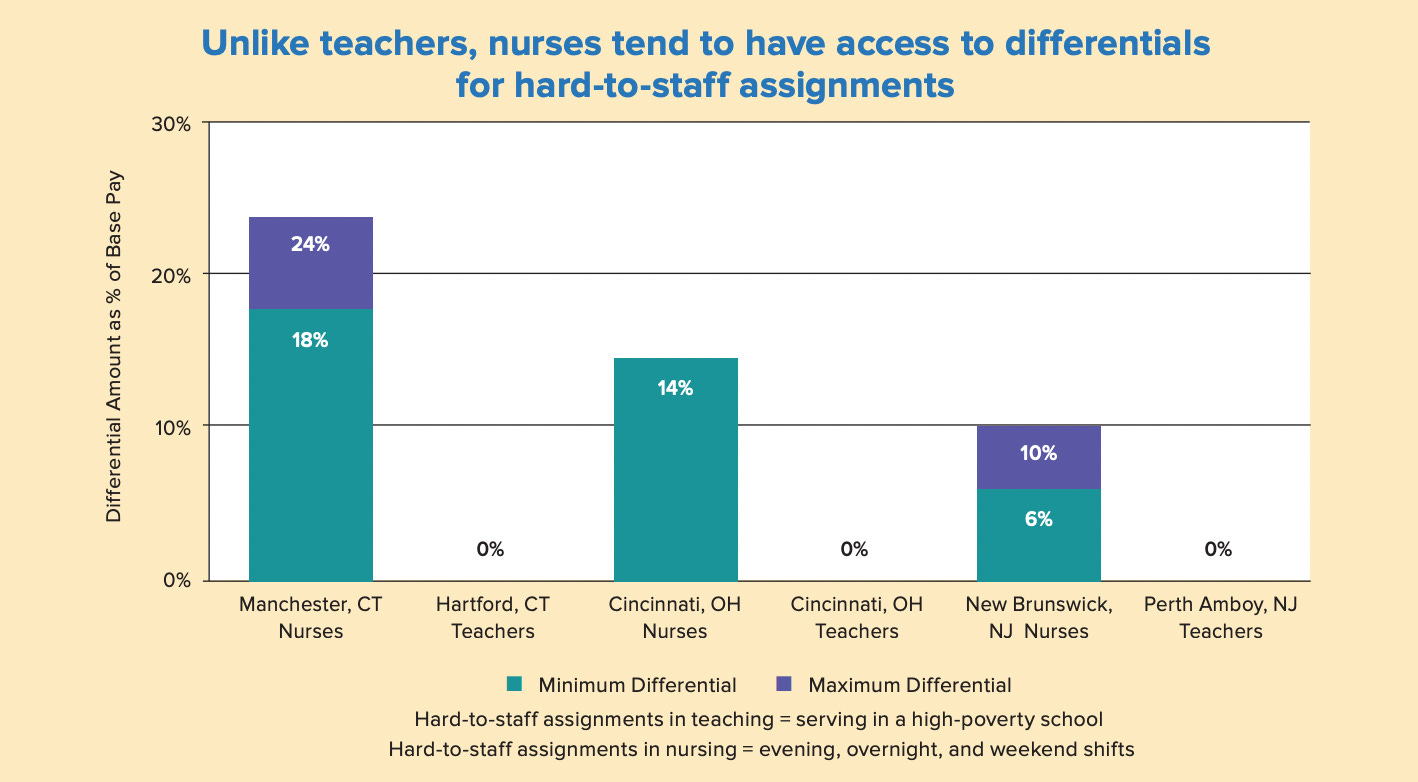
Meanwhile, the Cincinnati teacher contract technically does have a provision allowing the superintendent to offer differential pay, but they haven’t used it since at least 2022.
Read the full NPU report or start with the op-ed version.
Early childhood spending falls short
I’ve served as an advisory committee member for a project convened by The Center for Early Learning Funding Equity (CELFE) at Northern Illinois University. They’re attempting to compare how much we as a country spend on kids before they start kindergarten versus what we spend in public K-12 education.
The chart below highlights a striking imbalance. In 2022, we invested just $1,503 per child ages 0–3 and $2,915 per preschooler—compared with $13,939 for each student in public K–12 education.
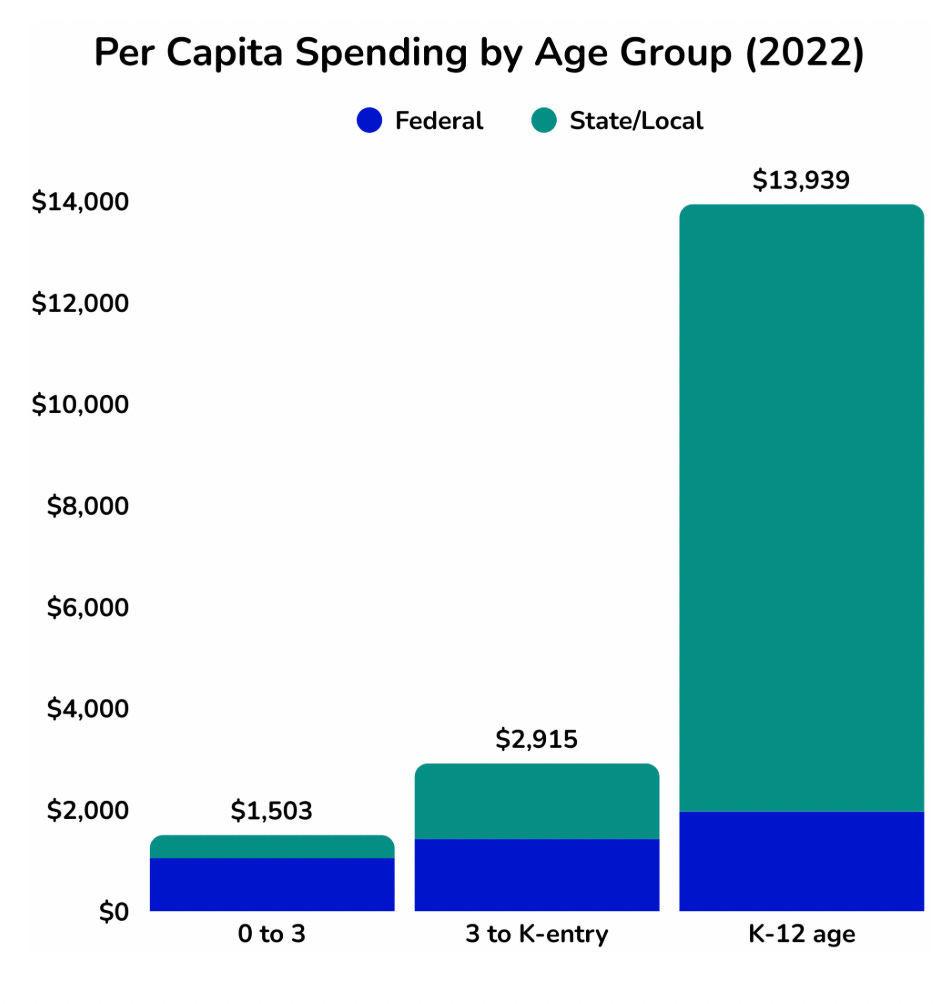
This was yeoman’s work to add up all the sources of funding, particularly for the various federal and state funding streams that support home visiting, child care, preschool, and early intervention and special education services for children from birth to kindergarten-entry. After adding up those totals, at the national level the authors found that, “for every dollar spent on a child during their K-12 years, only 11 cents were spent on infants and toddlers and 21 cents were spent on preschoolers.”
See the full Shortchanged report with state-level data here.
Reading List
NY Times on Michael and Susan Dell’s $6.25 billion donation toward children’s savings accounts1
Dual Enrollment Surges in New York, Saving Families Money
Accommodation Nation by Rose Horwich
Kevin Mahnken: 12 Charts That Defined Education in 2025
The headline on the story is super negative, but the actual content of the story is quite positive.
Points well taken on early childhood as a 'lost opportunity.' Rather than have government solve another problem that belongs with the family and community, is there any effort to educate parents about how to do their jobs better? Delaware just funded an early literacy program to get kids better prepared before K; we'll find out in a few years how it's working. However, I've seen some studies that say the gains from this early intervention get lost over time. What's missing between 4th grade (decoding emphasis) and 12th grade (comprehension?) Any theories?
Thank you so much for this post. If we want to see improvements in student achievement during the K-12 years, we must focus on infancy/toddlerhood. There is so much good research on this topic that we seem to ignore. In the K-12 world, we are obsessed with fixing and not preventing.