

Three Headwinds Facing American Schools
New NAEP data reveal important shifts in how students spend their time

New NAEP results came out this week. It was the Long-Term Trend, which is a paper-and-pencil test that has been given in a comparable form going back to the early 1970s. Here’s a good write-up of the results by Kevin Mahnken in The 74.
My quick take: Some reasonably good news, especially for 9-year-olds and the lowest-performing students. I’ll have more to say on that soon…
In the meantime, this release updated some important survey data that provides context about how students experience schools. If schools want students to learn more, they're swimming against these powerful currents.
1. Fewer kids are reading for fun
Books continue to lose the battle for attention, for adults and for kids. This week’s data showed that we reached new lows in the percentage of 9-year-olds who read for fun, while the percentage of 13-year-olds reading in their free time held steady.
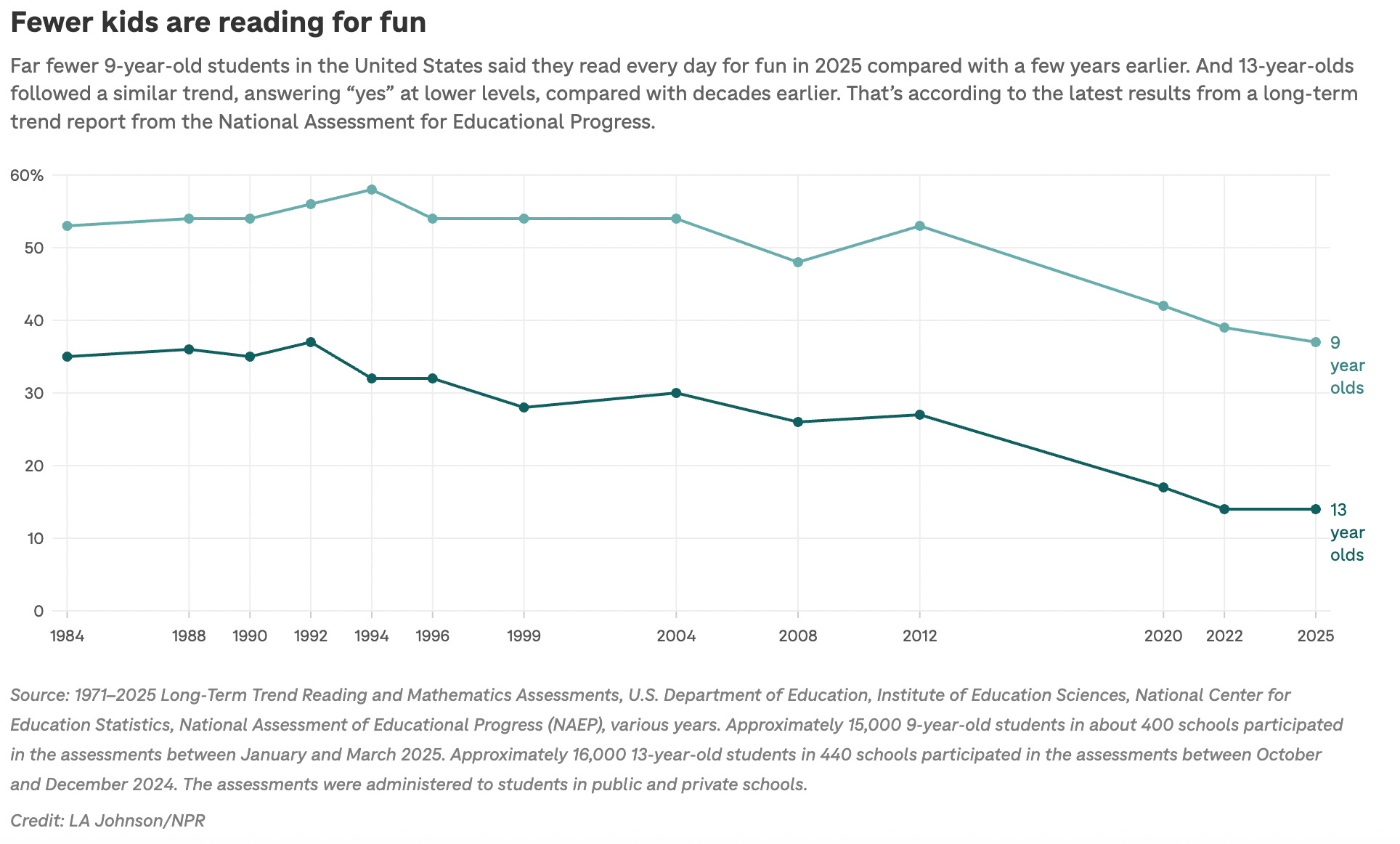
Why does this matter? Schools can teach reading, but they can't make students choose books in their free time. And there’s research suggesting that books — even children’s books — use more distinct words than the ones that come up in spoken conversations. The more kids read, and the wider variety of books they encounter, the larger their vocabulary is likely to become. And the bigger their vocabulary, the easier it will be for them to access and learn from new material.
2. More kids have no homework
Last month I shared data showing that more kids reported having zero homework. The new results extended that out to 2025, and we saw another big jump. When asked, “How much time did you spend on homework yesterday?” 37% of 9-year-olds and 40% of 13-year-olds said “none.” These figures are at all-time highs since NCES began collecting the data in the 1980s.
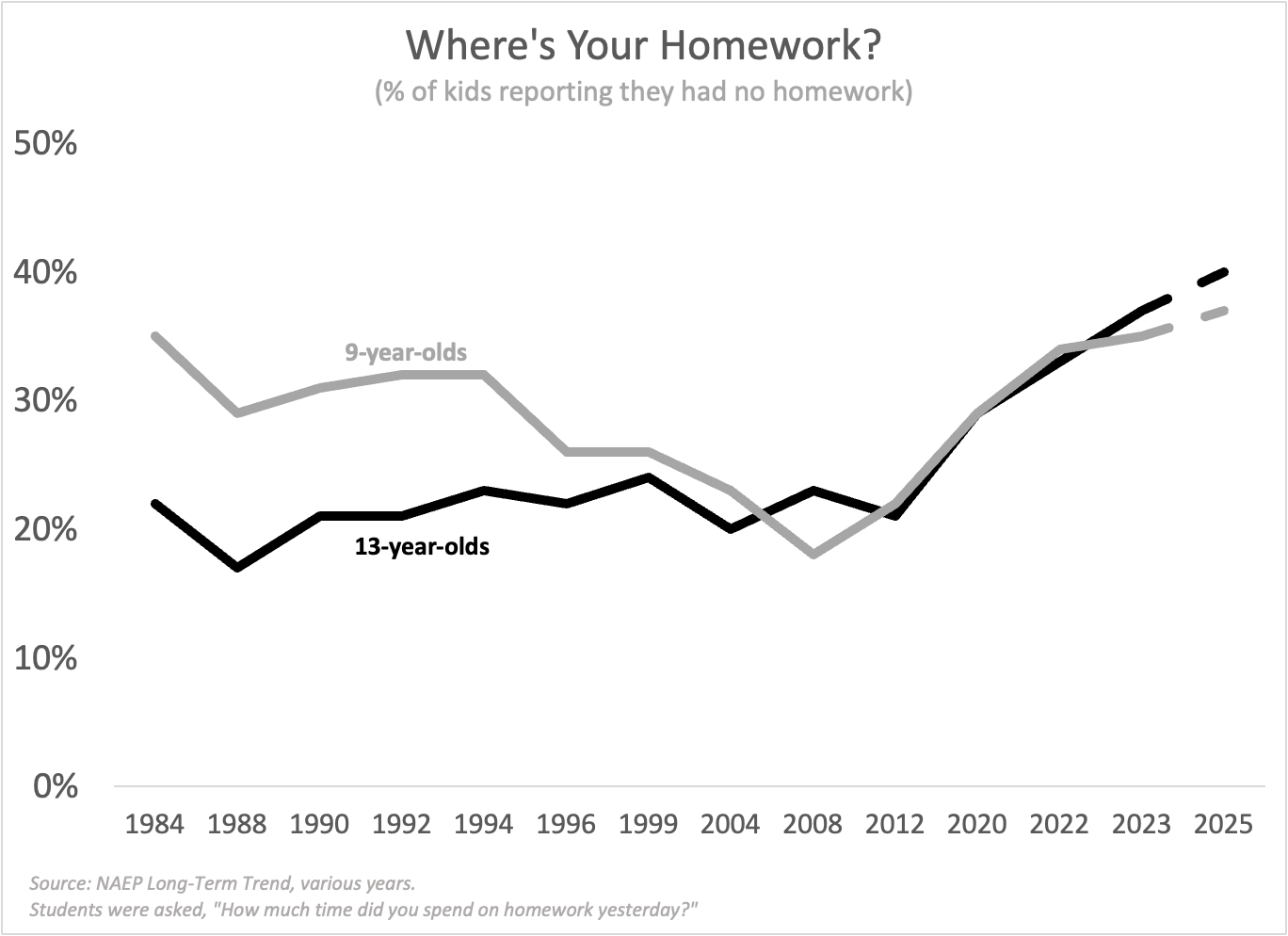
Why does homework matter? Because it creates additional opportunities for learning. It’s time for kids to practice the skills they’re learning in school, or to do extra reading they don’t have time to do at school.
Now, the research on homework is mixed, and it’s not always the case that more is better. But there’s some evidence that a small amount of homework that specifically reinforces what kids are learning in school can produce learning gains. It can also help students form productive habits and routines.
3. The rise and fall of 8th grade Algebra
For EduProgress.org, I wrote last year about the rise and fall of 8th grade Algebra. Throughout all of the 1990s and 2000s, the percentage of 8th graders taking Algebra rose steadily.
And then, it peaked and began to fall. Since 2012, the percentage of 8th graders taking Algebra has fallen from 34 to 23%.
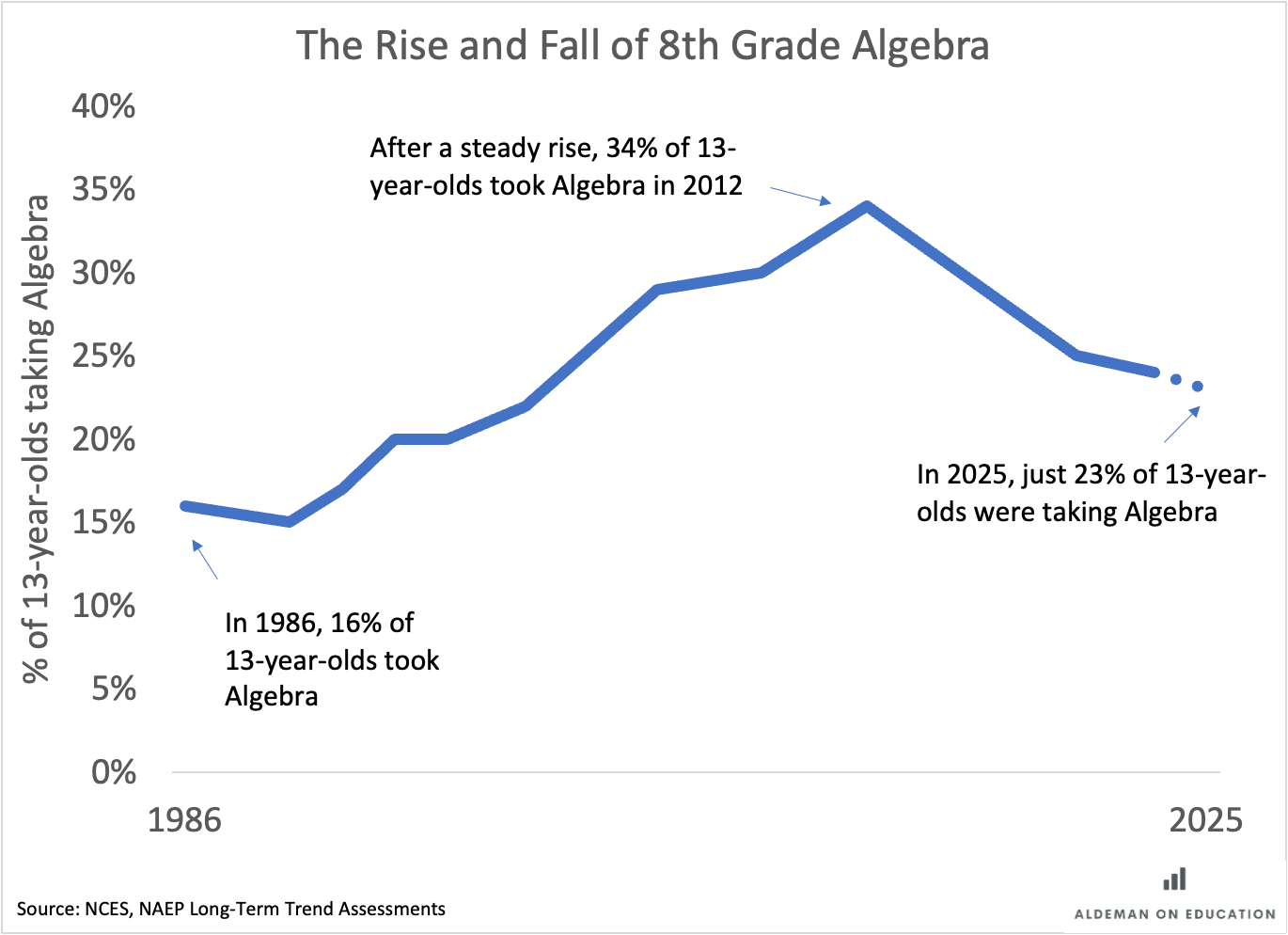
Is this good or bad? Well, that depends. My takeaway from the research is that advanced opportunities are very helpful for students who are ready for them. But it can be harmful to accelerate students who are not ready or to just relabel courses without also changing the content students receive.
The trick, then, is to open doors of opportunity for students who are ready to succeed while giving other students more time to get there. That’s why I support automatic enrollment policies.
Whatever the motivation, fewer students today are taking Algebra by 8th grade than they were a decade ago. That’s not a good direction, and, in my view, schools should find ways to identify students who are ready for acceleration opportunities and then give those students a chance to succeed.
None of these trends are determinative on their own. Schools can still help students learn more, read more, and take on challenging coursework. But it's important to recognize the environment educators are operating in. If students are reading less for pleasure, spending less time on homework, and enrolling in fewer advanced classes in middle school, schools will have to work even harder to produce stronger academic outcomes.
Reading List
Aldeman: Oklahoma has a strong charter school sector
New NBER study: The diffusion of the iPhone reduced birth rates
Alex Tabarrok: The Nationalization of American Science
Rick Hess: Tough Times for an Education Budget Hawk
Robert Pondiscio: Obvious, Intuitive, Seductive, and Wrong: Why Education’s “Instructional Illusions” Feel Right
Roland Fryer: “The classic summer job has been disappearing for nearly half a century”
Social Security Trustees: Unless Congress shores up the retirement program, the depletion of reserves would trigger a 22% reduction in benefits in late 2032
The thing with no homework in elementary school is that it gives supreme flexibility. Some kids are just beginning to master foundational skills and would sink under the pressure of real homework. A kid who needs phonics practise is free to take home phonics materials and work on foundational reading skills at home instead of filling out worksheets. Others can receive assignments from their teacher on an ad hoc basis, or even from their parents, or now have time to attend after school tutoring etc. Most schools with no homework policies assign daily minimum reading time. There’s no real benefit or need for homework in the traditional sense in those early years. Play, reading, family and social time, and sleep. Their job is to log the book they read or maybe work on a specific skill that needs extra time.
By 4th-5th grade and esp by middle school, it’s totally fair to introduce a reasonable amount of homework because the goal is now to teach the skill of independent study.
Important data here. I think the causes of student declines since 2012 are multilayered. Ed Tech and phone distractions are on the list... and so is a cultural shift in schools around expectations. This homework data is Exhibit A.