

The State of Private School Choice Programs in America
They're still small and largely unaccountable, but at least they're growing fast!

A couple weeks ago I wrote a charter school appreciation post. When you start thinking about how to design an education system that will dynamically improve over time, there’s a lot of like about the charter school model. It offers autonomy in exchange for public funding and greater accountability.
Today I want to take a look at the state of private school choice.
As you may have heard, private school choice programs have been growing fast. According to the annual “ABCs of School Choice” report from EdChoice, there are now 75 different programs across 34 states, Washington, D.C., and Puerto Rico.
The number of students served by those programs is also growing rapidly. By my eye, the number of students served has roughly quadrupled in the last 10 years, up to 1.5 million students this year.
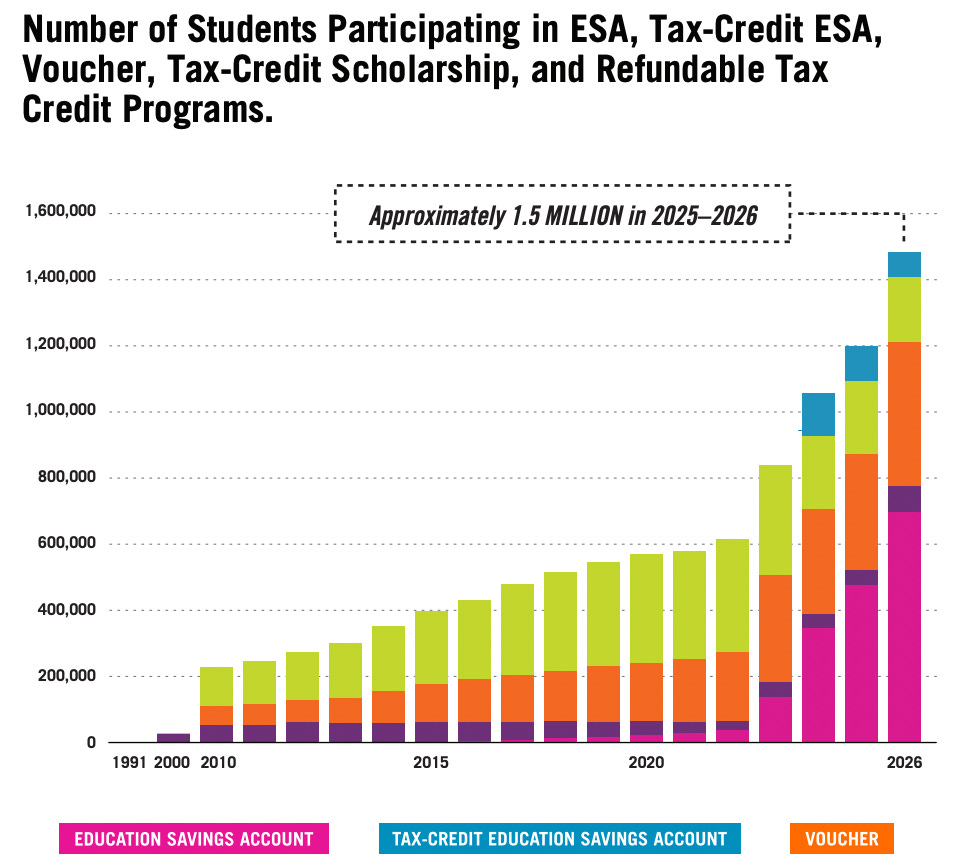
These figures are growing particularly fast in certain states. Arizona, Florida, North Carolina, and Ohio all now have private school choice programs serving more than 100,000 students.
How do these numbers compare? In relative terms, it’s still small in comparison to the 49.5 million students served by public schools.
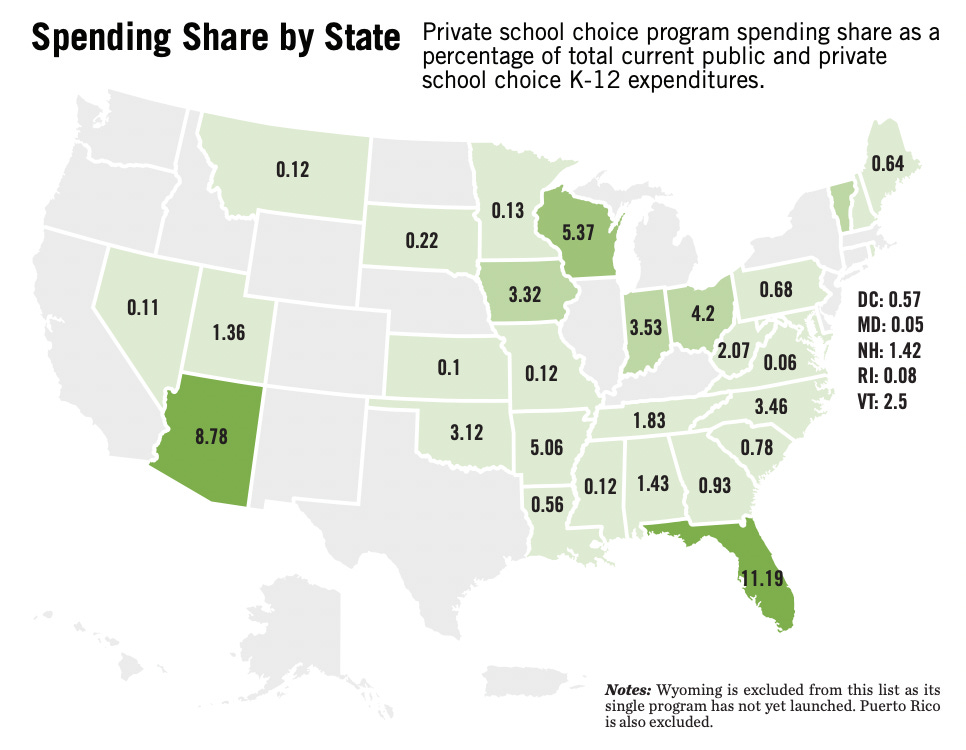
Another way to look at scale is spending. What share of state education budgets goes to private school choice? In most states, it’s less than 1 percent. But there are notable outliers, especially Florida (around 11 percent) and Arizona (just under 9 percent).
So the sector is growing. The question is: growing toward what? Are students actually learning? Can state leaders even answer these questions?
Unfortunately that information is harder to come by. And for some reason EdChoice decided not to report on private school testing mandates this year. But they had a much more extensive overview in their 2025 version. As of last year, only one state (Indiana) with an Education Savings Account (ESA) program required participants to take state tests in reading and math. Twelve states allowed families to choose their own tests, and four states had no testing mandate at all. Among voucher programs, only Indiana, Louisiana, Wisconsin, and Maine required state assessments.
Some people argue that private school students shouldn’t have to take state tests. After all, private schools don’t have to follow state standards or regulations in other ways, and they face accountability through parental choice.
But policymakers should be clear about the trade-offs they’re making. The research literature from recent large-scale voucher programs finds negative effects on achievement scores, even while showing more positive impacts on longer-term outcomes like attainment.
Would you accept that deal? Public investment, lower math scores?
I wouldn’t. I would want to know how my investments are working. Most states can’t do that right now. But if states aren’t collecting achievement data, all they have to judge their private school choice programs by is enrollment growth. And if that’s the only metric that matters, then sure, everything looks like sunshine and rainbows.
Reading List
Dale Chu: Vermont’s persistent delays in test reporting
Marty West: Could End-of-Course Exams Revive Accountability in Massachusetts?
MDRC: New York City’s investment in small high schools of choice boosted college attainment
Joanne Jacobs: Tutoring works -- if kids actually get tutored
“I would want to know how my investments are working. Most states can’t do that right now. But if states aren’t collecting achievement data, all they have to judge their private school choice programs by is enrollment growth.”
In all fairness, my public school district with a budget that exceeds $2 billion judges it’s success on things like enrollment (even though most families don’t have any other op), graduation rates, and “college and career readiness”. While I think private schools utilizing tax dollars need to be accountable for student learning, we shouldn’t pretend that public schools genuinely are in the current state of things. At least students aren’t trapped in those private schools.