

Thinking About Incentives...
An appreciation of the charter school model

One of my hobbies is reading about successful entrepreneurs and the companies they built. I’ve read Warren Buffett’s shareholder letters and Poor Charlie’s Almanack, and one of my favorite podcasts is Founders, where the host distills lessons from the memoirs and biographies of well-known business leaders.
One theme that comes up again and again is the importance of incentives. Incentives matter for individuals and for organizations as a whole. The way an institution structures and reinforces its incentives can push behavior in productive—or deeply unproductive—directions.
So let’s say we wanted to create a new system of public education from scratch. What would it look like? What incentives would it use to drive quality?

My starting list would include:
Schools would be funded primarily based on the number of clients (students) they served;
Schools would receive additional funding for serving harder-to-educate populations, such as students with disabilities, English Learners, and students living in concentrated poverty;
Parents would have a wide variety of options to choose from, including different school types and missions (STEM and classical education and career academies, etc.);
Schools would be held to a common set of minimum quality standards in core subjects like English, math, science, and social studies;
Schools would have broad autonomy over staffing and day-to-day operations;
Schools that produced strong results would be allowed to grow and expand to new locations; and
Any school that consistently failed on these measures would close.
Traditional public school districts fall short on several of these criteria. They are only partially funded based on enrollment, are heavily regulated, and almost never close, no matter how poor their results. District-run schools are further constrained by centralized rules around staffing, budgeting, and operations.
Traditional private schools also miss the mark. While they offer families a variety of options, those options are limited to families who can afford tuition. They are generally not held to common quality standards and often compete more on status than outcomes.
Is there anything that comes close to the incentive structure described above? Charter schools come the closest. They are public schools that trade autonomy for accountability.
Some state and local systems move closer to my ideal than others, but the broader lesson remains: If we want a truly dynamic and effective public education system, we have to get the incentives right.
Reading List
David Deming @Forked Lightning: Using generative AI to learn is like Odysseus untying himself from the mast
Chalkbeat: More Philadelphia students are graduating without passing state exams
Angela Duckworth: Willpower is overrated
Brookings: See post-COVID learning curves by grade level
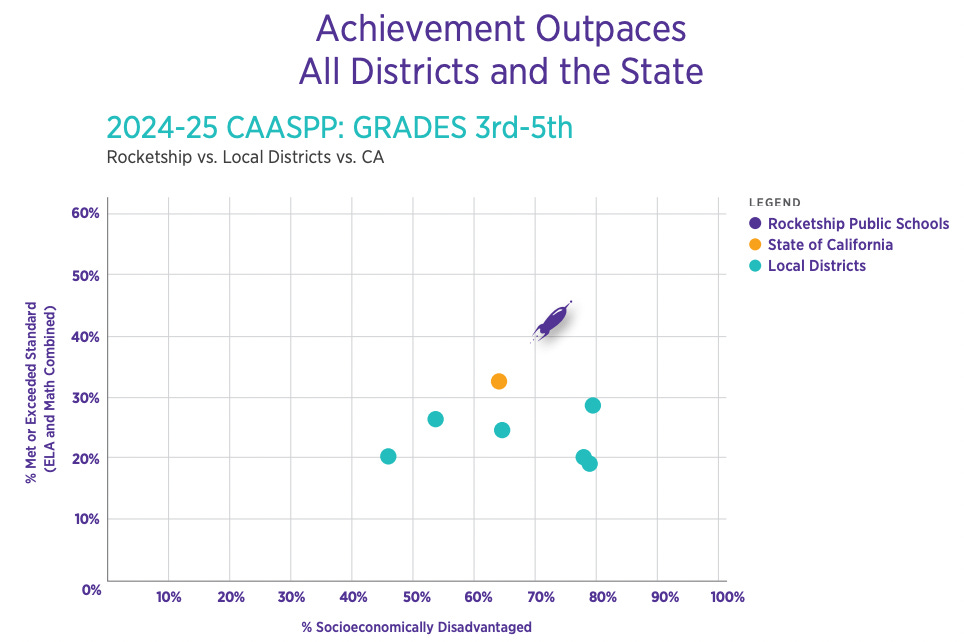
Rocketship charter school students are outperforming their peers:
I am curious what evidence do you have on private schools to say that "They are generally not held to common quality standards and often compete more on status than outcomes"? I know some private schools in NYC take a different standardized test than the state test, is that not common across the country?
Also, you mention that private schools are limited for families who have resources to pay. But fortunately now approximately 50% of kids in the country have access to school choice and could go to some private schools if this is their choice. It will be interesting to see if the enrollment for private schools increase in the next few years in the states that have school choice.