

The Science, and Culture, of Reading Instruction
What a new survey tells us about the state of literacy instruction in America

Something is happening in America’s elementary classrooms. After decades of reading wars, policy stalemates, and children quietly falling behind, teachers across the country are embracing the science of reading.
That finding comes from a new report from the Thomas B. Fordham Institute. They conducted a nationally representative survey of 1,244 public school K–3 teachers and found that that the winds are shifting on reading instruction. At least 40 states have enacted science of reading laws. Professional development programs like LETRS have reached a third of the nation’s K–3 teachers. And as the Fordham survey makes clear, teachers who have gone through these types of training know more and teach better.
But the report also tells a harder story, about what’s left to do. Because even as progress spreads, it isn’t reaching everyone equally. And the students most likely to be left behind are those who can least afford it.
Four important challenges remain.
Challenge 1: Teacher preparation programs are still failing new teachers
Here’s a finding that should be alarming to anyone involved in training the next generation of educators: teachers who reported learning the most from their preservice college and university training programs scored lower on the science of reading knowledge quiz than teachers who relied on any other source of learning.
Let me say that again. The more a teacher relied on what they learned in their teacher preparation program, the less they knew about evidence-based reading instruction.
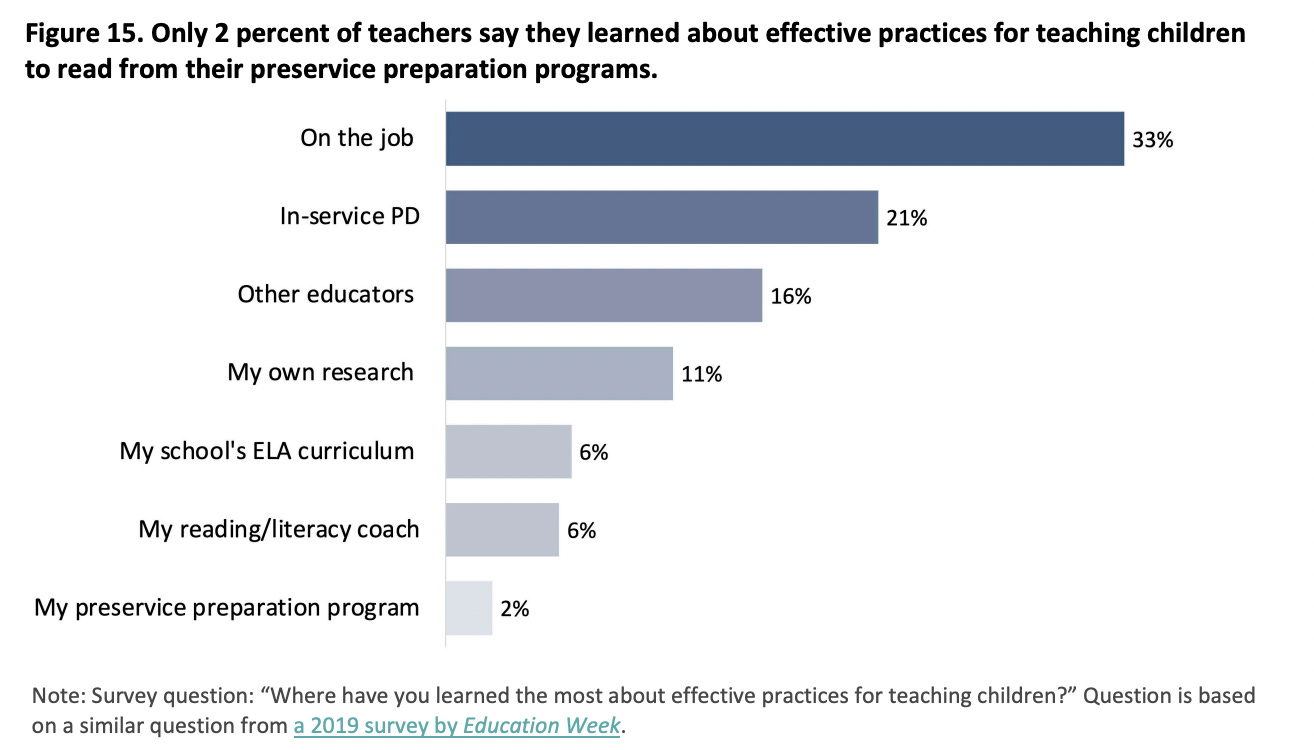
Only 2 percent of teachers said their preservice program was where they learned the most about effective reading practices. In contrast, 33 percent said they learned the most on the job, and 21 percent credited in-service professional development. For many teachers, college essentially taught them nothing useful. In some cases, that “preparation” may have actively pointed them toward discredited practices like three-cueing.
This is a fundamental bottleneck. States won’t be able to fix K–3 reading instruction at scale if their colleges of education keep sending new teachers into classrooms with an incomplete or outright misleading foundation. The Fordham report found that in states where licensure exams are aligned with the science of reading, teachers demonstrate meaningfully better knowledge.
Challenge 2: High-poverty kids are at greatest risk
Despite some signs of progress, the survey revealed a troubling gap: teachers in high-poverty schools are, on average, less informed about and committed to reading science than their colleagues in more affluent settings.
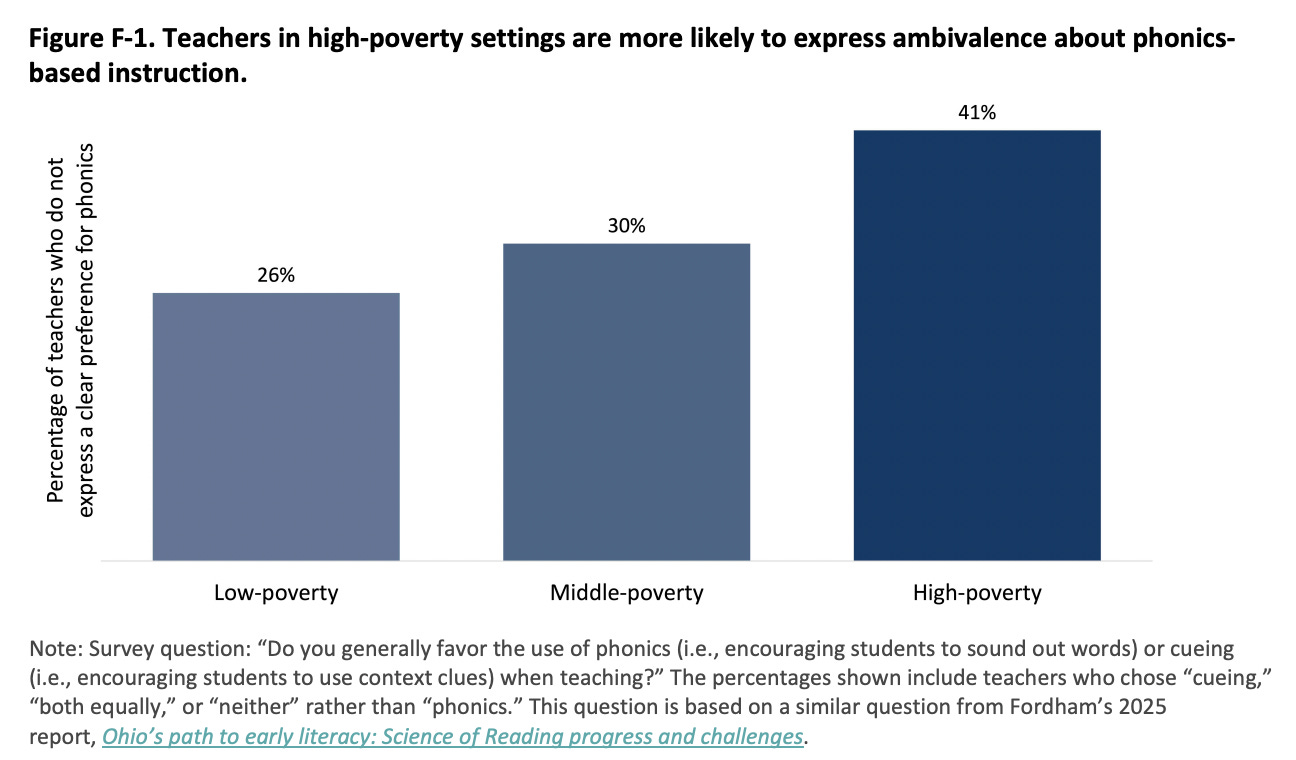
The gap is especially pronounced around phonics. Among teachers in high-poverty settings, 43 percent failed to express a clear preference for phonics over cueing, compared to 25 percent in low-poverty schools. That means nearly half of teachers in the schools that serve the most vulnerable children are ambivalent about the single most evidence-supported element of early literacy instruction.
Children who come from under-resourced homes depend on their teachers more than children who have compensating resources at home such as books, educated parents, and other enriching experiences that build background knowledge. When the reading instruction in high-poverty schools is weaker, the children who need the most get the least.
Challenge 3: Teachers still misunderstand reading comprehension
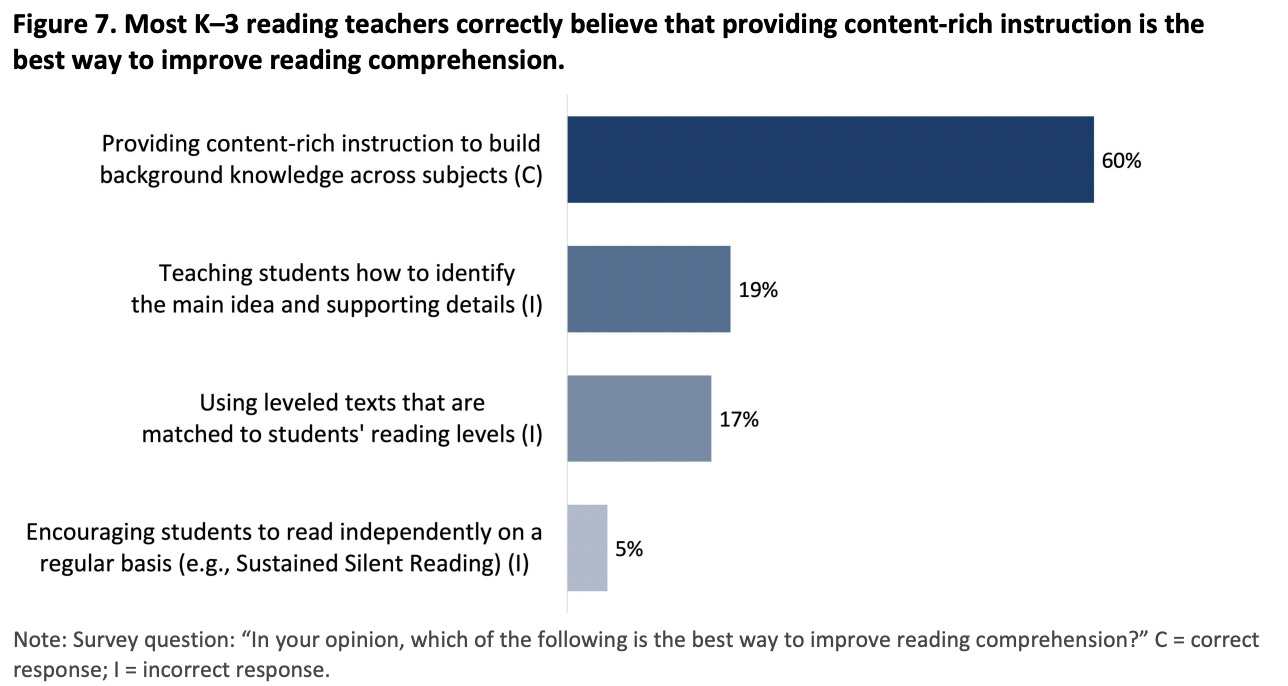
When teachers were asked to choose between two statements about reading comprehension, 58 percent chose the wrong one. They believed that reading comprehension is “a set of generalizable skills (like finding the main idea and making inferences) that can be applied to most texts.” Only 42 percent correctly identified that reading comprehension depends primarily on “what students already know about the topic and the specific vocabulary used in a text.”
This matters enormously. Elementary reading instruction has been dominated by comprehension strategies: teaching children to summarize, make inferences, identify the main idea, visualize, and so on. These strategies feel intuitive — surely if you practice finding the main idea enough, you’ll get better at it? But the research tells a different story. These generic comprehension strategies have very little transferable effect. What actually drives comprehension is knowledge. A child who knows a lot about the American Revolution will understand a passage about Paul Revere far better than a child who was drilled in comprehension “strategies” but who knows nothing about history.
This insight is why history, science, and the arts aren’t luxuries to be cut when reading scores are low — they’re the very substance that makes reading comprehension possible. When children learn about the water cycle, medieval castles, and the civil rights movement, they’re building the cognitive raw material that will make them better readers for life.
The good news: teachers did better when they were asked more specific questions, like the best way to build vocabulary. Seventy percent correctly identified embedding vocabulary instruction in content-rich nonfiction texts as the most effective approach. So the instinct is there. What’s needed is a deeper understanding of the full architecture of what skilled reading actually is.
Challenge 4: The culture around reading instruction is a work in progress
Perhaps the most human element of the Fordham report is what teachers say in their own words. Many are converts, enthusiastic ones:
“LETRS changed the way I teach. I am thankful to work in a district and state that is taking the science of reading seriously.”
“We’ve actually started teaching students HOW to decode and read. Before, we used the cueing system (teaching them to guess) and expected students to read novels after 15 minutes of modeling reading, and they couldn’t decode or understand what they were looking at.”
But others are ambivalent, even resistant:
“I learned from a balanced literacy era. I believe asking yourself ‘Did that make sense?’ is important while reading. I think the pendulum swings too far to one side and we need balance. I also think students need exposure to leveled or authentic text instead of constantly reading decodable texts.”
These responses are honest and human. Teachers who spent years building expertise in one approach, and who genuinely believed they were helping children, are being asked to fundamentally reimagine what good reading instruction looks like. That’s not easy. Professional identity is real, and pedagogical habits are deeply ingrained.
And yet the data are unambiguous: teachers who understand the science of reading produce better outcomes for students. The answer to “let us teach” is: yes, absolutely, but let’s make sure that students are learning to read.
The science of reading movement has momentum right now, but cultural change is notoriously slow. The worst outcome would be to declare victory prematurely and let that momentum dissipate before it’s had time to fully reshape how students are taught to read.
Want to talk more about this?
On Friday morning I’ll be moderating a conversation on “Running the Mississippi Marathon” about how it transformed reading outcomes. I’ll be joined by Judge Gray Tollison, former chair of the Mississippi Senate Education Committee, and Rachel Canter, the Director of Education Policy at the Progressive Policy Institute and founder of Mississippi First.

You can RSVP for the 11 a.m. Eastern livestream right here.
Reading List
Rachel Canter: States Are Learning the Wrong Lesson from the ‘Mississippi Miracle’
Andrew Rotherham: Has the Science of Reading really won?
Learning Science Design: The Chromebook-as-baby-sitter problem and the edtech abstinence movement
I think your description of challenge 3 reflects a profound misunderstanding. Reading comprehension absolutely includes both of the descriptive sentences. A child who rarely reads and has to work at a family garage won't understand Zen and the Art of Motorcycle Maintenance better than a widely read child who has never touched a motorcycle or worked on a vehicle. I of course agree that breadth and depth of topical knowledge matters, and I agree that just drilling summarization can't get a child from functional illiteracy to fluent comprehension. But the most important topical knowledge is in the broad topics of negotiation, parsing misunderstanding, navigating values differences and power dynamics, building and maintaining relationships, and other core aspects of human experience. You're confusing your disagreement around method with a definitional disagreement, and incorrectly judging teachers for embracing a perfectly valid definition.
You said: 'The more a teacher relied on what they learned in their teacher preparation program, the less they knew about evidence-based reading instruction.'
Is there evidence to say that a majority of the kids who leave school as illiterates were kids who had shut down from learning to read due to confusion?