

*Some* Kids Are Flourishing. Most Are Not.
Understanding achievement and engagement gaps

Student achievement scores are down on average, and they’re down particularly at the low end.
This is the key education policy trend over the last 10 years, and I’ve been writing about in piece after piece after piece.
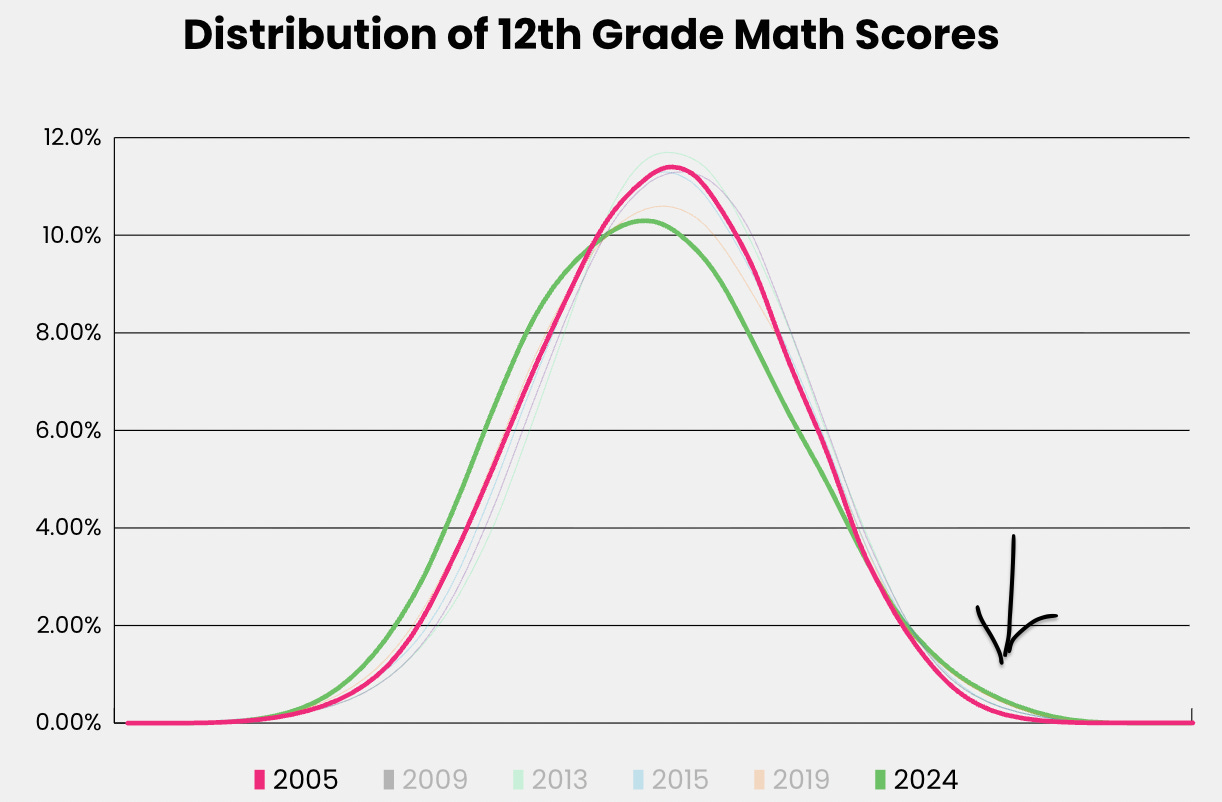
Look at the graph below from my piece at The 74 on the changing distribution of 12th grade NAEP math scores. The red line represents the distribution as of 2005, and the green line shows scores as of 2024. The main story is that the entire curve shifted to the left, and a lot more kids are earning lower scores.
I haven’t spent as much time on it, but recently Matthew Yglesias picked up on the fact that high-achieving students have actually been doing ok. In the version of the graph below, I’ve added an arrow pointing to the increase in the number of very high-achievers.
As another example from the same piece, consider the 12th grade reading scores. Again, the entire distribution shifted to the left, in pretty horrifying ways, but there was a small increase of very high-achievers at the top end.
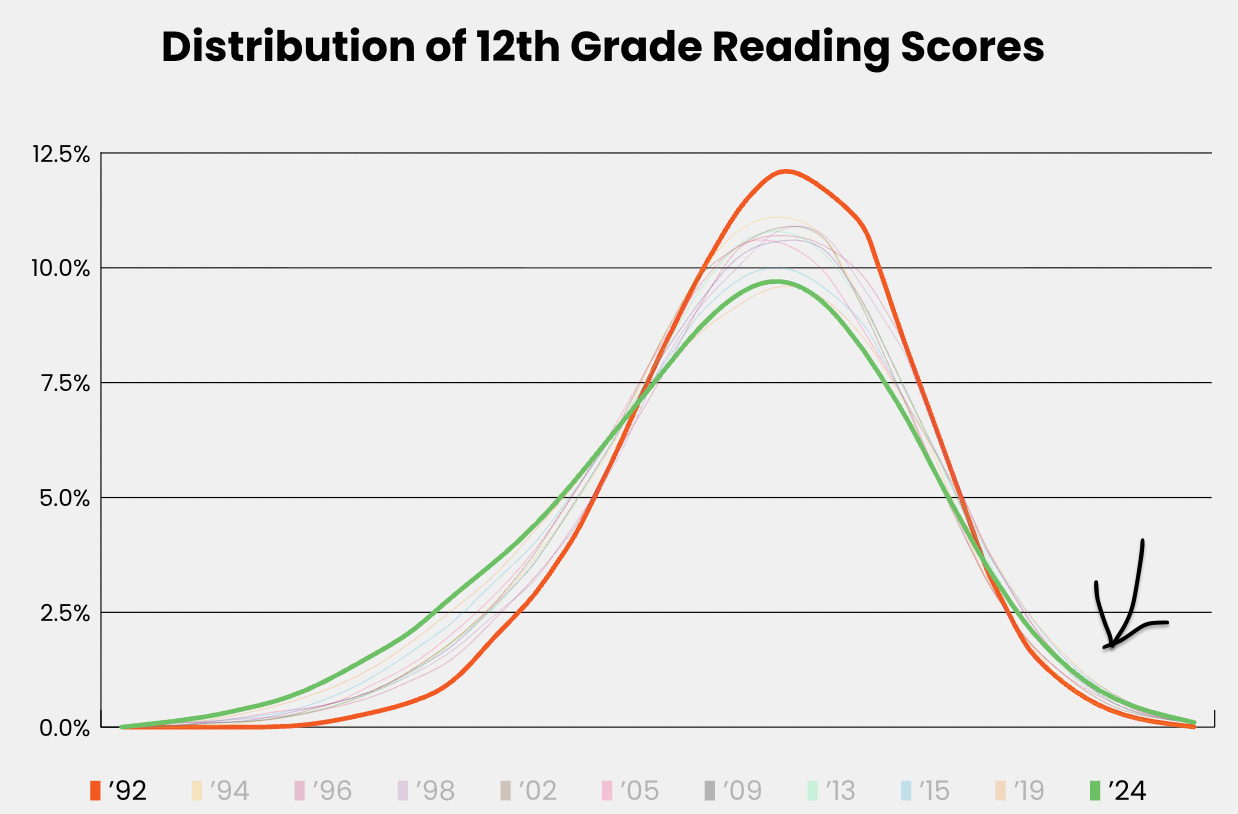
This trend shows up in a number of places and in a number of ways, but it’s important to hold both of these stories in mind. The bottom is falling, and the top is either staying the same or even rising a bit. This matters in terms of how policymakers should think about improvements. It’s important to define the problems correctly.
So who are the students on either side of these charts? What does their daily life look like?
Which kids are flourishing?
I’m a big fan of Mike G’s work at the Center for Teen Flourishing. In recent case studies, he showed that one way to keep teens off their phones is to give them something productive to do with their time, whether that’s track and field or a job.
This makes sense to me. When I want to eat healthier, I’m not great at restricting myself away from snacks or sweets, but adding fruits and vegetables to my plate seems to work better. Addition is easier than subtraction.
But for some reason this logic breaks down when it comes to teenagers. Can we really ask kids to add more? Aren’t kids overscheduled enough already?
The answers to these questions depend on which kids we’re talking about. It’s true that some kids are busy. They’re taking AP classes… and volunteering… and doing a sport or theater or other afterschool club. If you’re reading my wonky Substack, these could very well be the types of kids you’re most familiar with. My own kids are too young to be in high school, but they’re on this path.
But these are the kids on the righthand side of the graphs above. They’re doing just fine, flourishing even.
But the kids on the lefthand side of the achievement graphs above are not flourishing, academically or otherwise. They aren’t overscheduled. They don’t have as much homework as their peers did in the past. They don’t have jobs. They’re not volunteering. The students on the left side of the achievement distribution aren’t busy in any traditional sense—they’re more likely to be disengaged.
I’m putting this crudely and overgeneralizing here, but there’s a real disconnect in how teenagers are spending their time.
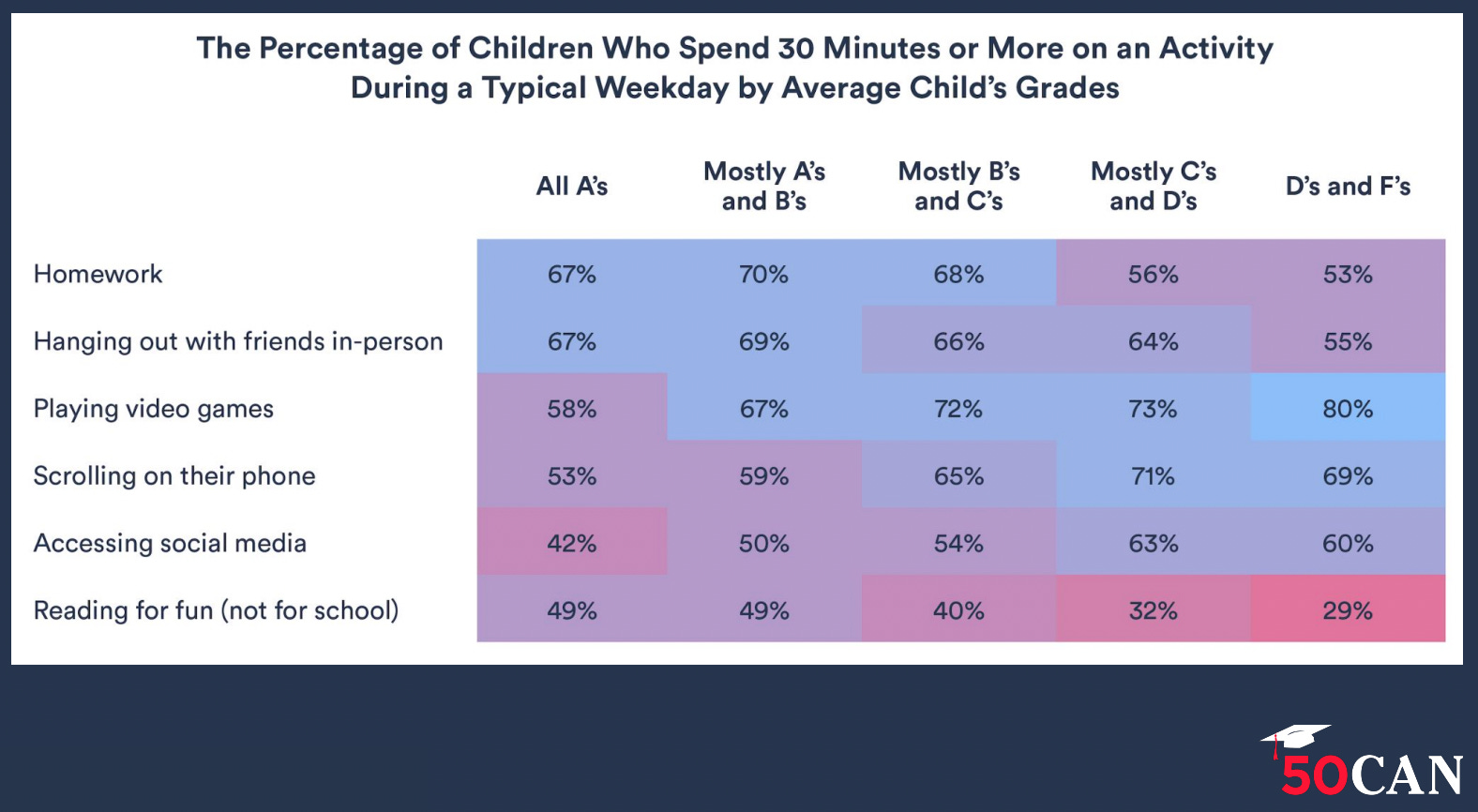
To put some data behind this, consider the nationally representative survey released by 50CAN last month. They found that higher-performing students spend their time at home differently. Kids who earn A’s and B’s are doing more homework, spending more time with friends, and doing more free reading. They’re doing it all.
In contrast, students earning D’s and F’s and more likely to play video games and spend time scrolling on their phones and accessing social media.
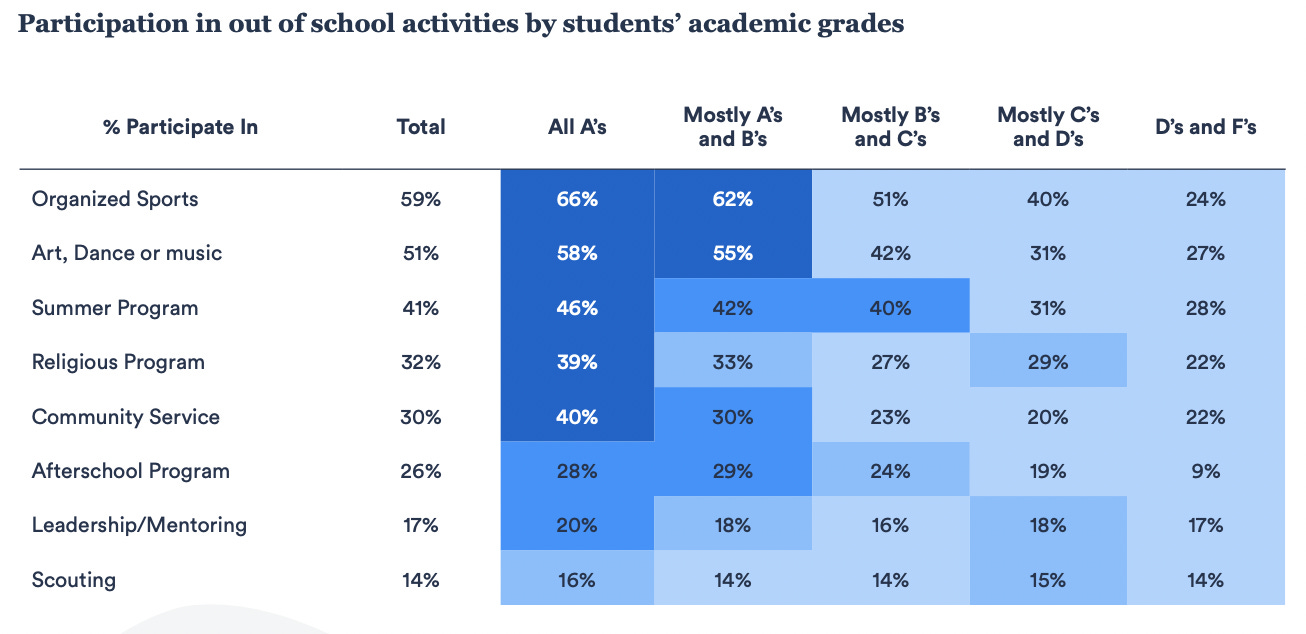
The 2024 version of the 50CAN survey also looked at other out of school activities. The participation trends were similar. Kids who were getting mostly A’s and B’s at school were far more likely to be in organized sports, arts and music, summer programs, religious programs, community service, and afterschool programs.
The story here isn’t just falling scores. It’s divergence. Some students are engaged in school and out of it. They’re busy. They’re studying, practicing, competing, and participating. They’re doing more, not less.
But the students at the bottom look very different. They have less structure, fewer commitments, and fewer demands on their time.
That’s the gap that matters.
And it points to a simple but uncomfortable truth. The students who are struggling the most don’t need us to take things off their metaphorical plates. They need parents and policymakers to ask more of them.
Reading List
Todd Collins: More on 8th grade reading results
Willingham and Hirsch: Knowledge as the Key to Reading
Adam Ezring: Governors are not using their platforms to elevate math as a priority
BullshitED: “The same people who say schools are broke, families need help, and programs are getting cut are working overtime to kill or stigmatize a donor-funded tax-credit mechanism because they are terrified someone in their coalition will call it a voucher.”
This is a great point, and I've absolutely seen this play out in my own 18 year old daughter's life. When they wanted to save up money for something they cared about (travel and tattoos, hah!), they got themselves a job and now spend a lot less time on their phone. High expectations are absolutely so crucial.
I have seen elsewhere, however, that students who attend high-achieving schools are more likely to suffer from anxiety and depression-- how do you connect that research to this?
Thanks!
As someone who did most of the out of school activities, do find it a bit surprising how much some of them diverge with the correlation, would not have thought leadership/scouting have no corr, while sports and religion are that strong (definitely would have expected positive corr for these two but maybe lower)