

Senate Democrats need a better plan
Mend, don't end, the federal tax credit program

Thirty-one Senate Democrats have signed on to cosponsor a bill to repeal the federal tax credit scholarship program, led by Arizona Senator Mark Kelly. In a recent video on X, Kelly described the policy as a private school voucher scheme that “funnels taxpayer dollars” away from public education.
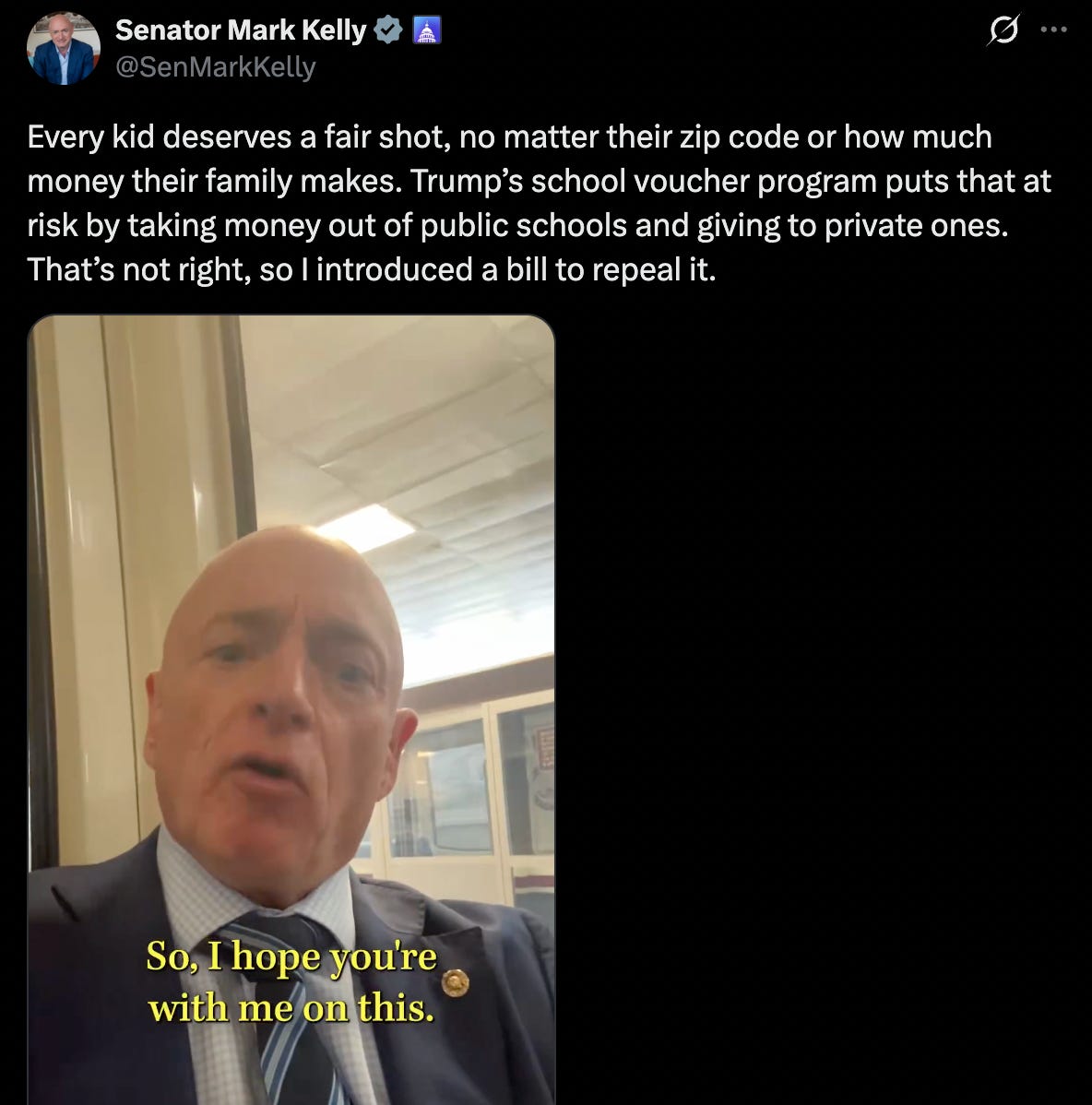
That framing is misleading, or at least incomplete.
The program is not a direct spending initiative that pulls money out of public school budgets. It operates through the tax code, offering credits to donors who contribute to scholarship-granting organizations. Left on its own, the program may well tilt toward private school tuition. But policy design—not just intent—will determine whether that’s the only outcome. That distinction matters, and its effects will ultimately depend heavily on how the program is structured, regulated, and used.
And that’s where the repeal effort falls short. By treating the program as nothing more than a traditional voucher, critics risk overlooking how it could be deployed to support a broad array of educational services, including tutoring, afterschool programs, and summer learning opportunities that benefit students in public or private schools. With some slight entrepreneurial thinking on the part of Democrats, this program could direct substantial new resources into those areas.
The question, then, is not whether the program should exist at all, but whether leaders of all political stripes will be willing to step up and use it in ways that align with their priorities. Right now, too many Democrats are focused on repeal. That could backfire and leave a lot of money and opportunities on the table. A more productive approach would be to utilize the policy and improve it so it better targets need, protects students, and expands access to high-quality learning opportunities.
As currently designed, the program falls short on several of those fronts. But those shortcomings point to opportunities for reform, not reasons to abandon the effort altogether. Here are four areas where policymakers could focus their attention:
Prevent discrimination by scholarship-granting organizations
Right now, the law is silent on which types of programs are eligible for funding. But we’re talking about a federal tax credit here that could cost the Treasury billions of dollars a year in foregone revenue—the least Congress can do is require that scholarship granting organizations (SGOs) not discriminate based on a student’s race, religion, sex, national origin, and disability status. You want a tax credit? You can’t discriminate.
Target scholarships to families with financial needs
When drafting the original legislation, the Republican Congress did set an income limit, but it’s laughably high. Recipients must be able to document that they earn within “300 percent of the area median gross income.” In Northern Virginia, where I live, the maximum cutoff is someone earning $491,700 per year. That is far too high. People earning that much money shouldn’t qualify for a federally subsidized education “scholarship.” That’s not a wise use of tax dollars, and Democrats should work to lower the income cap to focus on truly needy families.
Expand eligibility to cover early childhood services
The current program focuses on K-12 educational expenses. It’s a broad list of allowable expenditures including tutoring and other supplemental services, but it is limited to K-12. But why stop there? Many of the largest gaps in access occur earlier in a child’s life. Extending eligibility to cover early childhood services—from birth through age five—would open up a new stream of funding for childcare providers and early learning programs. That would not only support children’s development but also help more families afford care and participate in the workforce.
Give states the flexibility to adjust the program as they see fit
The law was written in such a way that the Treasury Department could have allowed states flexibility about the types of SGOs they wanted to let operate in their state. The Trump Administration interpreted it more rigidly and seem to be taking an “all-or-nothing” approach. We’re still waiting on the final rules, but Democrats could demand that states get a say. Federal rules could allow states greater flexibility to define eligible providers, set accountability standards, and direct funds toward priority areas. Some states may choose to emphasize private school options, while others might prioritize tutoring, summer learning, or evidence-based interventions within public school choice systems. Allowing that variation would enable states to align the program with their own policy goals while maintaining appropriate guardrails.
Lawmakers and advocates can continue to debate the program in familiar, polarized terms, or they can engage with the details and shape it into something that better serves students. Focusing exclusively on repeal risks ceding that ground.
A more constructive path would be to treat the program as a starting point—one that can be refined to better target need, expand opportunity, and ensure that public resources are used responsibly. Democrats who ignore those possibilities are doing a disservice to the children in their states.
Reading List
Jeb Bush: State leaders need to eat more broccoli
Rachel Canter: States can’t pursue Mississippi-lite versions and expect the same results