

Why I support 3rd grade reading laws
It changes adult behavior

I have a new piece out at The 74 this week on 3rd grade reading retention policies. There are a lot of arguments either way on this, but I think those debates often focus on the wrong things. What really matters is how they change adult behaviors:
In threatening to hold students back if they haven’t been taught to read properly, states are warning the adults to make sure each child is on track in literacy.
When you start to see third grade retention policies as less of an intervention and more about how they change adult behavior, you can see it show up in the research literature. For example, a study from Michigan — a state where, thanks to various exemptions and remediation efforts, the number of kids who are actually retained is just 0.5% — found positive effects of its third grade reading law even in districts that did not hold any students back. A Florida study found that flagging a child for retention improved the academic outcomes of their younger siblings. One of the study’s authors speculated that, “the high-stakes retention signal for the older siblings might inform parents and educators about the educational needs of the younger sibling and induce them to act.”
If the actual act of retention were the trick, these results should be impossible. As is, they imply that the laws are forcing adults to change their behaviors in ways that boost reading outcomes even for kids who were not retained.
Read the full piece here.
How is your school district doing?
If you’re reading this, you probably know that national achievement scores have declined over the last 10-15 years. I’ve written a lot about those trends.
The researchers behind the Education Recovery Scorecard have a big new report out breaking down the results for individual school district. The national report is here and their “districts on the rise” list is here.
They also partnered with The New York Times to show district-level trends. They could only make national comparisons for schools 40 states, but it’s a lot. (Try this gift link to look up your district.)
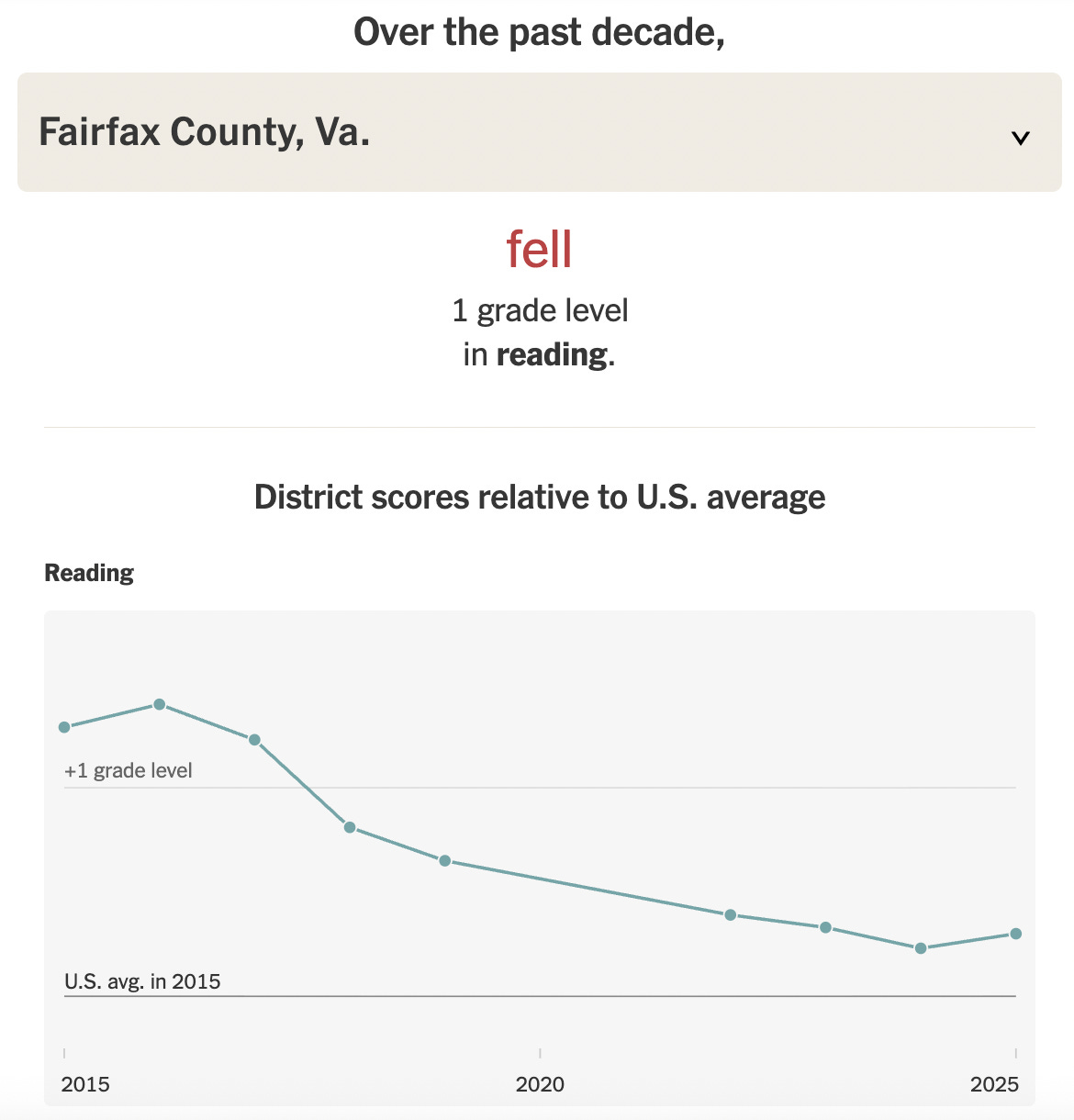
I found a few interesting things, starting with my home district of Fairfax County, VA. Virginia’s math scores weren’t comparable, but reading scores were available, and they do not look pretty. The district’s reading scores fell by 1 full grade level from 2015 to 2025. Woof.
Next I looked up West Des Moines, Iowa, the wealthy (for Iowa) suburb where I grew up. Like Fairfax County, a lot of people move there “for the schools.” And yet, its students fell by 0.9 grade levels in reading and 1.3 grade levels in math.
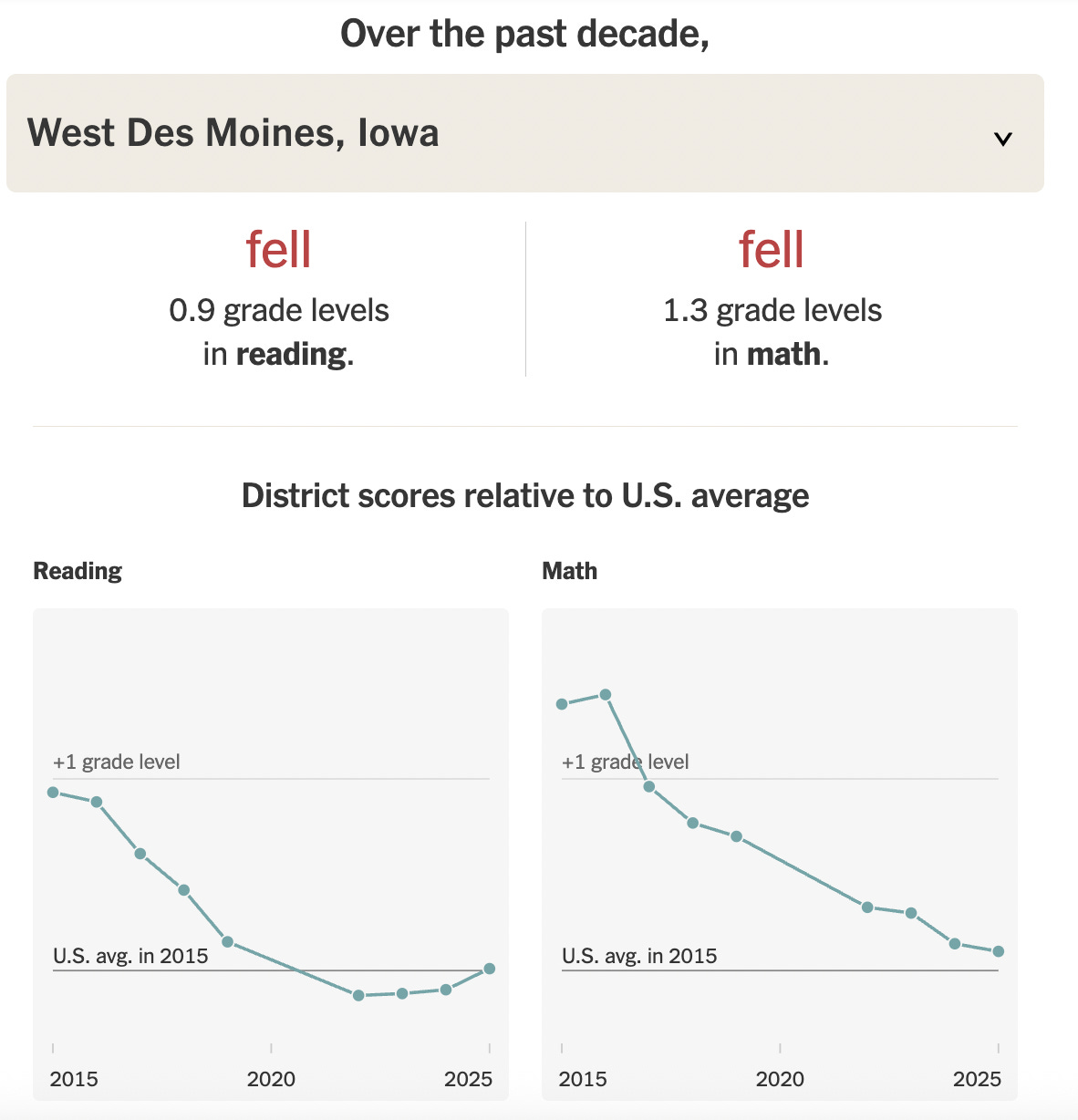
Across the country, where data were available, 83 percent of school districts suffered declines in reading. In math, 70 percent of districts suffered declines.
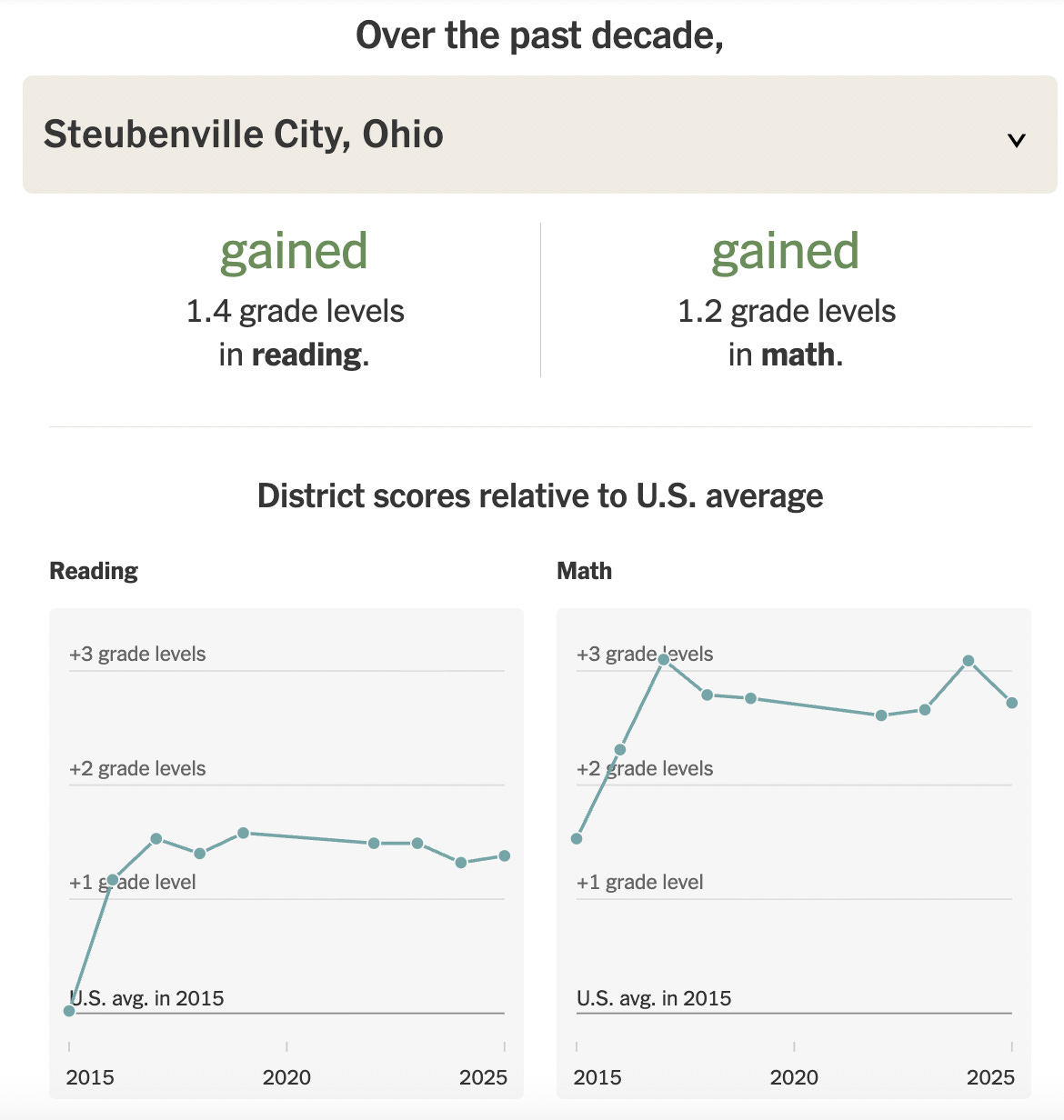
But not in Steubenville, Ohio, a district that Emily Hanford and I have both profiled in recent years. Its students gained 1.4 grade levels in reading and 1.2 grade levels in math.
Reading List
Kevin Mahnken: Anatomy of a ‘Learning Recession’: Academic Losses Began in 2013, Report Finds
Melissa Manno: More than 130 New York School Districts Are Using Discredited Reading Curricula
EdPolicy Hub: California Should Do More to Build a Coherent Curriculum Policy
Greg Toppo: Florida Cellphone Ban Promotes Academic Gains … After a Year or So
Your article, "3rd-Grade Retention Isn’t Really About Kids — It’s About Adults Who Teach Them" is an advocacy rather than an analysis. You need to make it clearer that you work for an organization that advocates 3rd-grade retention. The premise that retention is more for adults is speculative.
The Florida study (Green and Winters) has been called into question by researchers who found much smaller effects when selection bias was better controlled. Darling-Hammond found that countries with high-performing school systems achieve results without relying on retention. The disproportionate effect on minority and low-income families is noted but then ignored. You ignore all other aspects of the Mississippi school improvement model, such as teacher training and interventions to remediate lagging achievement. Comparing Mississippi to Oklahoma and South Dakota without recognizing the different contexts in each state is misleading.
You make it a binary decision, either retain or promote socially, and ignore social promotion with intensive interventions. The long-term effects of retention have shown that its effects fade by middle school and culminate in high rates of dropping out of school. You have not established that retention itself, rather than the accompanying interventions, drives the outcomes you cite.
Early and effective interventions by highly trained teachers are a better solution.
Can you please gift the NYT link?