

When Should You Accelerate Your Child?
A case study on math in Fairfax, Virginia

Led by Superintendent Michelle Reid, Fairfax County Public Schools has been dramatically increasing the percentage of its students who enroll in Algebra by 8th grade. By next school year, they project that 84.5% of 8th graders will be enrolled in Algebra I or higher.
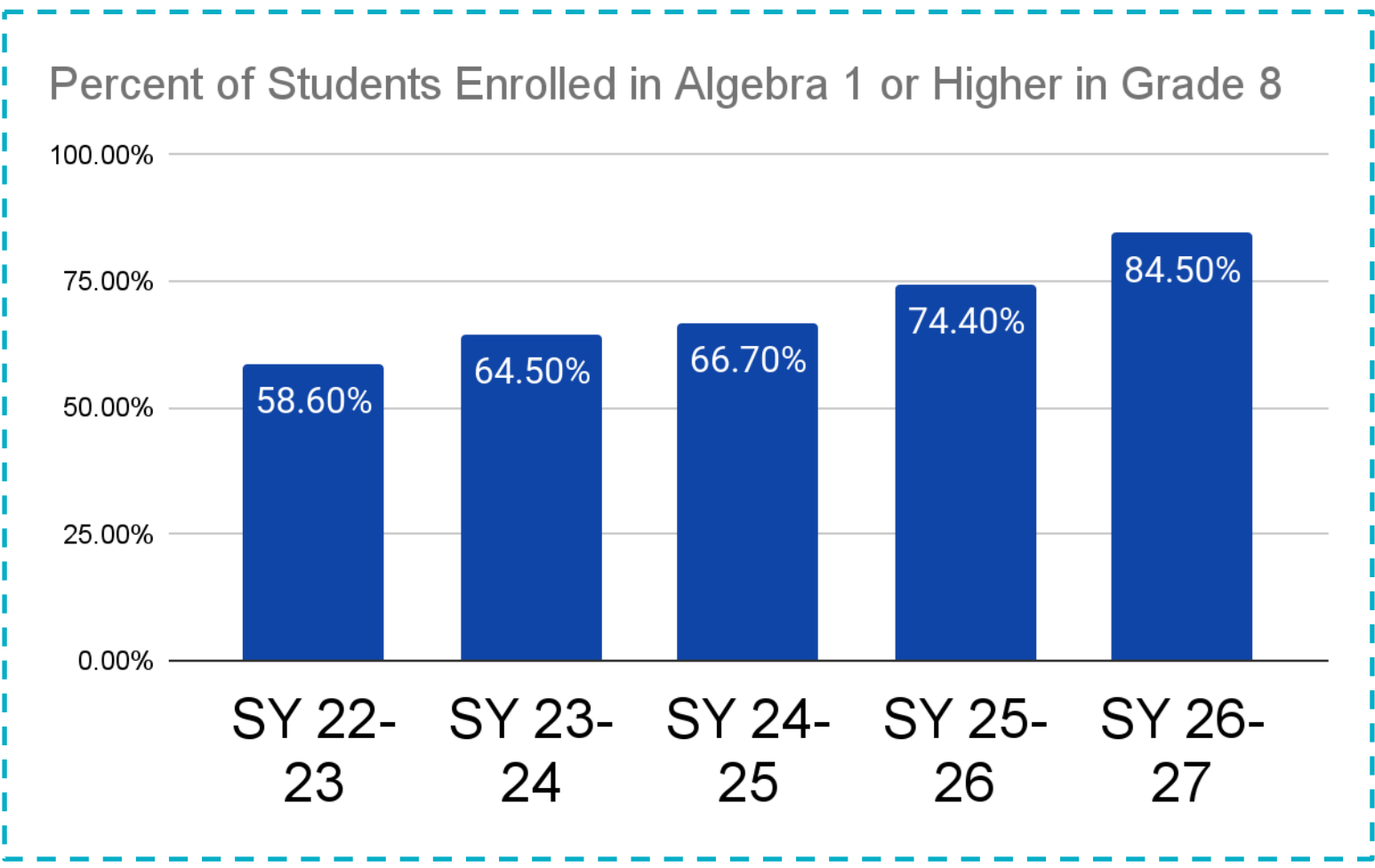
This is a big deal. These rates are far above the national average.
The context is also important here. I wouldn’t be applauding this move if the district was merely changing the name of its math classes. An “Algebra” class should mean the same thing everywhere. But because the state of Virginia requires all students enrolled in Algebra to take the same end-of-course exam, we can be confident that there’s a backstop on quality.
And thanks to those state tests, we have a good idea of how students are doing. Last year, 31,960 students across the Commonwealth took Algebra I as 8th graders, and 91.9% of them passed the end-of-course test. That’s pretty good!
But some students took it even earlier, and they did even better. 12,245 students took the same test as 7th graders, and 98.9% of those students passed. A select group of students—143—actually took it as 6th graders. 100 percent of those students passed.
Now, there’s almost certainly some selection effects here. But these high pass rates suggest that districts across Virginia may be just a little too choosy about which students get access to advanced math classes. After seeing data like this, both the state department of education and the state legislature pushed districts to open more advanced math opportunities to more students. (Disclosure: I helped implement the former and cheered on the latter.)
The research suggests that advanced math courses are good for kids, particularly girls and students of color who otherwise might not get those opportunities. But acceleration could also be harmful, if students are pushed too far above their skill set. The trick, then, is to open doors of opportunity for students who are ready to succeed while giving other students more time to get there.
But which students should be accelerated?
This question hit home over the last week. My own child received news that they were eligible for acceleration. A neighbor kid did as well, and the parents asked me to help them think through their options.
Fairfax is practicing automatic enrollment with the option for parents to opt out. That’s good. But are they communicating it well? Here’s the email I received (with personal details removed):
Dear Parent or Guardian,
We are reaching out to families of rising […] students who are currently enrolled in Advanced Math...
You should have recently received communication from Fairfax County Public Schools indicating that, based on your child’s current math placement, they will be automatically enrolled in Algebra 1 Honors... This course is a high school-level class that moves at an accelerated pace and will be included on your child’s high school transcript and GPA.
Families have the option to opt out of Algebra 1 Honors. If you choose to do so, your child will be placed in Pre-Algebra Honors, which continues to provide a strong and rigorous math foundation while allowing for a more measured pace.
As you consider this decision, we encourage you to reflect on your child’s academic history, including assessment data, classroom performance, and their readiness for the pace and expectations of an honors-level high school course. This decision should also align with your child’s long-term academic goals and interest in advanced mathematics coursework.
Next Steps:
Please log into Parent Digital Consent (PDC) to confirm your child’s enrollment or to opt them out of Algebra 1 Honors.
We are also providing this Google Form as an alternative option to define your student’s math enrollment.
We kindly ask that families submit any opt-out requests by […].
Please note that families will still have an opportunity to reconsider placement after students have taken the Math SOL and received their scores.
Is this a good message to parents? Having followed this policy professionally, I automatically accepted it and didn’t think anything of it. But my neighbors, whose child received a similar offer, was far more skeptical and had a lot more questions. Why does it matter whether a child takes Algebra in 6th, 7th, 8th, or 9th grade? And if they take Algebra earlier, won’t they eventually run out of math classes to take in high school? Isn’t this too much pressure to put on a child?
These questions get at a larger debate around academic acceleration. Critics worry about stress, burnout, and pushing students too quickly. Advocates argue that schools have historically erred in the opposite direction: keeping too many capable students out of advanced coursework—especially girls and students of color—because access depended on subjective recommendations rather than objective indicators.
To get another perspective, I reached out to Pamela Hobart who runs the Above Grade Level Substack. She argued that Fairfax’s automatic enrollment policy is important precisely because it reduces those barriers. Here’s what she had to say:
Academic acceleration has been established as the gold-standard, research-backed intervention for high-aptitude students since at least the publication of the Templeton report “A Nation Deceived: How Schools Hold Back America’s Brightest Students” in 2004. Yet schools and individual teachers often resist acceleration for some well-qualified candidates - even where the course offerings already exist.
Subjective acceleration choices, like those depending strictly on teacher recommendation, leave too much room for bias and unchecked discretion. Because it is much more noticeable when a student is mistakenly moved up a level rather than quietly kept behind, and because few parents know to challenge the school’s placements, the default recommendation-based system does not correct itself over time.
Automatic, opt-out acceleration policies can serve as an important check on school and teacher anti-acceleration biases. Ideally, automatic enrollment policies set a standardized test-based benchmark for placement in an accelerated track (usually math). Discretion is largely removed from the equation (in a good way) - except for those few parents who feel strongly enough about the placement to opt their students out of the accelerated enrollment. Virginia, where Chad lives, has recently adopted such a policy (HB2868) as has Texas, where I live (SB2124).
Automatic enrollment in advanced math is a particularly promising intervention due to the observed discrepancy between number of students working above grade level in reading vs. in math. Many bright students are able to race ahead in reading skills due to organic exposure to harder content outside of school. But, unless you come from the kind of family who invests in tutoring, it is less common to encounter advanced math unless that happens at regular school.
Staying one year behind in math when you could have moved ahead won’t literally ruin your life, but it will slow it down. Earlier math achievement leads to an earlier, longer career with more time for productivity and further learning. In last year’s automatic enrollment exposé, The Algebra Gatekeepers, education researchers Janet Johnson and John Wittle point out that the kids who don’t take Algebra 1 by 8th grade rarely catch up (top scorers who took 8th-grade algebra were 3x to 55x more likely to take chemistry and physics than equally capable peers who waited).
If someone offered tutoring that promised a 3x to 55x enhanced chance of giving students a STEM career, parents would be lining up to buy it! But when it’s regular school doing something a tiny bit unusual, skepticism becomes the default response.
Instead of advertising the benefits of accelerated math, Fairfax County invites parents to focus on the risk to their students’ GPA. They insist that the less-accelerated choice moves at a “measured” pace, subtly implying that the faster track must be frantic.
Parents are encouraged to “reflect” upon the accelerated placement, but most of them don’t have enough information or perspective on this choice in order to improve upon the basic screening the school has already conducted. We have ample evidence that responsibly-accelerated students do keep pace with older peers in the next class up. Waiting is a waste.
Viewed optimistically, Virginia HB2868 is a big step in the right direction away from capricious, stereotype-based math placements. Viewed cynically, the Fairfax County memo jeopardizes the spirit of HB2868 by sneakily reframing students’ already-earned advanced placements as a risky bet requiring sophisticated discernment.
My verdict: Kudos to Fairfax County (and Virginia state policymakers). They’re clearly doing something right here, but they may still have some work to do to convince more parents that this is a good thing.
Reading List
Pamela Hobart: How Many Students Are Above Grade Level?
NWEA: A typical teacher must deal with academically diverse classrooms
Patrick O’Donnell: Indianapolis Already Leads on Charters. Now It’s Going Even Further
EdPolicy Hub: California Is Spending Billions, Learning Nothing
Economic Innovation Group: Undergraduates are flocking towards the most-AI-exposed degrees
In Baltimore county where I grew up it was similarly common if not more so to take Algebra 1 in seventh grade than ninth (pretty similar to the numbers in this post I would think). Do not think it counted towards high school gpa (which frankly don't really think it should) nor do I think it was particularly considered accelerated though it was an honors course with just seventh graders. I took it in fifth grade which as the other commenter mentions certainly was not on par with in school experience (tutor came once a week and I'd do independent work) and in middle school there was a group of us who did go to a local high school for math before a bus took us to our school. Definitely think this opportunity was one I am thankful for but also think it was costly financially and definitely had both advantages and disadvantages to taking courses with people not in my year. In general would think the bar for moving people in advance of the rest of grade to point you can't have a full class for them definitely should have a higher bar than moving someone into more general honors course
There’s a huge difference between Algebra 1 Honors in 8th grade in 6th grade both developmentally and in terms of what FCPS is offering to students. In FCPS if the school has fewer than 15 students in 6th grade who have agreed to take Algebra 1 Honors, the teacher will be remote and not an FCPS employee. The 6th graders will only have access to online courses & no physical textbooks. That’s not educational parity. Additionally, students in 6th grade Algebra 1 Honors are able to drop out of the course through the end of the 3rd quarter, so I highly doubt that there is a 100% pass rate & they may also petition to have their grades expunged from their HS record. I believe my child will benefit by waiting until 7th grade to take Algebra.