

The World Is Safer Than Ever — So Why Don’t We Let Kids Outside?
Let the kids play

A reader recently sent in the following question to Slate’s Parenting Advice column:
My husband and I have a 6-year-old son, “Xavier,” and a 15-month-old daughter. We recently gave Xavier a new bike. Last weekend, he took off on it and disappeared for over two hours before he came home. Xavier said he’d just been riding around the neighborhood and on the next block over, but I was about ready to call the police! After this I don’t think our son should be allowed to ride his bike unless myself or my husband is with him until he’s at least 10. My husband, however, doesn’t think what he did is a big deal, citing the fact that he used to ride around on his bike for hours at a time when he was around our son’s age. That was more than 30 years ago when things were safer! What can I do to get him to take Xavier’s safety seriously?
Honestly, my first reaction was pride. I mean, good for Xavier! He’s getting exercise, playing outdoors, and building an assortment of life skills. I’m on the dad’s side here.
As a father myself, I’d say Xavier needs to start wearing a watch and to communicate with his parents about where he’s going to be and when he’s going to be home. I’d also double check that he was wearing his helmet, understands the concept of “stranger danger,” and has memorized his home address and his parents’ phone numbers.
What would be your reaction to this letter? How would you react if your kid did what Xavier did? But before reacting emotionally, it’s worth asking: Is the world actually more dangerous for kids than it used to be?
The answer to that question is no. In short, the letter-writer is dead wrong to imply that “things were safer” 30 years ago. Let me take you through a few pieces of data that bear this out.
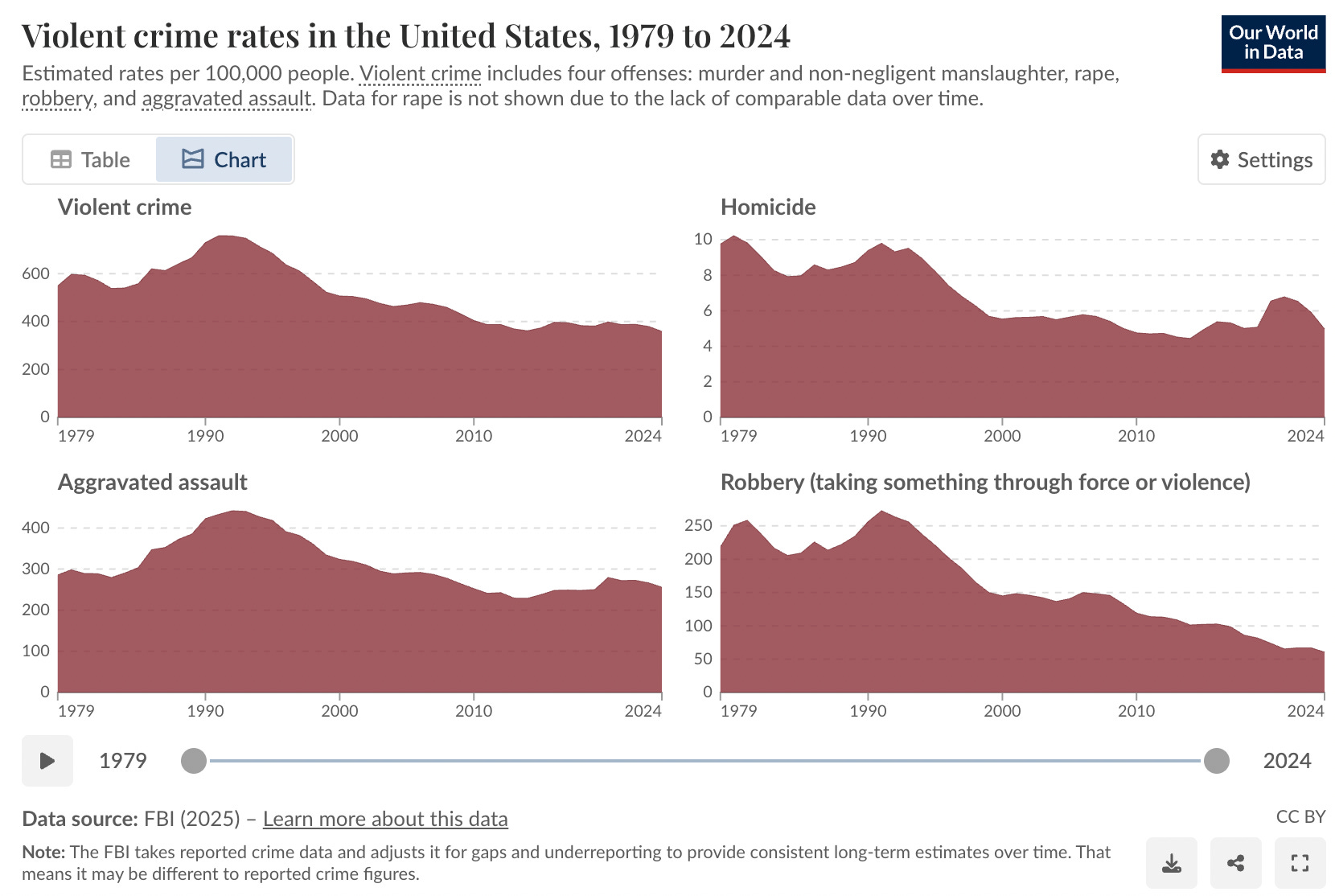
First of all, violent crime rates are significantly lower than they were in the 1990s. Homicides, aggravated assaults, and robberies are all way down. There was a small but important spike in the murder rate in the wake of COVID, but thankfully things are trending back down again.
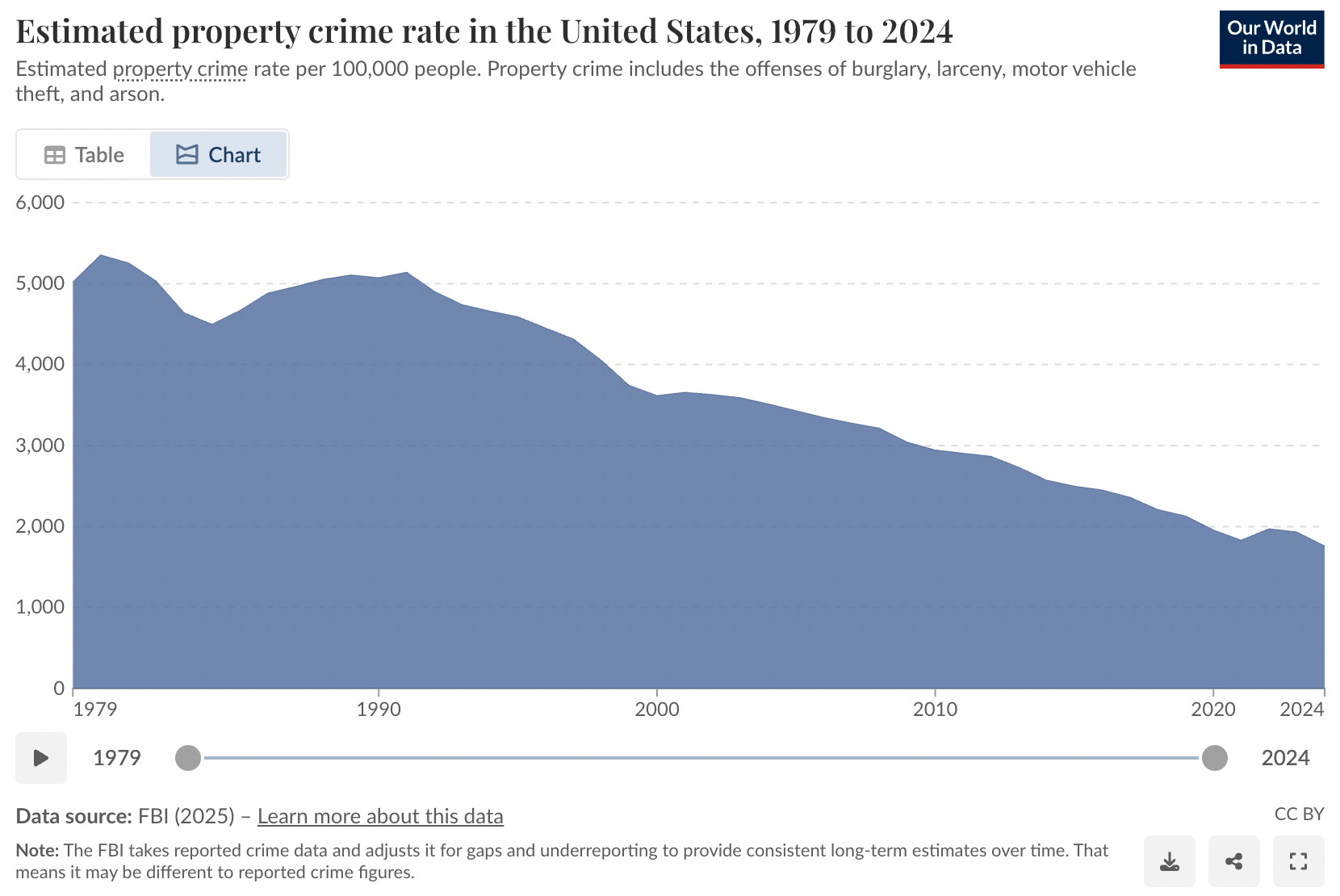
Property crime, including burglary, theft, and arson are down by even larger amounts.
What about kids specifically? The National Crime Victimization Survey from the Department of Justice reports that kids are far less likely to report being victimized. In 1992, about 19% of 12-18 year-olds reported being the victim of a theft or violent crime while at school. By 2019, the last year we have clean data, that figure had fallen to just 3%. Outside of school, the rates have fallen from 17 to 2%. Probably because the conditions in schools have improved, fewer kids report being afraid of attack or harm. That rate fell from 12% in 1994-95 down to 5% in 2018-19.
What about kidnappings, which may be most relevant to Xavier’s case? Across all age groups, the number of missing persons has fallen by about 40 percent over the last 30 years. The data on child kidnappings are less clear, but according to a 2019 Reuters piece, “fewer than 350 people under the age of 21 have been abducted by strangers in the United States per year since 2010.” Those victims tend to be young girls or women living in unstable homes. Now, a few hundred is still a tragedy, but for some perspective there are about 73 million children under the age of 18 living in the United States. Summarizing the FBI data, Reuters estimated that, among all missing children, about 95% are runaways, 4.9% are abductions from another family member, and only 0.1% are the “stereotypical” kidnappings from a stranger.
So, crime is down across a range of types, age groups, and locations. And so are death rates. We made HUGE gains in childhood mortality rates in the first half of the 1900s, but they have fallen by another 40-50% in the last few decades.
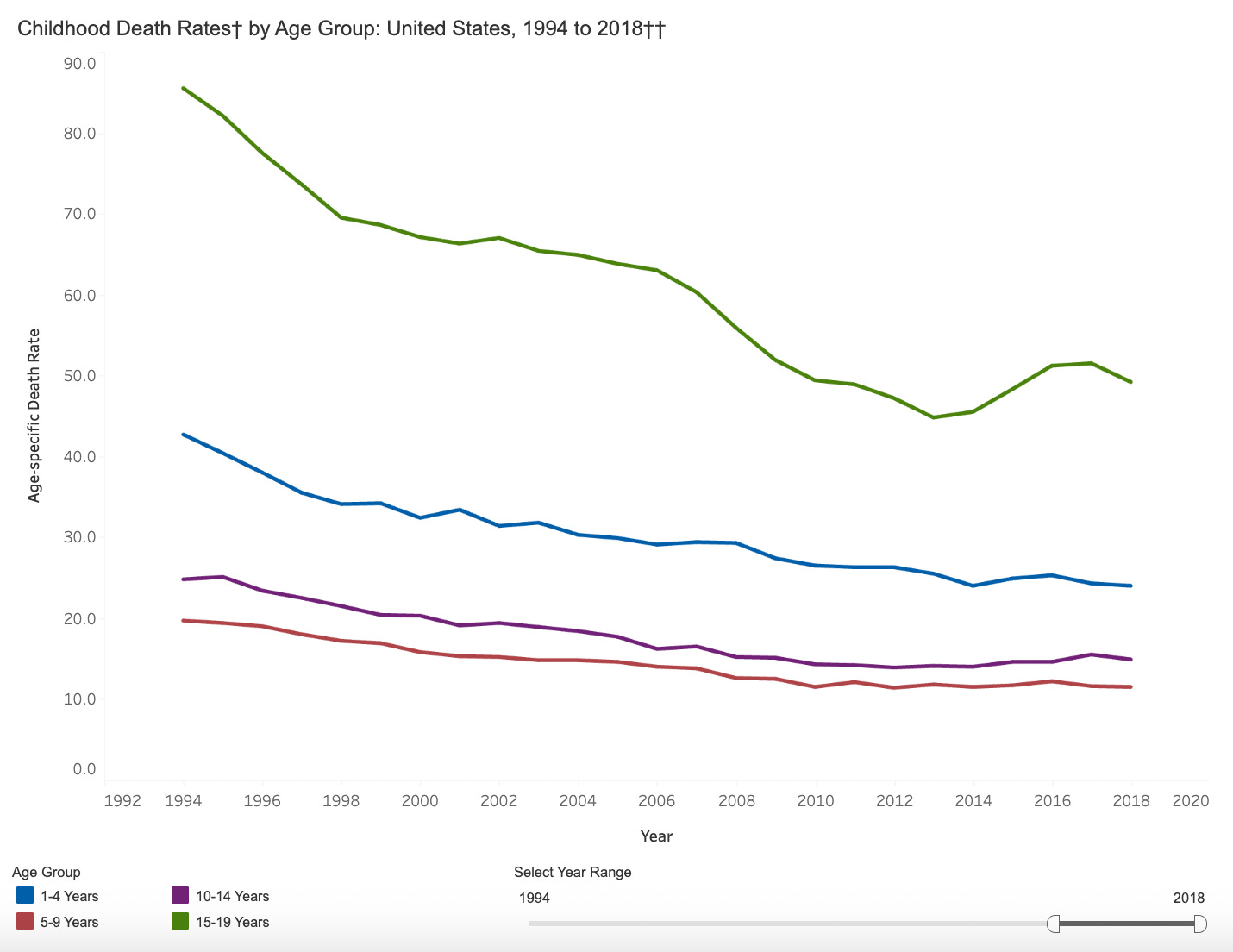
Now, all of these improvements are at least partly because people are taking fewer risks. We wear helmets when we ride bicycles now. We use seatbelts when we ride in cars. States have imposed graduated licenses for new drivers, and teenagers today are less likely to drink or smoke or party. So behavior is a big part of the explanation here. But it’s still the case that the world is objectively much safer today than it was 30 years ago.
So, how did Slate respond?
Hoo boy. They had a very different reaction than I did. They did not correct the record on crime and safety, as I attempted to do above. Instead, here’s how they started their response (italics original):
My friend, I’m glad you wrote in, because, respectfully, your husband isn’t the only one who needs a wake-up call here. It is absolutely unacceptable that you allowed your 6-year-old child out of your sight, out in the world, for two hours. Even 10 minutes gone without explicit permission and knowledge of where exactly you could find him would have been too much! As soon as he was out of your sight, you should have been after him. And if he left without your knowledge, you should have been canvassing the neighborhood as soon as you realized he was gone.
I was genuinely stunned by this response. Not only are they shaming this parent who’s already feeling a little uncertain, they go on to suggest that little Xavier won’t be ready to ride his bike alone until age 11 or 12. Have fun at home Xavier!
They go on to cite the case of a Florida family that, “had their children removed from their custody after a neighbor called CPS because their son was outside playing basketball for an hour-and-a-half waiting for them to come home.” After reading the tone of their piece, I can’t help but assume that Slate is coming down on the side of the nosy neighbor. They’re using it as a warning that parents shouldn’t let their kids ride their bikes alone, or else they might have their kids taken away by the state. That’s crazy!
Frankly, I’ve come to agree strongly with the work of Lenore Skenazy and her Let Children Grow initiative. I believe that children thrive when they’re given the freedom to roam and explore on their own. This, for example, resonates with me:
Somehow our culture has become obsessed with kids’ fragility and lost sight of their innate resilience. This concern grew out of good intentions! But treating kids as fragile is making them so. In fact, kids are “anti-fragile” — built not just to withstand some challenges, but to grow stronger once they do.
All of this is a balance, of course. Like any parent, I worry about something bad happening to my kids. My first instinct is always to protect my children. But when I look back on my own childhood, I am amazed at some of the things my parents let me and my brother do. I bet many people reading this would have their own stories. I look back on those things fondly, and I want to give my own children the sense of independence and accomplishment that I felt.
Kids need to learn how to manage the world on their own. They need to fail sometimes. Not in spectacular or tragic ways, but they do need to understand consequences and cause-and-effect. They need to build resilience and time management skills. And the only way to do those things is to take some risks and responsibility.
Instead, I know a lot of parents who have these mistaken beliefs about the world being a dangerous place. That affects how they view the world, and how they raise their kids. The reality is that the world has become objectively safer, and yet many people seem to be convinced that it’s the opposite.
Reading List
Yours truly: A staffing deja vu
Meredith Coffey: Should states cover the cost of AP exam fees?
Kunjan Narechania: Why states need to create a unified grant application for districts
Setting boundaries and tracking through phones/watches is commonplace, I’m a senior and my son tracks me … we have the technology, why not use it?
As you well know the (social) media environment is optimized for conflict. A dated reference but it’s as if the SNL skit that parodied Point-Counterpoint has become the AP Style Guide. So naturally Slate calls this dad out; it generates more clicks.
Our kids, inspired by parents like Lenore, traveled to and from lots of places on their own starting in 6th grade. Without phones. They even got lost!
But scare-mongers sell banner ads. Sic semper tyranus.