

The rise and fall of teacher turnover
The enduring staffing challenges are the same ones we've had all along

Is there a teacher turnover crisis?
The answer depends on what you mean. Teacher turnover did spike after the pandemic, but the latest data suggest that spike was fairly consistent across states, and it has largely receded.
In a recent piece for Chalkbeat, Matt Barnum took a comprehensive look at the latest trends in teacher turnover. He collected data from 21 states to create graphs like the one below.
The chart shows the percentage point change compared to the pre-pandemic baseline. For example, Arizona’s teacher turnover rate was 4.1 percentage points higher in 2022 compared to 2019.
The main takeaway, in my opinion, is how similar the state trends look. In nearly every state for which we have data, teacher turnover declined slightly in the fall of 2020, as many public schools remained remote and the broader economy was frozen. As the economy reopened, turnover rose for teachers, just as it did across much of the broader labor market. By the fall of 2022, those rates spiked to new modern highs. After that, as the pandemic slowly began to wind down, turnover rates started to fall.
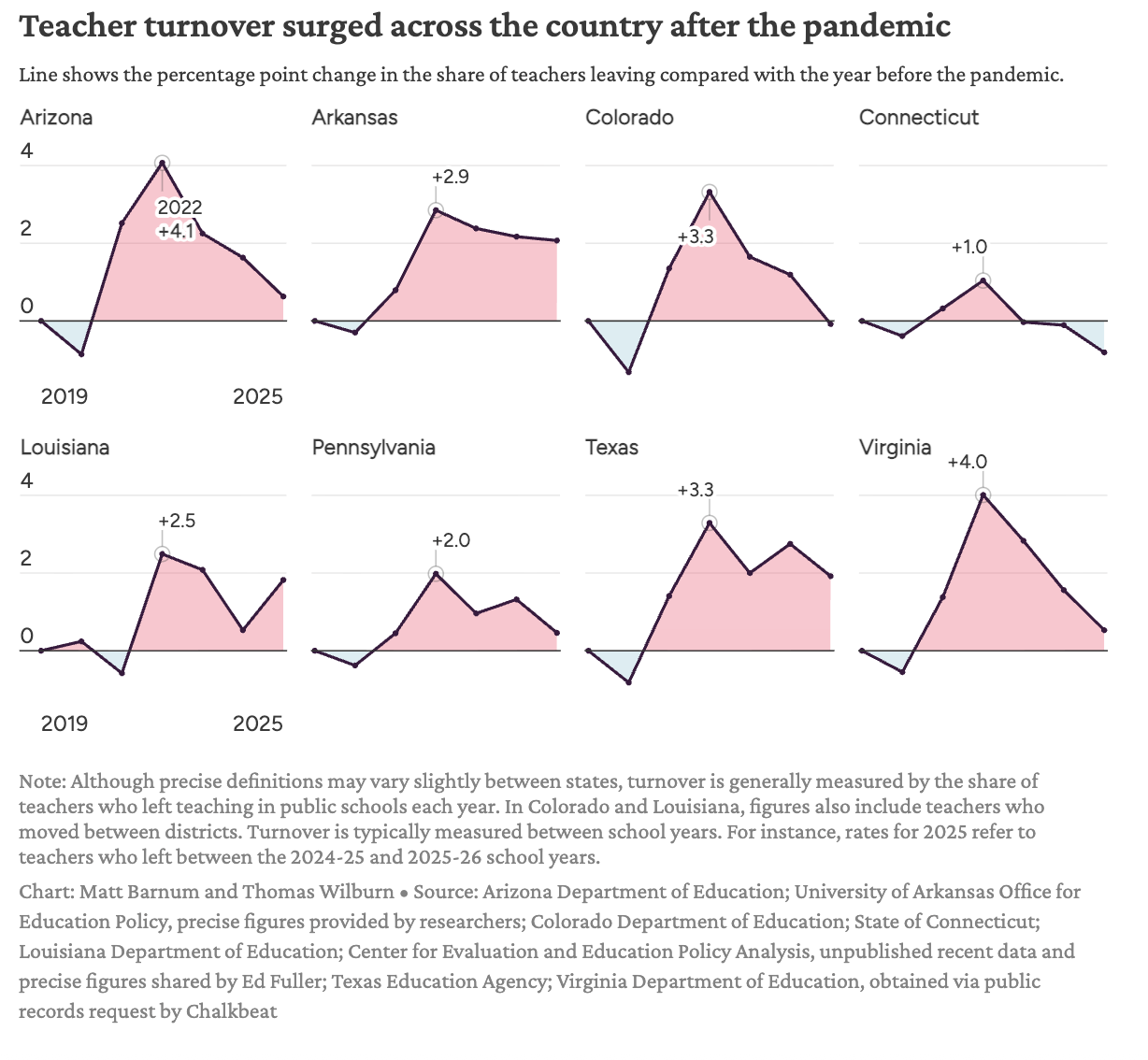
(Barnum’s story includes another graph like this one, albeit with states that had smaller jumps initially, but they all followed the same broad trajectory.)
How concerned should policymakers be about this? I’m not sure. For one, the absolute rates are still not that high. For example, Barnum’s data file shows that Arizona’s rate rose from 13.8 in 2019 up to 17.8 percent in 2022, before falling back to 14.4% last year. As of 2025, the state rates varied from 6.2% in Pennsylvania up to 15.7% in Colorado. These just aren’t that high, and teachers have similar turnover rates as other college-educated professionals.
The recent trajectory is also encouraging. Every state has seen turnover fall from its pandemic-era peak, although the trends look different depending on where you live. Colorado and Connecticut are fully back to normal, while Louisiana’s chart is bouncing around and Arkansas’ rate of improvement has slowed considerably. Policymakers in the latter group of states should be more worried, especially if teacher turnover rates continue to stall at a permanently higher plateau.
The pandemic temporarily pushed turnover higher almost everywhere. But the hardest positions to staff in education are still the same ones they were in 2019: schools serving disadvantaged students and subjects like special education, math, and science. Those problems remain and deserve sustained policy attention.