

The Rise and Fall of Homework

Note: Today’s piece originally appeared at We’reAllSolvers.org.
Before jumping in to new content today, don’t forget to join me at 11am ET this morning to talk about the “Mississippi Marathon” and what other states can learn from it. You can register for the conversation here.

Did your kids have any homework last night?
When asked on a set of longitudinal surveys from the National Center for Education Statistics, slightly more than one-third of all 9- and 13-year-olds reported they had no homework.
There are a few things to note about the long-term trends. One is that the percentage of 9-year-olds reporting they had no homework has followed a U-shaped trajectory. In 1984, 35% of students at that age reported having no homework, but those numbers had fallen in half by 2008. That year, 82% of 9-year-olds reported having some homework, with the vast majority reporting less than one hour of work.
As math expert Tom Loveless has noted, the trends started to reverse in 2008. Since then, the percentage of 9-year-olds saying they had no homework surged from 18 to 34%. The percentage reporting they had more than two hours declined by 1 point (5 to 4%), the percentage with 1-2 hours declined 3 points (12 to 9%), and those with less than an hour of work declined 14 points (60 to 46%). We also hit a new high in terms of kids who said they had homework but didn’t do it (7%, up from 5).
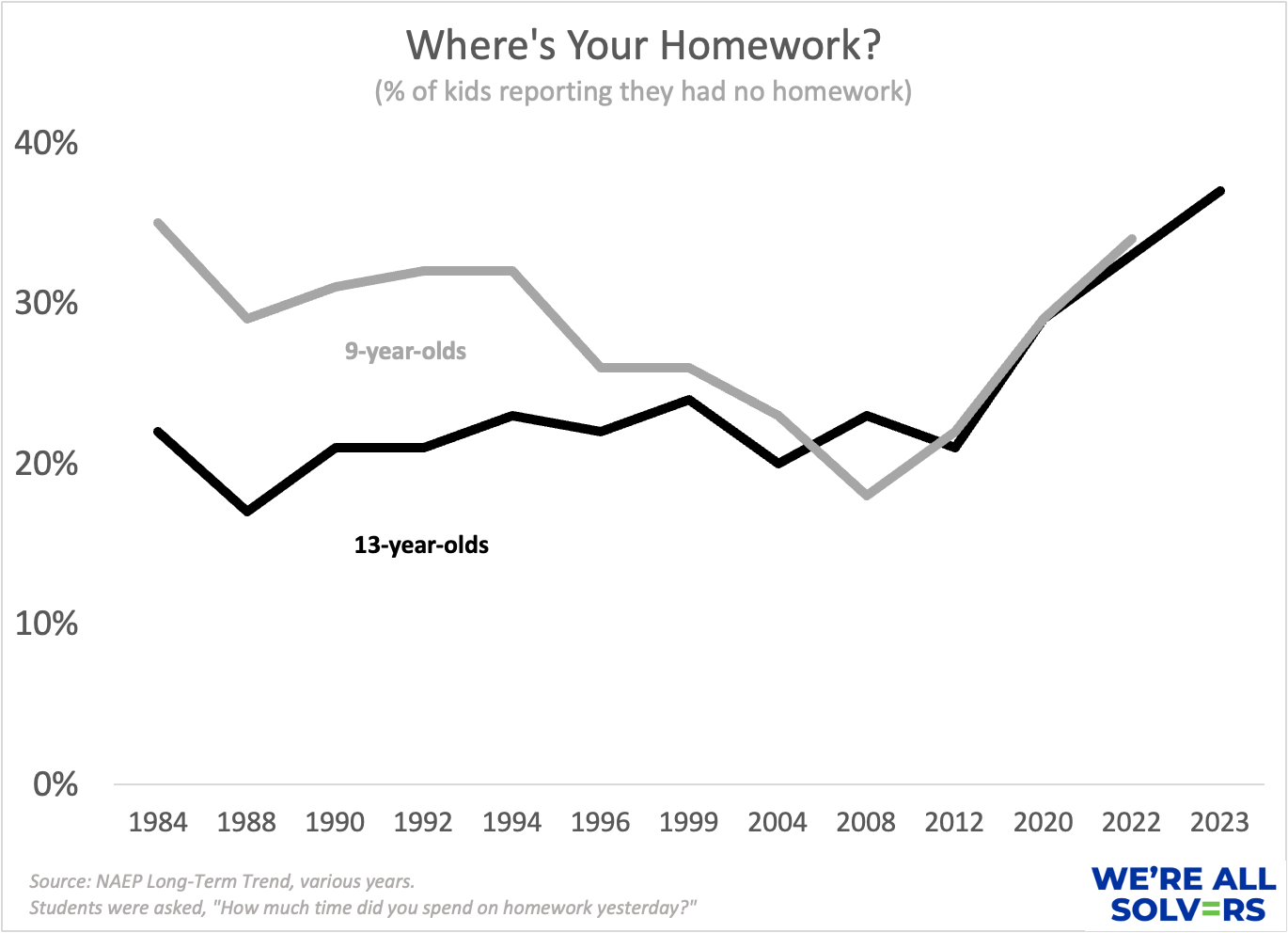
That’s for younger kids. 13-year-olds have not followed the same rollercoaster pattern, but they are also doing less homework today than their older siblings and parents did in the past. As of the latest data, nearly two out of every five 13-year-olds reported having no homework.
What should we make of these trends?
One obvious place to start might be asking why homework levels have changed so dramatically over the last 15-20 years. The data don’t tell us, unfortunately, but my suspicion is that it may be tied to broader cultural trends. States and school districts have cut back on accountability in a number of ways, from weakening graduation standards and easing back on school and district accountability requirements to limiting in-school suspensions and expulsions. Some advocates have argued that homework is inequitable because not all kids have the same at-home supports or responsibilities.
However, it’s hard to ignore the comparison between homework levels and achievement scores. As homework expectations ramped up throughout the 1990s and early 2000s, math achievement scores rose. Those increases were broadly shared across the performance spectrum—low achievers got better and so did higher achieving students.
But as homework demands started to drop off, so did student achievement scores. While fewer students were being given homework, the scores for the lowest achievers fell particularly fast.
Now, it’s possible these trends are merely coincidental. After all, the research on homework is mixed, and it’s not always the case that more is better. But there’s some evidence that a small amount of homework that specifically reinforces what kids are learning in school can produce learning gains. It may also lead to better habit formation and responsibility.
The homework of today doesn’t necessarily need to look like it did in the past. For example, the ASSISTments program is a digital platform that lets teachers assign students math problems to work on at home, and it has built-in supports alongside immediate feedback and grading. Research studies have found it can lead to significant gains.
Students would also benefit from more time on learning platforms like Khan Academy, Zearn, or DuoLingo. If the holy grail to learning is the amount of time students spend engaged, homework represents an opportunity for teachers to ask kids to squeeze in just a bit more practice time.
Reading List
Jorge Elorza and Ben Austin: 4 ways get schools back on track and working for families.
Charlie Barone: “If leaders listened more carefully, they would hear a remarkably consistent request from parents: stop turning schools into symbols and start ensuring they deliver what parents, voters, and taxpayers are clearly asking for.”
Doug Lederman: Why MOOCs didn’t work
The Reading Symphony: How to help your child improve their writing
Matt Barnum: School data goes stale after Trump cuts Education Department research arm