

The Pandemic Changed Attendance Norms
Schools are settling into much higher levels of student absenteeism.

Chronic absenteeism remains stubbornly high, but AEI's Nat Malkus has uncovered an even more troubling pattern. Students who weren't even alive when COVID hit are now missing school at much higher rates than children did before the pandemic. In other words, the pandemic didn't just disrupt one generation of students—it seems to have permanently changed norms around school attendance.
Progress has stalled
As Figure 1 from Malkus’ paper shows, chronic absenteeism rates, the percentage of students who miss 10 percent or more of the school year, nearly doubled from 15% in 2019 to 28% in 2022. Those have come down a bit over time, but the rate of progress has slowed. At the national level, chronic absenteeism rates dropped 2.6 points in 2023, 2.2 points in 2024, and 0.9 points in 2025.
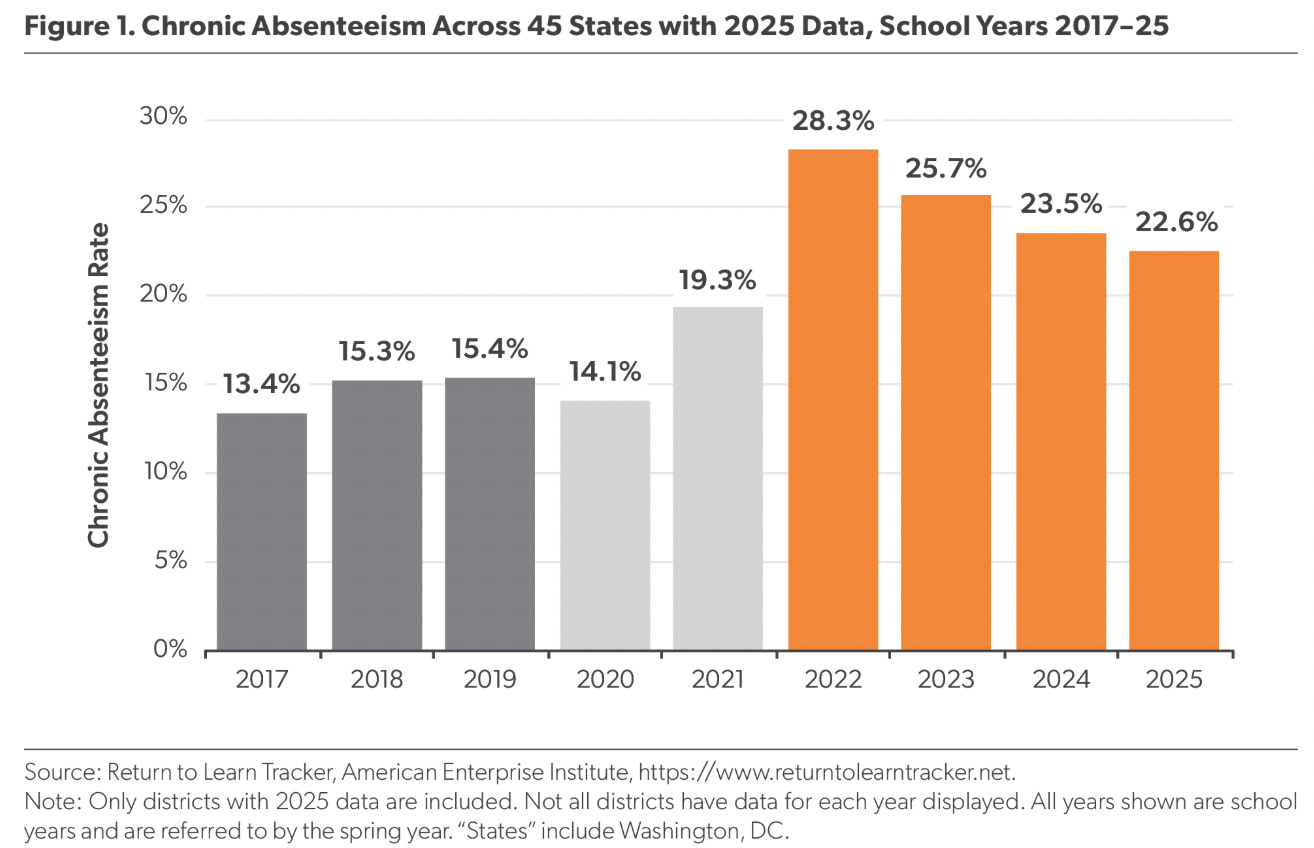
The patterns vary across states and schools, but the overall trajectory is not promising and suggests we may soon hit a plateau that’s much higher than we saw pre-pandemic.
It seems to be a systemic problem
Malkus has been following these data for years, but one new wrinkle with this year’s update is that he looked at how chronic absenteeism rates have changed across grade levels. Not every state reports the data in this way, but he found 13 states that did. It allowed him to investigate whether today's attendance problems are merely about the specific cohort of students who lived through school closures, or if the pandemic changed expectations about school attendance for everyone.
The chart below from the AEI report comes from Table 5 Panel B. It shows how chronic absenteeism rates have changed by grade from the 2019 baseline. Looking across the top row, chronic absenteeism among kindergartners in 2025 was 7.2 percentage points higher than it was for kindergartners in 2019. Those children were babies—or not yet born—during the pandemic. Yet their attendance looks the same as it does for older students. Malkus summarizes this by saying, “Chronic absenteeism is elevated in every grade in every post-pandemic year, and there is no clear differential between students who did and did not experience schooling during the pandemic.”
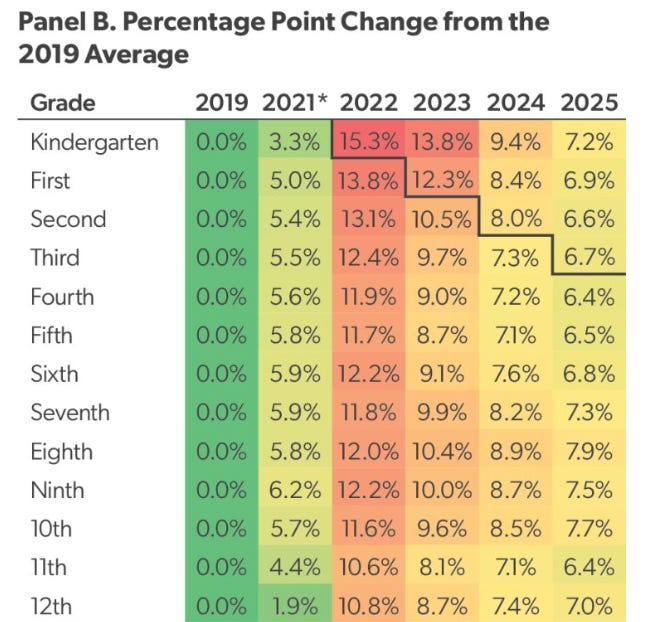
Another way to look at is to follow the stair-step line in the table. For example, first-graders in 2022 had chronic absenteeism rates that were 13.8 points higher than their peers from 2019. As those students moved on to second grades in 2023, their rates improved somewhat and they were now down only 10.5 points. A year later and they were down 7.3 points. In 2025, when these students were in fourth grade, they were 6.4 points behind. These are improvements, but the rate of change has slowed considerably.
In his conclusion, Malkus writes that, “whatever is keeping absenteeism elevated is a property of how American families and schools currently approach school attendance. The pandemic damaged our approach to schooling, not merely a particular generation of students.”
How to shift norms?
There’s a whole lot of blame to go around. Parents, Malkus notes, almost universally acknowledge the importance of going to school on a regular basis. However, parent surveys suggest that they may be wildly out of touch about the depths of the attendance challenge.
Students were more accurate about their own attendance patterns, but about half report missing school for “fun reasons, like going on vacation, skipping school, or traveling for a sport.”
Schools have invested a lot of resources into improving chronic absenteeism rates, and they are understandably leery of being held responsible for something they don’t think is under their control. But a recent news story from Oregon suggests accountability may have a role to play. After Oregon lawmakers eliminated truancy citations statewide in 2021, officials in one small county decided to restore citations as a last resort. That county now has one of the strongest attendance recoveries in the state. District leaders there note that they rarely have to actually issue citations or collect fines. Instead, the threat of legal consequences gives schools leverage to bring families to the table, connect them with services, and develop attendance plans.
The Oregon example is one case study showing how policymakers and school district leaders can prioritize in-person instructional time. Small signals matter here. When adults treat school as something that can be skipped for convenience, students and families notice. Likewise, when school leaders cancel classes, shorten days, or soften the consequences for missing school, they unintentionally reinforce the idea that instructional time isn't that important. But it is. Every missed day is a lost opportunity to learn, and a growing body of research links chronic absenteeism to lower achievement, lower graduation rates, and weaker long-term outcomes.
In other news, I had a fun conversation with Holly Korbey about the “decoding threshold” and what it means for students and for policymakers. Check it out —>

Reading List
Oregon Journalism Project: Oregon’s poorest county now posts the state’s best attendance numbers
Dr. Miah: The Secret to a Bigger Vocabulary
Jean M. Twenge: How to do a tech detox with your teen
AASA: The Budgetary Impact of Healthcare Costs on School Districts
Kevin Mahnken: Why Have AP Scores Soared?
As my mom says: if you’re not there, you can’t learn. Attendance is so important, and I am not at all convinced that for most kids online learning is sufficient.