


Reading makes you smarter. Literally. Even picture books contain words like mischief, glimpsed, or silhouetted — vocabulary children rarely hear in everyday conversation. They also use longer, more complex sentences than typical adult speech. Books expose kids to language that talking alone simply doesn’t.
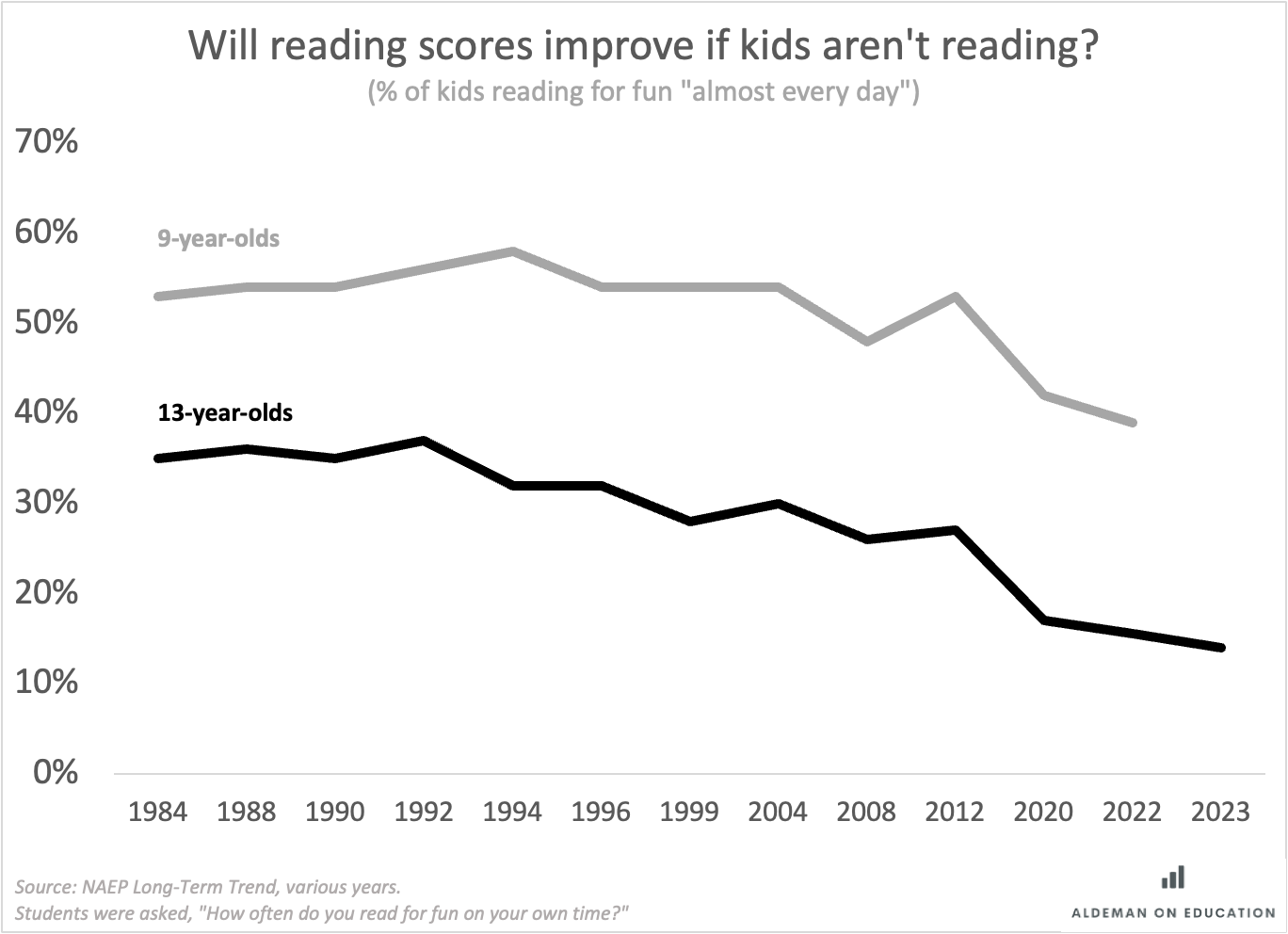
And yet, kids are doing less reading today than they did in the past. Long-term NAEP data show a steady decline in how often kids read for fun. Since the mid-1980s, we’ve been asking kids “How often do you read for fun on your own time?” For 13-year-olds, these numbers fell steadily throughout most of the last few decades, but they took a noticeable dive from 2012 to 2020 and fell again in 2023.
Just 14% of 13-year-olds now say they read “almost every day.”
The numbers for 9-year-olds have always been better, and they remained fairly consistent for a long stretch of time. In 2012, for example, the exact same percentage said they read almost every day (53%) as their peers did in 1984. But those numbers have fallen sharply since then and were down to just 39% in 2022.
What about assigned reading? Those numbers are down too, although not quite as noticeably. Teachers are assigning fewer pages of reading at school, and they’re assigning a lot less homework as well.
A lot of this has to do with broader societal trends. Some, though not all of it, can be blamed on screens and technology.
Schools and parents shouldn’t accept these trends as inevitable. I interviewed a school district recently that expected all of its elementary school students to read for 30 minutes a day at home. Kids had to keep a daily reading log and parents were engaged as partners and asked to sign off on their child’s work. That kind of sustained daily practice is almost certainly part of why they perform so well. I’ll have more to say about that outlier district soon…
In the meantime, if reading volume is falling, we shouldn’t be surprised when achievement follows. The simplest lever we have is also the most obvious: get kids reading more.
Reading List
New research: Virginia had particularly large COVID math declines
LAUSD Board to Vote on 3,200 Layoff Notices Amid Budget Crisis
Bronx charter school set to open 12 hours a day, 7 days a week
Biting, kicking, wandering: Teachers see rise in misbehavior even among the littlest kids
San Francisco teachers can’t afford rent, but at least they get free healthcare
Jorge Elorza: Public education is a goal, not a fixed set of institutions
I also think there are a lot of missed opportunities to read in other classes thru the day. When my sons were in elementary, they read all kinds of books about history, for example, but by the time they got to middle school, they read very little, rarely even an article, in history, it moved to almost all power point slides and video.