

NCLB Wasn't Perfect...
...But it helped drive historic achievement gains

Ross Wiener’s op-ed this week for the NY Times struck me as oddly incurious about why achievement scores rose during the No Child Left Behind era and why scores declined when it ended. On top of that, he layers on some fuzzy notions that maybe achievement doesn't really matter that much anyway.
He starts off by noting that:
New data from Stanford’s Educational Opportunity Project confirms what close observers already knew: America’s test scores are slipping. The pandemic worsened the decline, but the slide began years before. In one-third of school districts, students are reading a full grade level lower than they were in 2015.
The part I bolded sounds really bad! Did anything happen in 2015 that could have led to such large achievement declines?
In his next paragraph he tells us that there was, indeed, a big policy change in 2015 that could have been contributing to these declines:
The new data is emboldening calls to restore something like the No Child Left Behind Act, the stringent, test-based accountability policy that defined American education from 2002 to 2015 and imposed penalties on schools whose students did not meet proficiency requirements on state standardized tests.
But weirdly, Wiener is not arguing that we should restore or improve upon those accountability policies. In fact, he suggests the opposite!
Before going back to Wiener, let me remind you that the No Child Left Behind era coincided with some of the fastest achievement gains we’ve seen for Black, Hispanic, and low-income students, for students with disabilities, and for English Learners. It was by no means the starting point, but it culminated what Education Next authors dubbed “A Half-Century of Student Progress Nationwide.”1
Just to focus on the No Child Left Behind era specifically, take a look at a graph I worked on with Eamonn Fitzmaurice at The 74. I called it “A Tale of Two Eras,” because it compared the achievement gains during the No Child Left Behind era to what came afterwards.
Prior to 2013, achievement scores were rising. Those gains were broadly shared, including for the highest and lowest performing students (in yellow and red, respectively). But now look to the right of the graph. When NCLB was no longer in effect, achievement scores fell, and they fell particularly fast for the lowest performing students (in red).
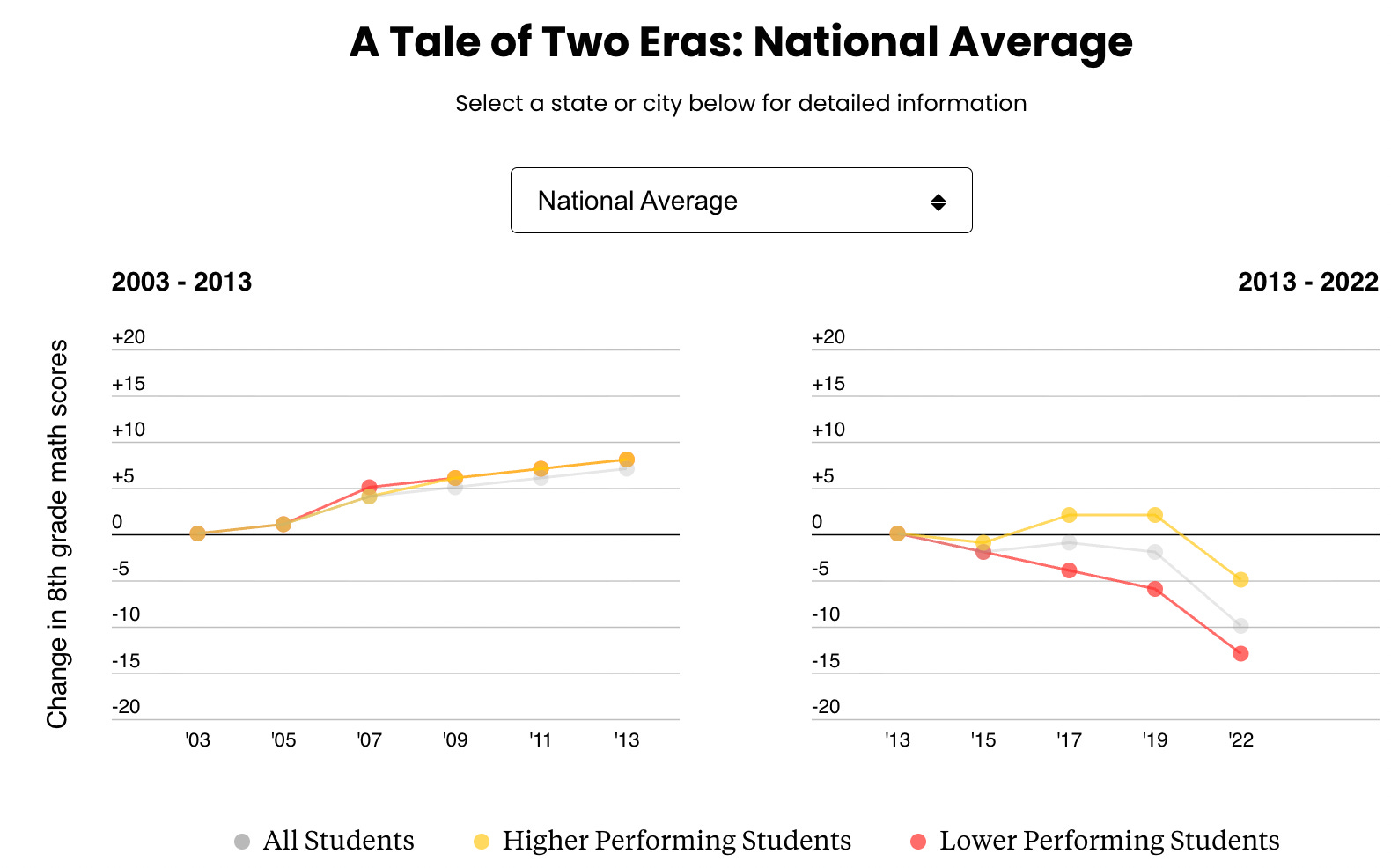
Now, is this just a coincidence? Maybe? There were other things that were going on at the time that could explain some of these trends. In my piece for The 74 I explored some of those other possible explanations, but I argued that school accountability policy could plausibly explain at least some portion of what we’re seeing. Jim Wyckoff and Nat Malkus have done excellent analyses along similar lines.
But do test scores even matter?
Wiener seems to have made a hard pivot. He used to believe that objective, standardized measures of achievement mattered, and now he doesn’t. He now seems to believe that the act of trying to boost reading and math scores was in fact harmful:
Over time, I became convinced that, with the best of intentions, I and many others in the education reform community had transferred our moral commitment to children over to the standardized tests. We had done this earnestly, not cynically, but we still did damage.
His column barely grapples with why policymakers felt the need to create accountability systems in the first place. Before NCLB, many states simply did not know—or did not publicly acknowledge—how poorly some groups of students were performing. Without objective, comparable data, schools can tell comforting stories indefinitely. This is what we’re seeing now with the rise of grade inflation and high school graduation rates. More students are earning higher grades and graduating from high school, but objective measures suggest they are learning less than previous generations. When they go out in the real world, that lack of knowledge will affect their ability to do their jobs, whatever those might be.
And this is where Wiener’s essay really breaks down. Per Michael J. Petrilli’s point, Wiener implies there’s a choice between reading and math achievement on one hand, and richer educational experiences with “meaning and purpose” on the other. But there’s no inherent tradeoff. A school can (and should):
teach kids to read and do math fluently,
build strong character,
offer meaningful projects,
foster civic engagement, and
create a welcoming environment so kids want to come to school.
These things are not in tension. In fact, solid fundamental skills in literacy and math are often what makes many of the other goals possible. Students who struggle with the basics are less able to participate in project-based learning, civic engagement, career preparation, and almost every other educational aspiration.
The real lesson of NCLB
The lesson of NCLB is not that accountability was a mistake; it’s that accountability systems need to evolve over time. NCLB got important things wrong, from its fixation on proficiency rates to its unrealistic expectation that all students would reach proficiency on the same timetable. It also encouraged schools to focus too heavily on tested subjects at the expense of other important goals.
But we should also be humble about how much progress any policy can deliver. The NCLB era produced some of the fastest achievement gains on record, particularly for historically underserved students, and yet those gains were still not enough to close longstanding gaps.
Reading List
Alex Zimmerman: Lots of buzzwords, little clarity: NY unveils new graduation requirements
Wayne D’Orio: Iowa Declared War on Chronic Absenteeism. Now It’s Gaining Some Ground
Linda Jacobson: This Summer Program Boosts Learning for Tens of Thousands of Kids
Shakeel and Peterson: A Half Century of Student Progress Nationwide
My favorite part of Wiener's argument is his non-sequitur blaming schools and standardized testing for how "sad and hopeless" Gen Z is. But doesn't mention phones. At all. L-O-freaking-L.
I'm just not convinced that we have really strong causal evidence here. Test scores were improving before NCLB. We could argue NCLB accelerated those gains, but the effect is pretty small. Test scores post-2015 dropped across almost the entire developed world. We can't pin that on NCLB. (And I'm still looking for a comparative study looking at the declines between different countries in a rigorous way.)
I think the best we can say causally is that NCLB caused small improvements, in particular in some areas of the k-12 system, but at a large cost. We still have some elements of that system and we have no evidence that bringing back others would cause improvement. I'm not convinced that bringing back NCLB will be net-positive because we could focus that same energy on other reforms. I also find this whole train of thought backward-looking and I'd rather we look in new directions. Two examples:
We didn't have the science of reading movement 20 years ago. It's not like 2010 was a high water mark for phonics. But I think the science of reading has huge potential to improve education outcomes.
We didn't have strong math curriculum 20 years ago. Then it was bland, poorly-designed textbooks. Now it's progressive inquiry mumbo-jumbo. Neither are very effective tools. We could choose to fund and put energy behind a new generation of practice-focused, standards-aligned math curricula with an emphasis on fact fluency, breaking concepts down into small steps, and retrieval practice.
That's just two examples, we could debate the best use of energy and resources, but broadly speaking my argument is that maybe the answer isn't to look toward what we did in the past but to look at what we haven't tried yet that has strong evidence and give that a shot.