

It's the Threat That Counts?
How 3rd grade reading laws change adult behavior—and improve student outcomes.

Back in May, I wrote a piece for The 74 explaining why I supported 3rd grade reading retention policies. I cited results from Michigan showing positive effects even in districts that didn’t hold a single student back, and in Florida where the younger siblings of a student who had been flagged for retention also showed gains. If the actual act of retention was the trick, these results should be impossible.
Instead, retention policies put adults on notice that a specific child needs help learning to read, and that causes the adults in that child’s life to act differently. A teacher might give the child more attention or specific practice, a principal might find a spot for extra tutoring or summer school, and a parent might start to get more involved or take other steps to support their child.
There are two key points here. One is that the state has to issue a credible threat that a child will be held back if they fail to meet a clear and objective standard. And two is that there must be time to give that child the extra support they need to meet it.

A new working paper from Sarah Souders and Robert Bifulco adds more support for the value of the threat. They find that Ohio’s third grade reading retention policy improved reading and math outcomes for students who were flagged as being at risk of being retained, and those academic gains lasted through at least 7th grade. Again, most of the students who benefited were never actually retained.
Souders and Bifulco wanted to understand what happened after students received their first notification. For example, they cite a news article from the first year of Tennessee’s version of the law, when nearly 60% of students were flagged for retention but only 1.2% were ultimately retained.
Could that initial flag change adult behavior in ways that benefitted students?
Souders and Bifulco studied this question in Ohio, where they found that roughly one-third of students were identified as at-risk of retention based on fall assessments, about 15% scored below the threshold on the spring assessment, and approximately 3% were ultimately retained after re-takes or exemptions. This retention rate remained stable over time (until the state removed the mandate in 2023). Specifically, the study compared students just below the retention threshold in the fall, who potentially faced the risk of being retained, with those who scored just above the threshold, who faced no such risk.
Figure 3 from their paper (copied below) shows that students just below the threshold who faced the retention threat in Grade 3 achieved higher ELA scores than students just above the threshold who did not face the retention threat. But not only that. They scored higher in grade 4, grade 5, grade 6, and grade 7. (The scores for 8th grade were also higher, but those results were not statistically significant.) Souders and Bifulco conclude that, “the persistence of positive effects through Grade 7 suggests that retention threat influenced more than short-run test-taking effort alone.”
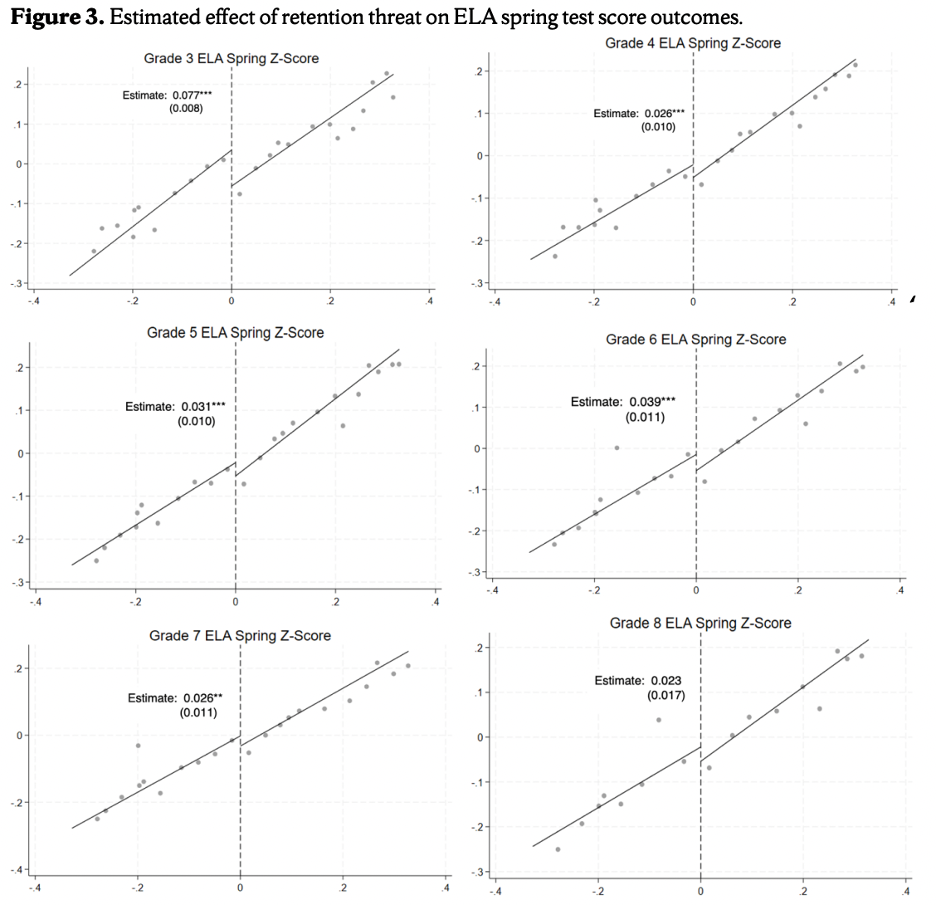
Although not pictured here, they also found gains in math in grades 3-6. If the policy simply caused kids to cram harder for a reading test, we might expect reading effects. But the gains in math suggest that something broader was happening.
In fact, the authors find that adult behaviors changed in response. Students who were flagged as being at risk of being retained in the fall of their third grade year were more likely to receive targeted literacy instruction, participate in small group or one-to-one tutoring, and to receive special help on vocabulary, fluency, comprehension, or sight-word reading.
Students who received the threat of being retained also had slightly better school attendance. Since these are third graders we’re talking about, that implies that parents whose children were at risk of being retained may have made an extra effort to get their children to school.
Because Ohio state policymakers placed an extra emphasis on literacy efforts during the study time period, the authors were also able to see if additional accountability pressures and financial incentives tied to third grade literacy rates boosted student reading outcomes. In fact, the threat effect was more pronounced in places facing the strongest accountability pressures and after the accountability policies took effect.
This is an important distinction in how we judge retention policies. The main point is to identify struggling readers early, make the consequences of continued failure credible, and give schools and families enough time and support to respond. If the adults respond, and children learn to read well enough to avoid retention, the threat has done its job.
Do. Not. Wait.

This post will be a little different from my normal programming. I sent it out to ReadNotGuess parents but wanted to share it here as well…
The Ohio results also suggest that the threat works best when adults face consequences of their own. The student retention rule was more effective when schools faced stronger accountability pressure for third grade literacy. In other words, the policy did not merely put a third grader on notice. It put the adults responsible for that third grader on notice too.
Reading List
Kogan: Why Ohio’s third-grade retention law worked (until lawmakers killed it)
Cerf: Accountability in contracts tells providers they will be judged by how much children learn
Third Way: The New Normal in K-12 Education
NBER: The Long-Run Impact of a Universal Child Care Program on Maternal Work and Income
zero2eight: More Dads Are Taking Paid Paternity Leave
I’m on deck to moderate a SXSWEDU panel exploring what changes when education investments are tied to student outcomes instead of inputs, with panelists including @Jacqueline Kronk Chief Strategy Officer of Indiana’s DOE, @Christina Grant, Exec Director of the Center for Education Policy Research at Harvard, and @Karl Rectanus, CEO of Really Great Reading. Vote for us here!