

Is Technology to Blame for Achievement Declines?
Yes! No! Maybe somewhat?!

I recently heard from a friend who was upset that her kindergartner came home from school talking about some silly video they had watched on YouTube. Apparently the teacher let the kids watch videos after they came in from recess as a way to calm down and regroup. This family has fairly strict limits on screen time, so it was particularly galling to them that the school would use technology in this fluffy, non-educational way.
Schools are starting to get more pushback like this—the WSJ had a story recently about YouTube specifically—and policymakers in some states and districts are responding with age-based restrictions on screens and technology.
But I find the technology debate terribly imprecise. Some random YouTube videos are less educational than Mark Rober’s science explanations. Scrolling TikTok or playing Minecraft are less educational than doing Khan Academy math lessons.
In other words, the problem isn’t “screens” in the abstract—it’s what’s on them, how they’re used, and for how long. These distinctions are important for parents evaluating what’s going on in their kids’ schools, for teachers to be thoughtful about what’s happening in their classrooms, and for policymakers to think about how to craft rules carefully.
Some people would love to have a single bogeyman they can point to for why American student achievements scores have fallen over the last 10-15 years. And “technology” seems to fit the bill. The timing roughly lines up, and there is an obvious logical case to be made about the harms of technology.
But it’s a complicated story, and there are important exceptions. So I’m going to try to make the “it’s the screens, stupid” argument in order to arrive at a more nuanced understanding.
Duh. It’s the screens, stupid.
Like the mom worried about her son’s mindless YouTube consumption, we can all understand why screens are harmful. Whatever your particular technological drug of choice, you’ve probably experienced the feeling of losing track of time. In part we’ve done this to ourselves by becoming heavy users of email and text chats and consuming digital rather than physical entertainment.
The tech companies have played a role here too. They’ve engineered their algorithms to suck us in and keep us on their sites/ in their apps. The longer we’re “engaged” on their platforms, the more ads they can sell.
Schools have played a role here, too, as they bought Chromebooks and iPads and stopped buying physical textbooks and novels.
All of this is bad for our attention spans. And it’s no coincidence that as people have spent more time on digital devices and less time with books, reading scores have gone down (even for adults). Indeed, Jared Cooney Horvath has lined up the timing of the widescale adoption of technology in schools and noted that it’s relatively close to when reading and math scores started to declines.

However, I don’t think we should be satisfied with fuzzy correlations like this. In fact, if you look closely at Dr. Cooney Horvath’s graphs, you can see that achievement scores had already started to plateau before what he calls the “digital inflection” point. It’s hard to blame technology for a trend that started beforehand.
It’s Not (Just) the Screens
There are real problems with the simple “it’s the technology” explanation for America’s achievement declines. Just to pick a convenient example from the top of the alphabet, consider Alabama. Cooney Horvath codes 2018 as the year that Alabama passed its “digital inflection” point, “corresponding to the first operational period in which statewide accountability assessments were administered through fully computer-based platforms as the default testing mode.”
And yet, look at Alabama’s 4th grade math scores on the National Assessment of Educational Progress (NAEP). Its scores dipped slightly from 2017 to 2019, but they stabilized and then rose from 2022 to 2024. If technology were the main driver, we’d expect consistent declines after adoption.
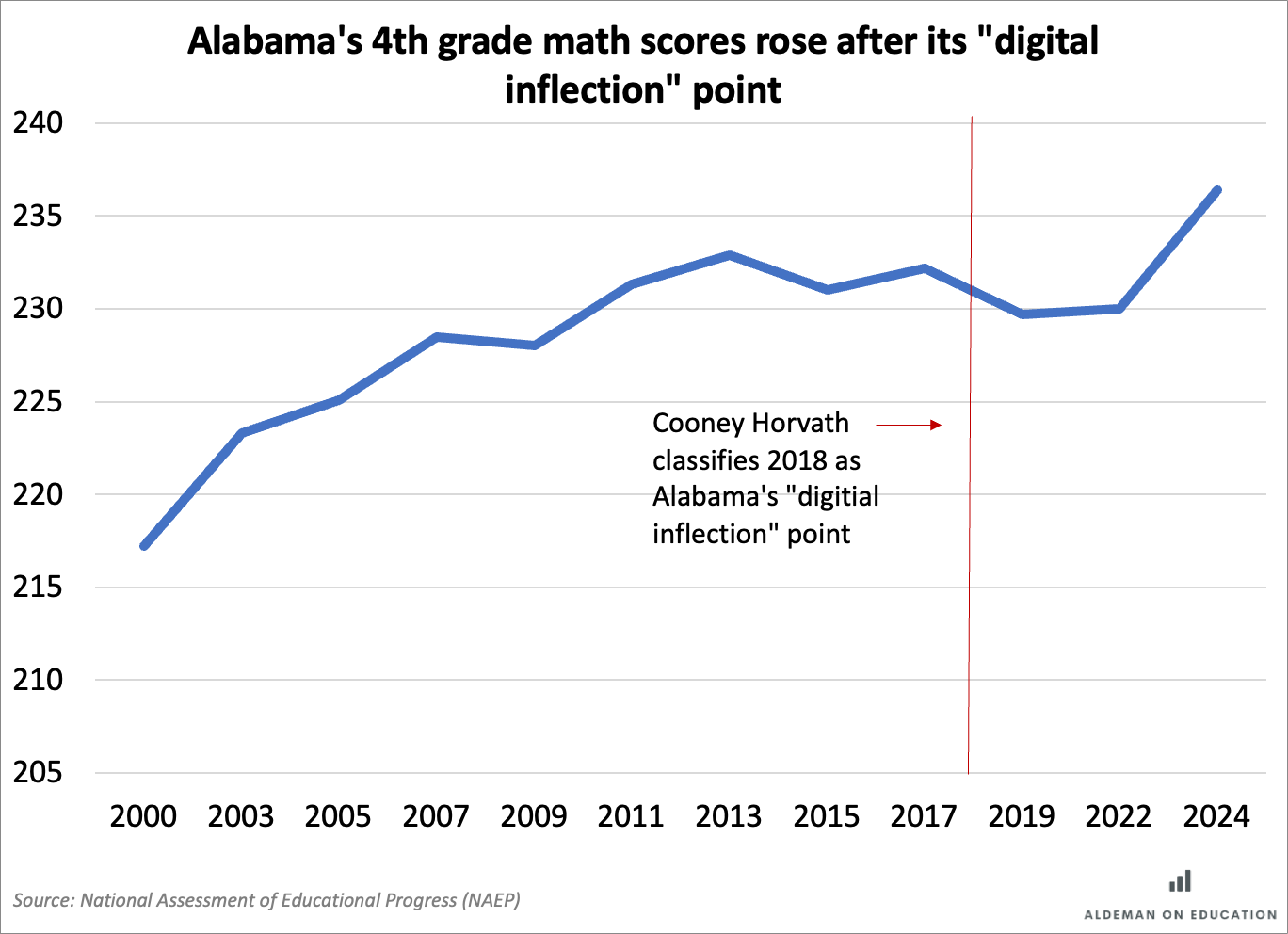
You might accuse me of cherrypicking here. But it’s easy to find other counter-examples. Mississippi has bucked the national trends, as have the Department of Defense (DoDEA) schools. Internationally, England’s math scores have risen while the U.S. scores fell.
The harms of technology also don’t seem to be playing out for all students equally. For example, why have higher-performing students mostly been immune to the national trends? I suppose I could weave a compelling story that high-performing students are also the best at avoiding digital distractions—and in fact are the most likely to benefit from digital tools—but that’s not how it’s been sold by the media.
Don’t overthink it
Ultimately, the explanations behind America’s achievement declines are complicated and multi-faceted, and there’s no one right answer. Screens and technology may be part of that story, but they can’t explain everything that’s going on. Rather than going all-in on tech or fully back to the paper era, we should evaluate each use case and ask a simple question: is this helping students learn, or not?
Reading List
Lindsay Dworkin: How technology is used matters more than how much it is used
Jessica Baghian: Don’t Ban EdTech. Do This Instead.
Dana Goldstein: Mixed results on school cell phone bans
Another problem with Jared Cooney Horvath's argument is that he claims everything was just fine with our education system until technology arrived and "broke" it. That overlooks some more fundamental problems with curriculum and instruction that have been around for a long time--as well as the longstanding test-score gap between high- and low-SES students, which was widening even before the boom in ed tech (although ed tech may have made contributed to making it worse).
I wrote about this at greater length in my own Substack post on this topic (https://nataliewexler.substack.com/p/has-technology-broken-an-education).
I definitely think is important that we break down the screens/tech issue further rather than having it be all or nothing. From my perspective as a parent the issue isn’t just around literacy or academic achievement levels but about the daily experience for kids when they are using a lot of screens.
Showing one YouTube video after recess might be innocuous, but always using a video to calm down makes it hard for kids to develop the emotional skills to do that on their own. Those of us who went to school in the early 2000s used computers and technology but it was once a week rather than hours each day. It supplemented rather than replaced peer interaction, reading books, or doing physical activities.
It seems hard for parents to know what the situation will be in their individual child’s classroom and then if they do realize their child is losing social, emotional, and physical skills there is little they can do about it at that point. And I know many teachers also agree but are pushed to use Ed tech or do not have the bandwidth/resources to implement other activities.