

Goldilocks and the ed tech problem
Is your school high-tech, no-tech, or stuck in the middle?

I have a new piece out at The 74 looking at the Alpha School, an AI-fueled school that boasts they can help students achieve dramatic learning gains in only two hours per day. If you find those claims hard to believe, I hope you’ll read my full piece.
Alpha is an example of a super high-tech school. It doesn’t really even have “teachers.” Instead, it employs “guides” whose job is to keep kids motivated and on track to complete their digital lessons each day. All of the academic instruction is delivered virtually through apps and other digital programs.
I personally find the Alpha model appealing. I wish I had the chance to attend a school like it when I was a kid, and I would willingly send my own kids there.
But some people (including my wife!) find all this technology… distasteful. Rather than leaning into technology, they’d prefer to lean out in favor of reading print books and having Socratic seminars with real human teachers. Their preferred model would look more like art classes and nature walks and Montessori preschools with wooden blocks.
I find both of these extremes compelling. But I suspect most public schools are somewhere in the vast middle.
Let me give you an example. As part of a research project this week, I was searching for a school online. I wanted to start with the school’s homepage and learn more about it. Instead, I happened to land on their ed tech page for student and parent accounts. It looked like a smorgasbord of reading games and assorted digital apps:
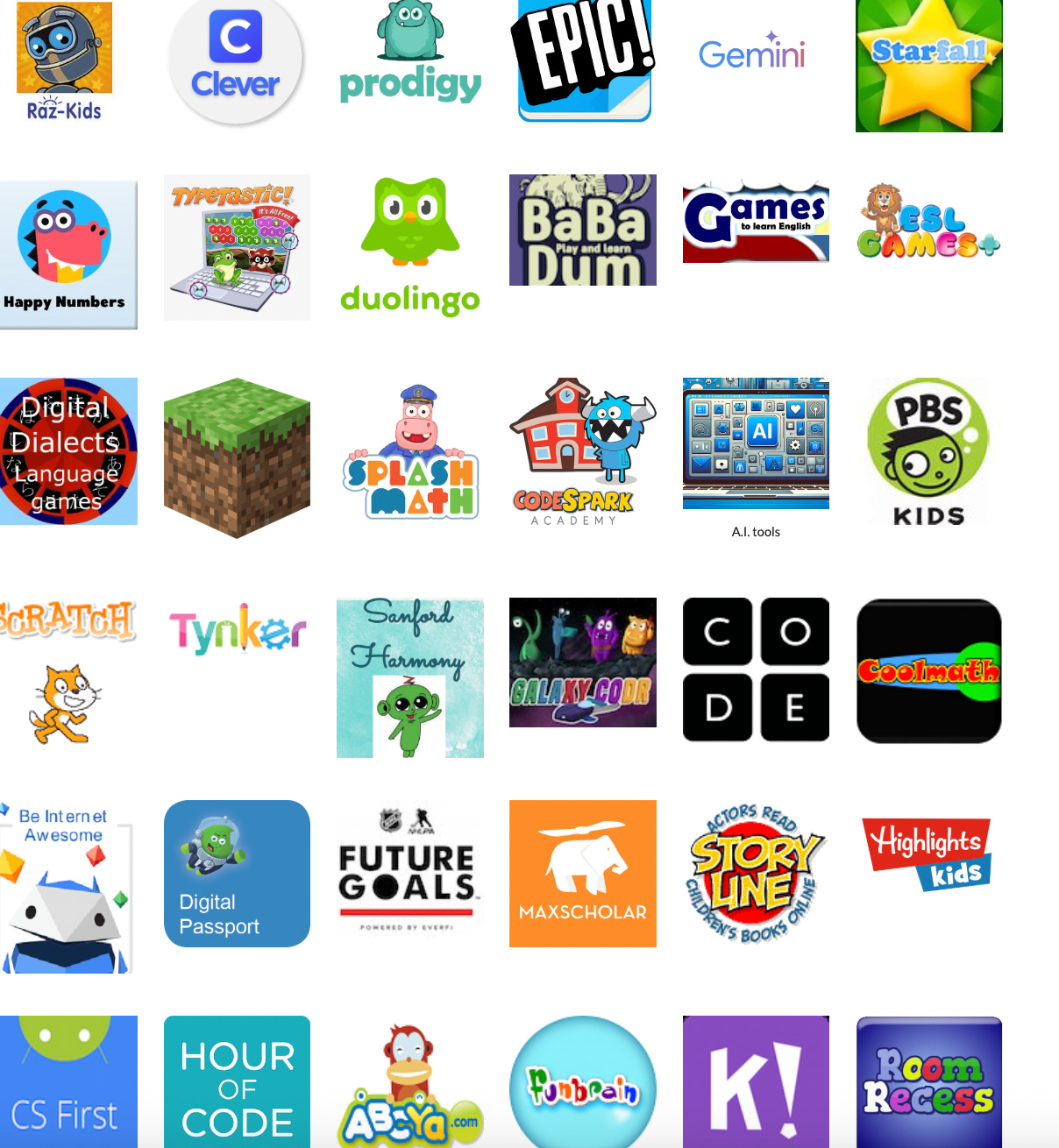
You could look at this picture, count the number of programs listed, and notice there are 36 individual programs listed. Is that a lot? It certainly might be for a parent who doesn’t know what they’re looking for. If their child is struggling with reading, would they know which of the various reading-related apps would be the best fit?
On the other hand, 36 digital tools is not even particularly high for one school. One tech survey last year found that the average student accessed 48 different digital tools over the course of a school year. The average teacher used 50(!). I can’t vouch for the quality of the survey, but that’s… a lot… of accounts and data to manage.
But this is where I think most schools and districts are right now. They have a wide variety of technological tools and apps and programs that they’re using, but are they integrated? Do the apps and programs speak to each other? Is the reading intervention program aligned with the core reading program? Are the math tutors following the same sequence as what kids are learning during their regular math class? Are school and district leaders being intentional about which program they’re using for which purpose? Is anyone actually using most of the programs, for the suggested dosage amount?
These alignment and integration questions matter, but my sense is these things are mostly not happening. And in the meantime, individual teachers, students, and parents are being left to navigate their way through the technology thicket.
So rather than being pro- or anti-technology, I think the right stance is to look at how any particular tool is being used and integrated. If technology is incorporated systematically and thoughtfully, it can enhance student learning and make teachers’ lives easier. If not, well, then, it may just lead to confusion and fragmentation.
Read my full piece on how Alpha School incorporates technology into its model.
Reading List
Andrew Rotherham’s In and Out List
Alex Tabarrok on The Tyranny of Complainers
Linda Jacobson: As School Choice Tax Credit Goes National, the Battle over Regulation Begins
Jon Valant wants states to play a role in regulating tax credit scholarship granting organizations
Tom Allon: It’s time for abundance in [New York City] specialized high schools
Indiana’s Summer Learning Labs appear to be producing student learning gains
Chicago’s investments in community schools have not yet, “led to widespread improvement in how likely students are to attend school regularly, graduate from high school, or pass key reading and math tests.”
Please write more about why you would like to send your kids to Alpha!
I've read all of the "big pieces" and listened to some of the podcasts, but I can't wrap my head around how/when Alpha students are doing the deep thinking and elaborative work that Natalie Wexler wrote about recently. Are the students reading novels? Who are they discussing them with? As far as I can tell (and I may be off-base here), for ELA, they spend a lot of time reading short passages on a screen and answering comprehension questions about them in order to prepare for MAP or SAT testing.
Not sure you'd willingly send your kids there, Chad, since I know you a little bit.
Look more deeply at the model and how it plays out.
One of the challenges I saw when I went to visit was that the goals of the system are future ready skills but the measures continue to be very traditional standards velocity and standardized test achievement--kids sign a contract about the SAT score) not a lot of 'how might i solve a problem collaboratively'.
Another challenge I saw was the hyper individualism (value was how much money could be made and which elite institution you could get into-- And while one might see those as typical liberal goals, I am thinking pure capitalism. Fuel for the innovation engine is collaboration.
There are some interesting things to look at and learn from at There are other models worth a look. Happy to chat!