

Doing the Improbable in Reading
Worcester County leads Maryland in 3rd grade proficiency — for low-income students, students with disabilities, and everyone else.

I have a new piece out at The 74 this week about a Maryland school district “doing the improbable” in teaching kids to read.
Despite a poverty rate that falls somewhere in the middle of the pack, Worcester County leads the state in 3rd grade reading proficiency. It also leads the state in reading scores for low-income students and for students with disabilities, and for non-low-income students and students without disabilities.
In other words, it’s doing a great job serving all of its students.
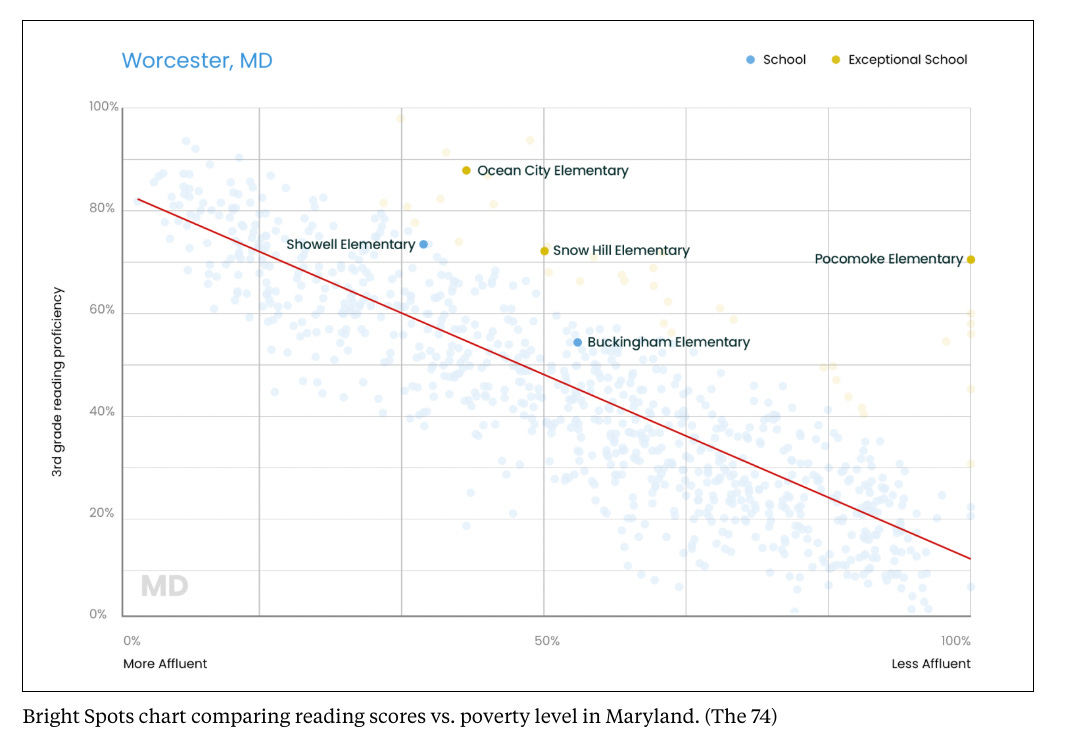
So what is Worcester County doing differently? Their secret sauce seems to be a combination of determined leadership, a focus on high-quality core instruction for each and every kid, and strong partnerships with parents.
As I write in the piece:
…they are religious about giving kids lots of time to practice.…During the school day, kids are typically reading physical books that help them build phonics skills or engage in sustained independent reading. Students are expected to complete two 15-minute blocks of reading at school — and then read for 30 additional minutes per day at home. This regimen may vary based on the child’s age and skill level, but kids have to log what they read and then have their teacher or parent sign off.
Families, in fact, are the third key component of Worcester’s reading plan. At the beginning of the school year, they’re asked to sign a “home coach contract” saying that they will check and monitor their child’s reading. Throughout the year, kids are expected to read for half an hour at home five days a week. Over the course of a 180-day school year, that could add up to 900 extra minutes of practice.
Check out the full piece for more on what we can learn from Worcester County.
Reading List
Carrie Hahnel and Alex Spurrier: An Abundance Agenda for K-12 Education
XQ report: 10 policy actions states can take to bolster high school innovation
Nicholas Bagley and Robert Gordon: Blue-state governors and mayors need to get serious about delivering excellent public services
Stanley Litow: P-TECH gives low-income students a path to a diploma, an associate degree and good-paying jobs.
Kate Rix: High-impact tutoring is producing large reading gains in San Francisco
Resonates with the Sold a Story episode on Steubenville’s outlier results.
Thank you for highlighting excellence!
Worchester probably has a daily attendance of 95% or higher, Poverty Risk Indices track closely with attendance and achievement, Raj Chetty’s recent work re how housing patterns impact school outcomes is enlightening