

Where do teachers come from?
Plus assorted links on AI and content knowledge, math gaps, graduate loans, and more

There’s a graph that startled me when I first saw it, and it may change how you think about the teacher labor market.
Before I show you the graph, take a moment to envision where you think new teachers come from. Are they 22-year-olds coming directly from a teacher preparation program at a college or university?
And take a moment to think about the number of newly licensed teachers versus the number of new teacher hires. Which one would you expect to be higher?
You might assume that these lines would run pretty much in tandem. Or maybe you might think that the state’s teacher preparation programs are preparing a few more teachers each year than eventually get hired. That is, not every teacher preparation candidate can end up with a teaching job in-state.
Now look at the chart below, from the Texas Education Agency. It compares the number of newly certified teachers in Texas (in blue) versus the number of new teachers hired by public schools (in gray).
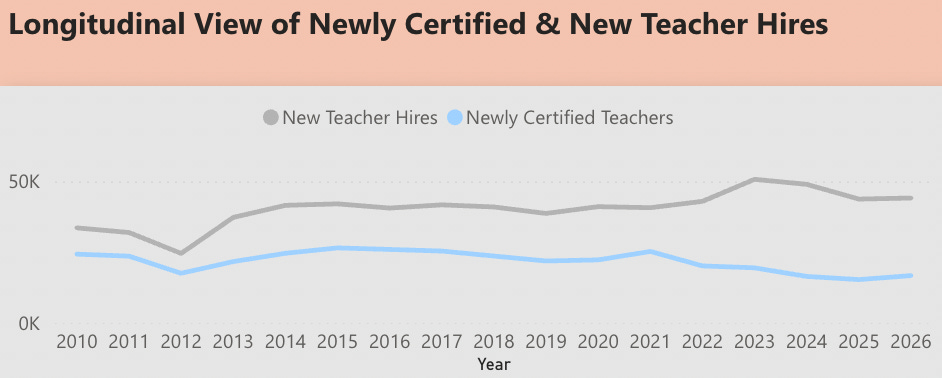
Not only are there more new teacher hires, the numbers aren’t particularly close! In fact, the gap has been widening more over time.
Who are these people? Is this just unique to Texas? Yes and no.
The next chart comes from the same state dashboard. As you can see, the largest source of new hires are actually re-enterers. These are people who taught for a while, took some time off, and then came back into the profession. Having a large number of re-entrants is not unique to Texas and is often a large source of teachers for schools all across the country.
But the second biggest source of new hires was unique to Texas. These are people with “No Texas Certification/Permit.” This source of 12,000 teachers is unique to Texas, which, for a few years, allowed schools to hire teachers without any prior certification. The state has recently pulled this back due to research suggesting these teachers weren’t as effective in the classroom and tended to have higher turnover rates. Still, it will be interesting to watch how Texas schools fill that gap in the future.
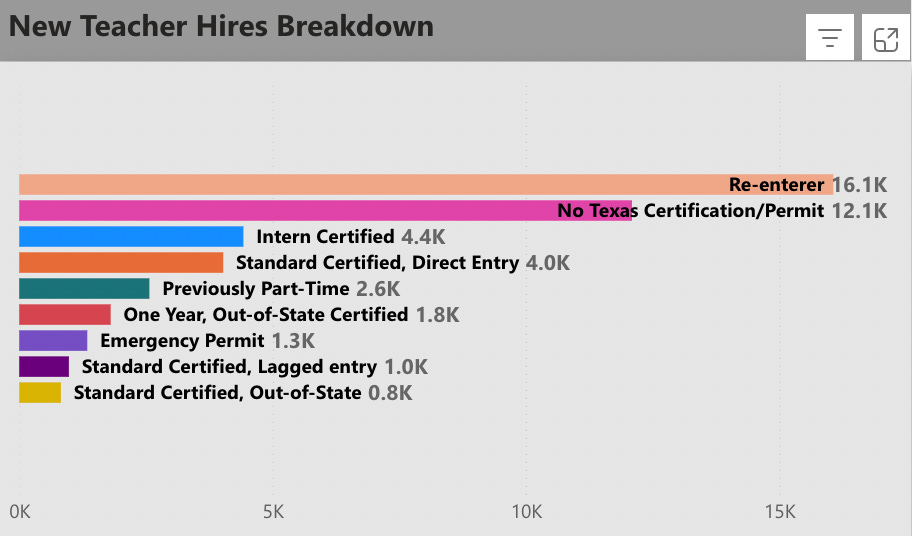
Before I leave off, take a moment to look at all the other categories here. More teachers enter Texas schools with an alternative “intern” certificate than a “standard” teacher preparation program. The remainder of the list includes things like teachers who were working part-time, who came from out of state, or who earned a certification in the past but hadn’t found a teaching job yet (“lagged” entrants).
Again, Texas is unique in some ways, but the next time you think about the teacher preparation pipeline in your state, I hope you’ll remember that it often looks different than the standard story of college—>teacher certification—>teaching job.
My quote of the week award goes to Andy Rotherham, near the end of this passage on AI and education:
So for schools, whether you like AI or think it’s good for education matters less than how you respond to it. In the same way that whatever you think about cold matters a lot less than dressing appropriately when it’s going to be freezing out.
The second is carpentry. I’m a mediocre carpenter. I have friends who do it professionally or as serious hobbyists and they’re not mediocre. They take shortcuts, move quickly, and can skip steps. I can’t do those things. I take my time, I follow the sequence. The same is true of cooking: amateurs follow exact recipes, pros can improvise. To some extent this is also true in music, which is why pros can sit in and play together in ways amateurs cannot.
You can see where I’m going. The same logic applies to learning in school. If you already know how to write, you can sometimes skip steps. If you’re a skilled reader, the same is true. And in areas where you’ve accumulated a lot of knowledge, you develop a kind of “horse sense” that translates to efficiency and allows you to use some tools differently. But none of that is helpful while you’re still learning. You need to follow the steps — and the shortcutting we now call “cognitive offloading” doesn’t help you learn. It makes you worse off.
…
The idea that we live in such revolutionary times that you don’t need to know anything — you can just look it up — is a seductive, stubborn, and bad, idea that lives zombie-like across the sector.
Reading List
Aldeman: When Students Earn a High School Diploma But Still Can’t Do Math
Jessika Harkay: High-Need Connecticut School District Doing ‘Things People Don’t Believe Are Possible’
Upshot: What New Federal Loan Caps Will Mean for Graduate Students
Liz Cohen: Will tutoring save us?
Kelsey Piper: Education research is weak and sloppy.
Jed Wallace: Three Policy Changes to Accelerate the Marginal Revolution
Mike G: “you have to actually build up a teen’s Real Life Substitutes for screentime”