


If budgets reflect priorities, the federal government’s main priority is old people.
Check out the table below, courtesy of the Penn-Wharton Budget Model. They tallied up federal outlays and then did their best to allocate that spending based on the age of the recipient. All told, the federal government spent $449 billion on children and young adults under the age of 26. The bulk of that money went toward health care and income security (including child nutrition subsidies and childcare assistance). Given the size of this population, the total spending works out to about $4,300 per person under the age of 26.
But now look at retirees. They’re getting Medicare and Social Security benefits, plus retirement savings subsidies, Medicaid long-term care, and housing assistance. Those add up to $2.7 trillion in annual expenditures, or about $43,700 per person over the age of 65.
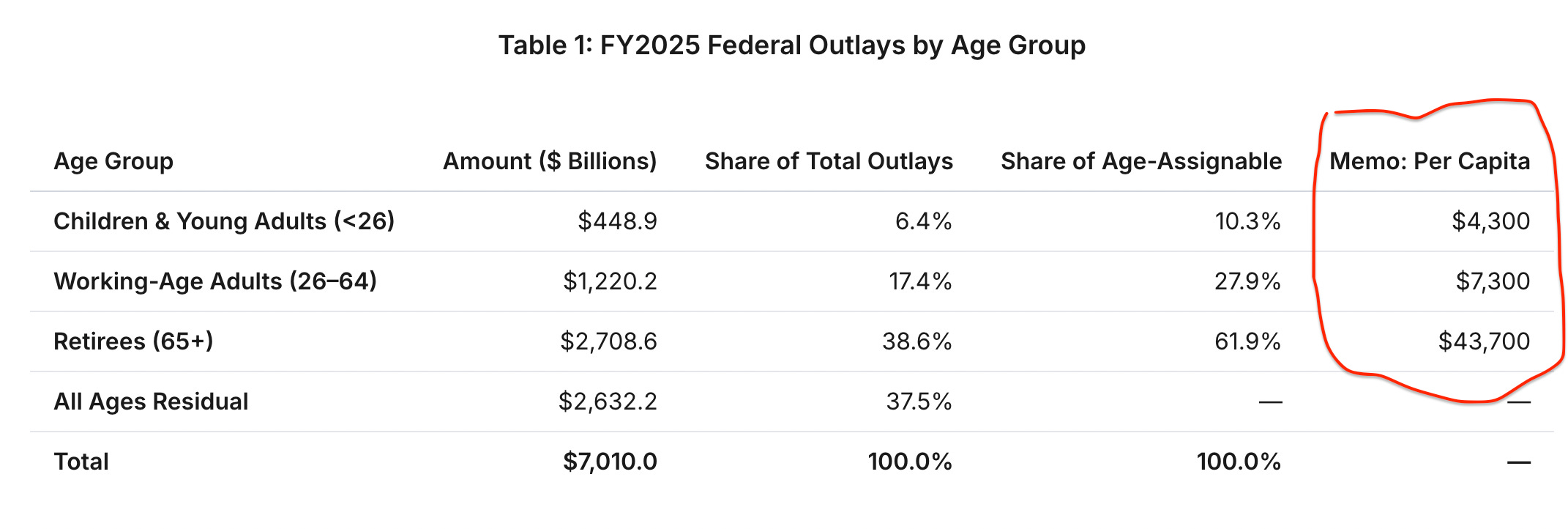
In per-person terms, Washington spends about ten times as much on retirees as it does on children and young adults.
In fact, direct spending on retirees now outpaces the spending that can’t be directly connected to someone’s age (what the chart calls “all ages residual”). This latter category includes things like interest on the national debt and the military, as well as transportation, justice, and community investments.
The Wharton authors conclude that, “An age-based view makes clear that older adults receive the largest assignable share of federal outlays… and that spending on younger people is concentrated in a narrower set of means-tested and education-related programs.”
Reading List
Kevin Huffman: “The difference between tutoring that works and tutoring that doesn’t is often whether students actually receive enough of it.”
Fordham: Industry-recognized credentials produce positive earnings gains, but mainly for males who pursue construction, manufacturing, or transportation
Blueprint Labs at MIT finds that, “test score value-added is a better predictor of longer-term school effectiveness than qualitative information reported by either students or experts.”
Opportunity Culture schools are producing exceptionally strong student growth rates
Is this simply an observation, or is there an implication to be drawn from these data points?
If the U.S. had single payer healthcare, not only would the spending on all age groups be higher but the U.S. would be spending even more on the elderly.
The question on the elderly should not be focused on government spending but on what is the maximum percentage of GDP can any country spend on retirees.