

A weak federal education law turns 10
Why I won't be celebrating

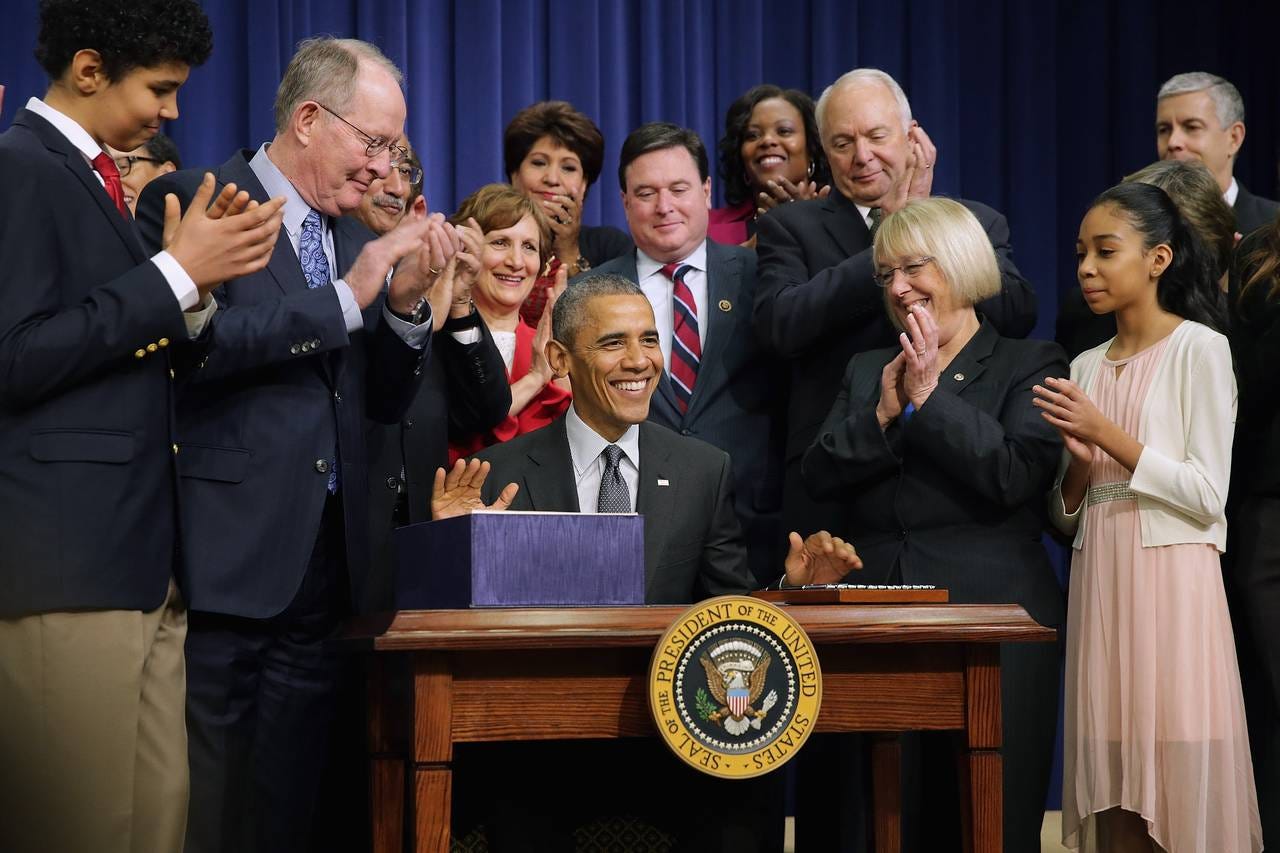
Forgive me for feeling like a bit of a Grinch. The Every Student Succeeds Act officially turns 10 today. President Obama called it a “Christmas miracle” when he signed it, but I won’t be celebrating its anniversary.
Why not? I previewed this in a piece for The 74 back in April, but I think it was and remains a weak law. Over the last decade, student achievement has plummeted, especially for the lowest-performing students. Some of that was due to what happened during COVID, and accountability policy deserves only a portion of the overall blame. Still, ESSA has done nothing to stop the declines and may have contributed to some of them. Here are five major flaws with the law:
1. ESSA looks at schools but ignores districts
Whereas No Child Left Behind had both school and district-level accountability components, ESSA focuses solely on schools. That was a mistake. After all, district leaders control budgets, adopt the school calendar, negotiate major contracts and determine pay schedules. A principal can perhaps set a cultural tone within a given school, but there’s only so much they can do if district leaders don’t set them up for success.
We saw this play out in a major way during COVID. It wasn’t teachers or principals who were making the consequential decisions, and yet the law ignored districts and instead required states to continue focusing on individual schools. That made no sense — and it was borne out in the data. The Education Recovery Scorecard report found achievement gaps within the same districts stayed about the same during the course of the pandemic. Meanwhile, achievement gaps between districts grew substantially.
In other words, district decisions over how to handle COVID, not COVID itself, were what caused gaps to grow. Going forward, districts should be the primary unit of accountability.
2. ESSA allows states to use normative-based accountability systems
This is kind of a wonky one, so let me explain. Under NCLB, states were required to use criterion-referenced accountability systems. That is, states set their own achievement benchmarks, and all schools were held accountable for meeting the same standards.
Famously, this was one of the reasons for the undoing of NCLB. It became unrealistic to assume that 100% of students could meet state proficiency targets by 2014. This goal was aspirational when it was adopted in 2002, but it became more and more of a problem as the end goal got closer.
In response, ESSA allowed states to take a different approach. States still had to set standards and measure whether kids were meeting those standards, but no school was identified based purely on the percentage of kids who met the bar. Instead, states were allowed to rank their schools and just focus on the very lowest performers. Then, states had to promise to take serious steps to help those low-performing schools improve.
But this is a flawed theory of action for several reasons. One, it’s very hard to make bad schools better. Not impossible, but very, very hard. Dramatic improvements require dramatic changes, and most schools are unwilling to pursue the types of changes needed.
Two, the research on NCLB found that the improvements schools made under the law weren’t due to any specific intervention—in fact, schools were mostly taking the easy route when they could—but the threat of an intervention forced schools to get better. ESSA took that threat away from the vast majority of schools.
And three, the specific ranking mechanism means that no school has to get any better; it just has to do a little bit better than its peer schools. That is, a school could go from just below to just above the cutoff even if its students make no gains at all, as long as other schools fared worse.
Go look closely at your state’s accountability systems, and you’ll likely see these sorts of normative systems prevalent in everything from the growth models they use to how they identify schools for improvement to when they decide that a low-performing school had made sufficient progress. Under ESSA, in most states, schools are not being held to objective standards.
3. ESSA took the pressure off of schools to pay attention to their lowest-performing students
This point is related to the one above but it’s somewhat distinct. Under NCLB, every school was accountable for all of their student groups to hit annual benchmarks.
That is no longer the case under ESSA. As noted above, far fewer schools are identified for improvements. And with their normative ranking systems, some states explicitly limit how many schools they will identify. They might identify, say, the bottom 5% of schools overall plus 10% of schools with the largest achievement gaps. But that leaves everybody else off the hook, and it’s a far cry from ALL schools having to pay attention to their low-performing students.
I don’t think it’s a coincidence that we see this in the achievement results. Across a range of tests, grades, and subjects, the overall averages have gone down a bit, but the scores of the lowest-performing students have cratered.
4. ESSA has largely been a bust on assessment innovation
When ESSA passed, it had a few provisions that promised to lead to new, better state tests. It specifically allowed for computer-adaptive testing to test students with questions above or below the student’s grade level. It created a new assessment innovation pilot program for states to try out new assessment designs. It allowed for multiple interim assessments that could add up to an overall summative score.
These have… under-delivered. There are some states trying out the multiple assessment idea, but that’s not without its own complications. The pilot assessment program took off with a bang, but it didn’t come with any new money so the existing pilots have mostly faded out and not a single state applied during the four years of the Biden Administration. Meanwhile, states take too long to deliver their assessment results to actually be meaningful for parents or teachers. For more on my vision for the future of state assessments, see here.
5. ESSA took away parental options for school choice and tutoring
Under NCLB, students in low-performing schools were eligible to transfer to other schools within the same district or to have access to free afterschool tutoring. These provisions never worked all that well. Only a small percentage of eligible students took advantage of the transfer provision (although that still added up to 165,000 students nationwide at its peak). And the tutoring programs were often misaligned with what kids were learning during the school day.
School districts hated these provisions because they interfered with their school assignment policies and because they pulled money out of their budgets for external tutoring programs. In response, the Obama Administration got rid of them, first temporarily through a set of accountability waivers and then permanently when the President signed ESSA into law.
Since 2015, students assigned to low-performing public schools have had no recourse but to suck it up, go private, or move. Under NCLB, families at least had access to some escape routes, but ESSA closed them off. Congress should consider reinstating these types of options as part of a broader accountability strategy.
Reading List
Yours truly: Teachers take out large loans to earn academic credentials that don’t help them do their jobs better
Kelsey Piper: A lot of people are way too eager to declare Mississippi a myth
Karen Vaites: The antidote to sloppy skepticism about Mississippi
Vlad Kogan: Debunking deBoer’s Education Reform Pessimism
Youth mental health improved when schools reopened after COVID
Now I'm feeling nostalgic. Might have to dig out my prized NCLB safe harbor flow chart from the attic and have a good cry.
A bad education law turns 10! The whole series of laws that began with Tarence Bell's abomination called "A Nation At Risk." It was a biased and fatally flawed report that generated a false premise that the federal government could improve education by acting like a slave master: produce more cotton, or I'll peel the skin off your back. When other countries were making vast improvements in their education systems with highly educated teachers who were given the autonomy and resources to meet high expectations, the US was threatening and degrading teachers, cutting budgets, and telling teachers how to teach. The testing regime was not intended to improve learning but to please legislators and create an illusion of monitoring school effectiveness. There was no immediate feedback to teachers on student learning. In fact, every competent teacher knows exactly how each of their students is learning without a billion-dollar test regime. The corporate-education syndicate determined student achievement, not the teachers and the school districts. Granted, some states had very underfunded public schools as persistent racism tried to maintain a status quo from segregation. The standards were created with an agenda to be like Japan and were deeply flawed because teachers and child development experts were shut out of the decision-making process. In the book Flight of the Buffaloes by James A. Belasco & Ralph C. Stayer, it is shown that ignoring those who make the sausage leads to stagnation.