

A Bad Jobs Report for Public Education
After reaching record highs, K–12 employment has begun to edge downward.

According to the latest jobs report from the Bureau of Labor Statistics, K-12 schools lost 57,000 workers from June to July. The numbers for May were also revised down by another 47,000.
These are seasonally adjusted numbers. Each year, public schools “lose” about 1 million employees who come off the payrolls in the summer months, only to add those workers back in the fall. But the latest numbers suggest that the 2026 decline is a bit larger than normal.
Because of these summer patterns, I like to look at the non-seasonally adjusted numbers. The graph below shows that trend over the last few years. Each line represents one calendar year. The 2020 line is in red. You can see the big drop-off in March when schools shut down for COVID. They no longer needed as many bus drivers and lunch staff, etc. But each year since then payrolls have grown (follow the gray lines upwards).
Now look at the 2026 line, in green. It was trending slightly above 2025 in the spring, but it now sits below the 2025 line. As of July, with no seasonal adjustment, public schools employed about 29,000 fewer workers than they did at this time last year.
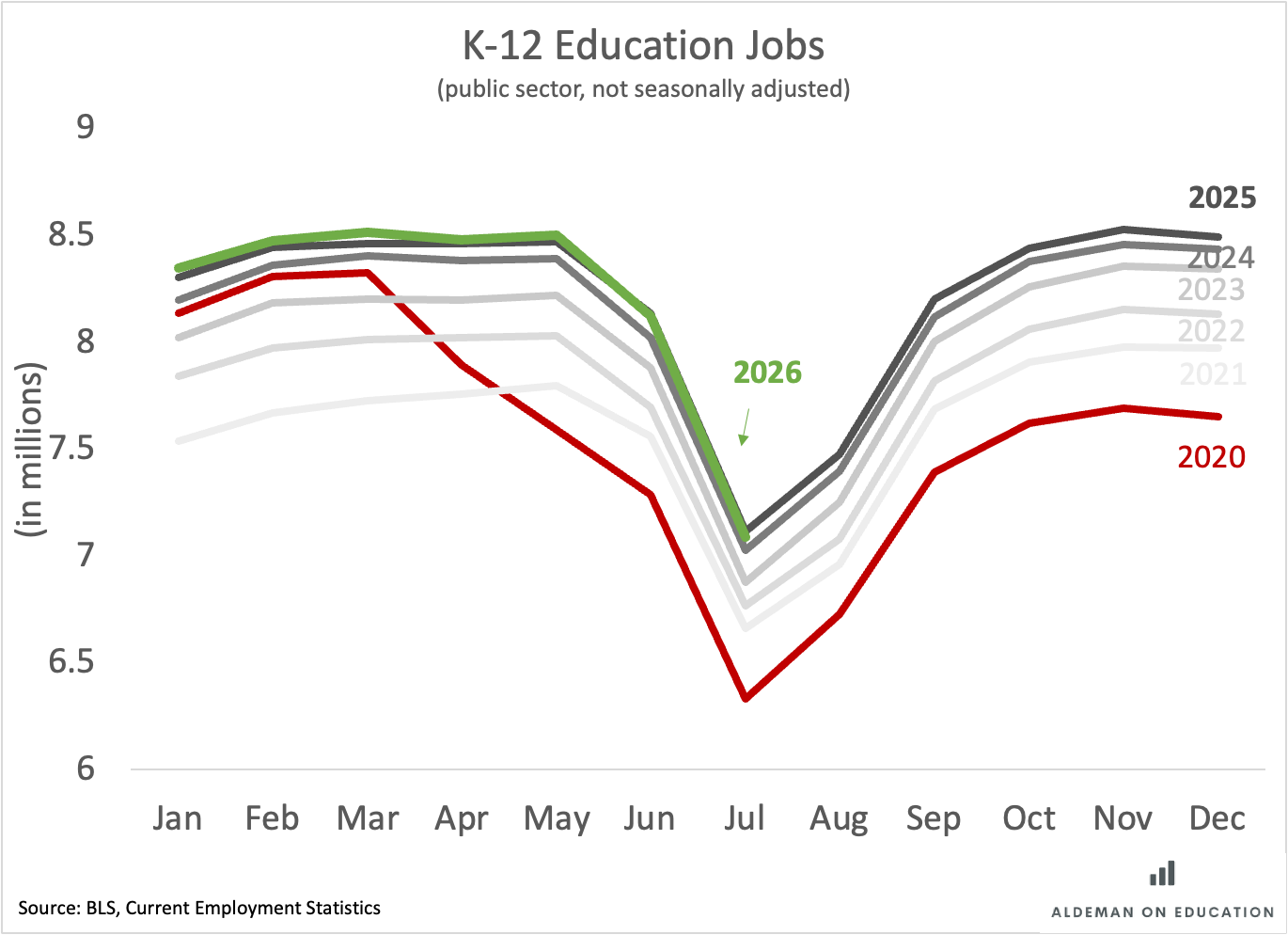
Now, these are preliminary figures subject to revisions. But they represent the first year-over-year declines that we’ve seen since the pandemic.
The decline so far is not large in percentage terms. We’re talking about a decline of 0.4%, and this represents total workers, not full-time equivalents. School districts typically adjust around the margins first, reducing part-time positions or cutting hours before eliminating full-time jobs. These also don’t represent increases in layoffs—those numbers remain stable. Instead, this is mostly about a slowdown in hiring.
This shouldn’t be entirely surprising. School districts have spent the last two years warning about the end of federal pandemic aid and slower state revenue growth. For a while, many districts have been able to avoid workforce reductions. These latest employment numbers suggest that budget pressures may finally be showing up in the national data.
The other education sectors did not have as big of a change. As I’ve written before, the number of state education employees (public higher education) peaked more than a year ago. As a sector, it is down about 25,000 employees from a year ago, a decline of 1.1%.
The private childcare sector is down about 5,000 workers from a year ago, a decline of 0.4%.
Whether the latest numbers mark the beginning of a sustained decline or just a temporary pause will become clearer over time. But the years of uninterrupted staffing growth may be ending.
Reading List
Josh McGee, Roy McKenzie, and Gema Zamarro: Arkansas Teacher Retention by Subject
New Yorker: What Scientists Learned by Eavesdropping on Thousands of People